Shotgun Shot & Choke Guide
Birdshot, buckshot, and slugs mapped by game, range, and application — plus choke selection for every load and distance.
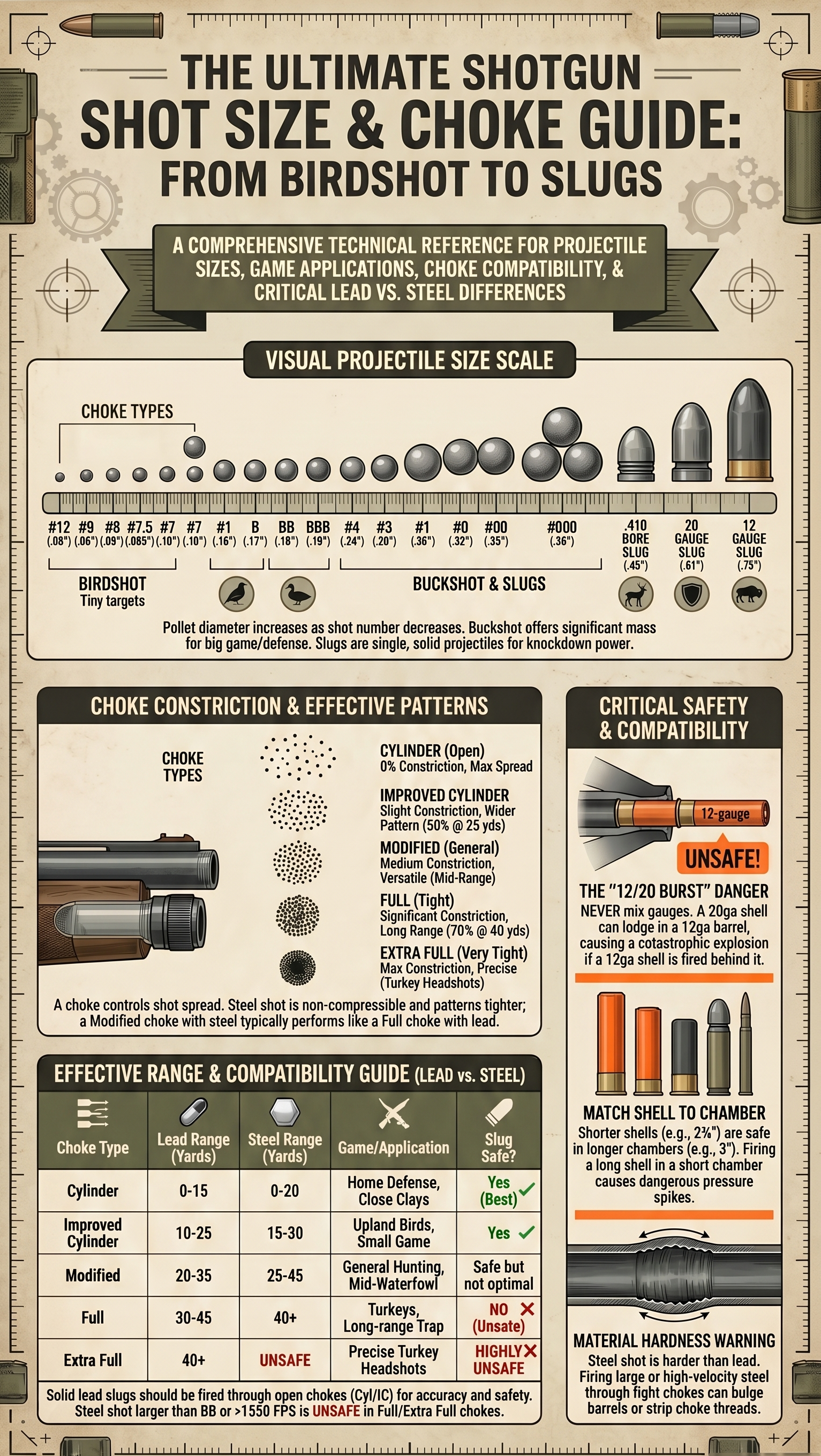
Save or print the full reference chart — covers every common load and choke combination.
Shotgun Shot Sizes: The Basics
Shotgun ammunition is categorized by payload type — birdshot, buckshot, or slug — and each category covers a range of sizes or weights suited to different applications. Shot size is counter-intuitive: smaller numbers mean larger pellets.
Birdshot
Birdshot pellets range from #9 (smallest, .08" diameter) to #2 (largest common field load, .15" diameter), with specialty sizes like BB (.18") used for large waterfowl. The right choice depends on target species and range.
| Shot Size | Pellet Dia. | Typical Use | Effective Range |
|---|---|---|---|
| #9 | .08" | Skeet, sporting clays | 15–25 yds |
| #8 / #8½ | .09" | Trap, clay target, doves | 20–30 yds |
| #7½ | .095" | Quail, pheasant, clay | 25–35 yds |
| #6 | .11" | Pheasant, squirrel, rabbit | 30–40 yds |
| #5 | .12" | Pheasant, turkey (sub-load) | 35–45 yds |
| #4 | .13" | Turkey, large game birds | 40–50 yds |
| #2 | .15" | Geese, large waterfowl | 40–55 yds |
| BB | .18" | Canada geese, large ducks | 45–60 yds |
Buckshot
Buckshot is designed for deer-sized game and self-defense. Pellets range from #4 Buck to 000 Buck (“triple-aught”). More pellets means denser pattern; fewer, larger pellets mean more individual impact energy.
| Size | Pellet Dia. | Pellets (2¾") | Best Application |
|---|---|---|---|
| #4 Buck | .24" | 21–27 | Dense pattern, close range, home defense |
| #3 Buck | .25" | 20–21 | Coyote, mid-range defense |
| #1 Buck | .30" | 16 | Deer, general defense |
| 00 Buck | .33" | 8–9 | Most common — deer, home defense standard |
| 000 Buck | .36" | 6–8 | Maximum energy, reduced pellet count |
Slugs
Slugs are single-projectile shotgun rounds, effectively turning a shotgun into a large-bore rifle for distances beyond buckshot’s reliable range. Foster slugs are designed for smoothbore barrels; sabot slugs require a rifled barrel for optimal accuracy.
| Type | Barrel | Range | Notes |
|---|---|---|---|
| Foster (rifled slug) | Smoothbore or cylinder | 75–100 yds | Soft lead, self-stabilizing, spins via angled ribs |
| Sabot slug | Rifled barrel only | 150–200 yds | Sub-caliber projectile in plastic cup; rifle-like accuracy |
| Brenneke | Smoothbore | 75–125 yds | Wad stays attached, adds stability; common in Europe |
Choke Selection
A choke is a constriction at the muzzle that controls how tightly your shot pattern disperses. Tighter chokes keep pellets together longer for greater effective range; more open chokes spread the pattern faster for close-range density.
| Choke | Constriction | Pattern at 40 yds | Best For |
|---|---|---|---|
| Cylinder (no choke) | 0" | 35–40" | Close-range defense, Foster slugs |
| Improved Cylinder | .010" | 28–34" | Close birds, skeet, home defense (with buckshot) |
| Modified | .020" | 23–28" | General purpose, pheasant, #2–#6 shot |
| Improved Modified | .025" | 20–25" | Turkey sub-loads, mid-range waterfowl |
| Full | .035" | 18–22" | Long-range birds, far waterfowl, trap |
| Extra Full / Turkey | .040"–.060" | 15–18" | Turkey at 30–50 yds, #4–#6 shot only |
Quick Reference: Load & Choke by Application
| Application | Recommended Load | Recommended Choke |
|---|---|---|
| Dove / Quail | #7½ or #8 | Modified or IC |
| Pheasant (close) | #6 or #5 | IC or Modified |
| Pheasant (flushed, far) | #5 or #4 | Modified or IM |
| Turkey | #4, #5, or #6 (turkey loads) | Extra Full / Turkey |
| Ducks (decoying) | #4, #5, or #6 (steel) | IC or Modified |
| Canada Geese | #2 or BB (steel) | Modified |
| Deer (brush) | 00 Buck or Foster slug | Cylinder or IC |
| Deer (open field) | Sabot slug | Rifled barrel |
| Home Defense | 00 Buck or #4 Buck | Cylinder or IC |
| Skeet | #8 or #9 | Skeet / IC |
| Trap | #7½ or #8 | Modified or Full |
Steel vs. Lead Shot
Federal law requires non-toxic shot for waterfowl hunting — lead is prohibited. Steel is the most common replacement, but it’s harder and less dense than lead, which means:
- Go up 1–2 shot sizes when switching from lead to steel (e.g., #4 lead ≈ #2 steel)
- Use IC or Modified chokes with steel — never Full or Turkey chokes
- Steel maintains velocity well but loses energy faster at range due to lower density
- Bismuth and tungsten alternatives perform closer to lead and are safe with tighter chokes
Download the Cheat Sheet
Print-ready reference — shot sizes, choke selection, and load-to-game recommendations in one sheet.