Ammo Types Decoded
FMJ, JHP, +P, SP, TMJ, OTM — Every Bullet Type Explained for Self-Defense, Range, and Hunting
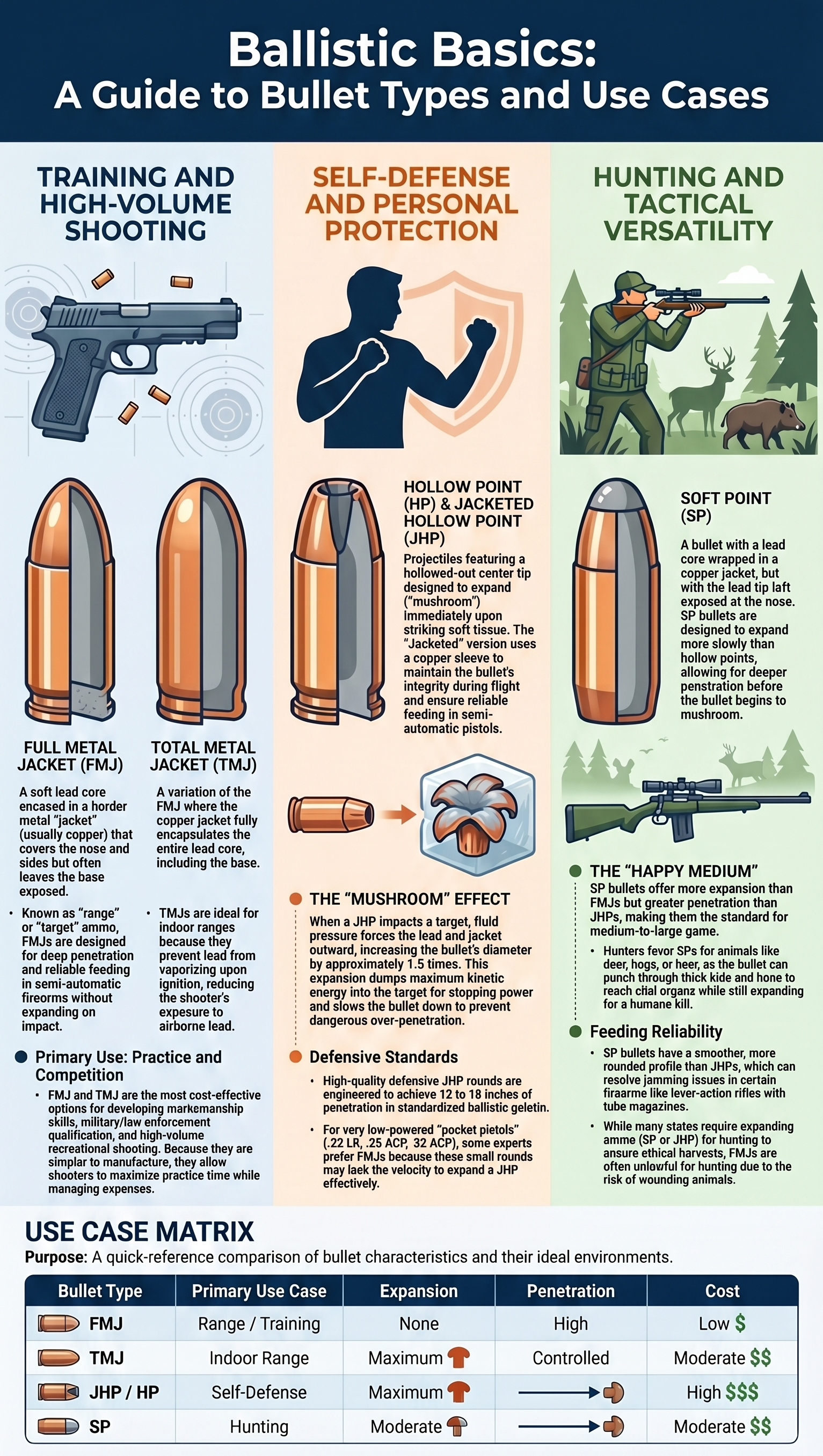
Understanding Bullet Types: Why It Matters
Walk into any gun store or browse any ammo retailer and you'll encounter a wall of abbreviations — FMJ, JHP, +P, JSP, HP, TMJ, OTM, and more. Choosing the wrong bullet type for your application doesn't just affect performance; it can affect reliability, legality, and safety. Bullet construction determines how a projectile behaves on impact, which is why the same caliber of ammunition — take 9mm Luger, for example — can serve entirely different purposes depending on its design.
The two most fundamental factors in bullet design are jacket type (what covers the lead core) and tip design (what shape the nose takes). Together, these determine expansion, penetration, feed reliability in semi-automatic firearms, and how the bullet interacts with soft tissue or intermediate barriers. Understanding these basics helps you make informed decisions — whether you're stocking a home defense load, selecting training ammo, or choosing a hunting round.
Full Metal Jacket
A lead core fully enclosed in a harder metal jacket (typically copper or a copper alloy). FMJ rounds do not expand on impact, making them pass-through projectiles. They feed reliably in semi-automatic firearms and are significantly cheaper than defensive ammunition.
Range / TrainingJacketed Hollow Point
A jacketed bullet with a hollow cavity in the tip designed to expand on impact. Expansion increases the wound channel, transfers energy more efficiently into the target, and reduces the risk of over-penetration. The preferred defensive load for most law enforcement and civilian carry.
Self-DefenseJacketed Soft Point
A jacketed bullet with exposed lead at the tip. The soft lead nose initiates controlled expansion on impact — slower and less dramatic than JHP, but offering deeper penetration. Commonly used in hunting applications where controlled expansion at varying velocities is needed.
HuntingTotal Metal Jacket
Similar to FMJ but with a jacket that fully encapsulates the lead base as well. TMJ rounds reduce airborne lead exposure, making them the preferred choice for indoor ranges. They perform ballistically similar to FMJ but are cleaner for enclosed environments.
Range / IndoorHollow Points: The Standard for Self-Defense and Concealed Carry
The defining characteristic of hollow point ammunition is controlled expansion. When a hollow point bullet strikes soft tissue, hydraulic pressure forces the nose cavity to open outward, mushrooming the bullet to two or three times its original diameter. This expansion serves two purposes: it increases tissue damage along the wound channel, and it slows the bullet's progress through the target — reducing the likelihood that it exits and strikes an unintended secondary target.
Not all hollow points expand equally. Velocity, bullet weight, and jacket design all affect how reliably a hollow point opens. A round that expands perfectly at full velocity from a full-size pistol may not expand reliably from a short-barreled carry gun. Always test your defensive load through your actual firearm before relying on it. Premium defensive loads — Federal HST, Speer Gold Dot, and Hornady Critical Defense — are engineered for reliable expansion across a wide range of velocities and through common barriers like heavy clothing and denim. These are the rounds that law enforcement agencies qualify with for exactly that reason.
Some jurisdictions restrict hollow point ammunition for civilian carry. Verify your state laws before selecting a defensive load. New Jersey has historically restricted civilian carry of hollow points outside the home; check KiloTango's State Laws guide for details.
What Does +P Mean on Ammunition?
The +P designation indicates ammunition loaded to a higher-than-standard pressure, producing greater muzzle velocity than standard loads of the same caliber. For a 9mm JHP +P load, this means faster expansion at the muzzle and improved terminal performance, especially from shorter-barreled carry pistols where velocity loss is a concern.
The tradeoff is increased recoil, louder report, and accelerated wear on your firearm's components — particularly the barrel, slide, and recoil spring. Only use +P ammunition in firearms explicitly rated for it. Check your owner's manual; most modern pistols from Glock, SIG, Smith & Wesson, and others are +P rated, but compact and subcompact frames may have different recommendations. A +P JHP is popular for carry in 9mm and .38 Special, where it provides a meaningful ballistic upgrade without the feeding complications of exotic designs.
+P for carry if your gun supports it. Standard pressure JHP if it doesn't. FMJ for practice regardless. Never use +P for regular range training — reserve it for defensive qualification and annual function checks.
OTM and Match Ammunition for Rifle Shooters
OTM (Open Tip Match) ammunition is often confused with hollow points, but the purpose is entirely different. The small open tip cavity on an OTM bullet is a byproduct of the manufacturing process — the bullet is formed base-first around a mandrel, leaving a very small opening at the nose. This construction produces exceptional concentricity and consistency in the bullet jacket, which is the actual goal: accuracy at distance, not expansion.
OTM rounds are the choice for precision rifle shooting, long-range competition, and any application where sub-MOA consistency matters. They are not designed for controlled expansion on soft tissue and are not a self-defense substitute for JHP. For rifle shooters running .223 / 5.56 or .308 Winchester, OTM match loads (Federal Gold Medal Match, Hornady ELD Match) represent the highest-accuracy factory ammunition available.
Matching Bullet Type to Application: 9mm, .45 ACP, .223, and More
The simplest framework: use FMJ or TMJ for training, use JHP (+P if supported) for defensive carry, use OTM for precision rifle work, and use JSP or bonded soft points for hunting. This covers the majority of applications across handgun and rifle calibers.
In practice, caliber matters too. 9mm is the most popular handgun caliber in the US and has the widest selection of JHP defensive loads — there is no shortage of excellent 9mm hollow point options at multiple price points. For .45 ACP, the larger diameter already produces a wide wound channel, making standard-pressure JHP very effective without the felt-recoil penalty of +P. For hunting with .308 Winchester, bonded soft points or controlled-expansion hunting loads outperform standard FMJ by a significant margin.
For hunting, the calculus gets more nuanced. Thin-jacketed hollow points designed for varmints will fragment violently on impact — ideal for prairie dogs, not appropriate for deer-sized game where clean, deep penetration is required. Bonded bullets, where the jacket is chemically or mechanically attached to the core, maintain their integrity through bone and resist separation — a key characteristic for medium to large game at varying ranges.
| Bullet Type | Expansion | Penetration | Best Use |
|---|---|---|---|
| FMJ | None | Deep / Pass-through | Range training, target shooting |
| TMJ | None | Deep / Pass-through | Indoor range, reduced lead exposure |
| JHP | High | Controlled | Self-defense, home defense, concealed carry |
| JHP +P | High | Controlled | Self-defense (firearms rated for +P only) |
| JSP | Moderate | Deep | Hunting medium game, mixed-use |
| OTM | Minimal | Deep | Precision rifle, long-range competition |
| HP (Lead) | High | Moderate | Revolver defense, low-velocity applications |
For semi-automatic pistols, feed reliability matters as much as terminal performance. Some older designs with tight feed ramps can struggle to cycle hollow points consistently. Run a minimum 200-round function test with your chosen defensive load before trusting it for carry or home defense.
Download the Cheat Sheet
Print-ready reference — all bullet types, use cases, and selection guide in one sheet.