Mastering MILs
The Long-Range Shooter's Guide to Range Estimation and Holdovers
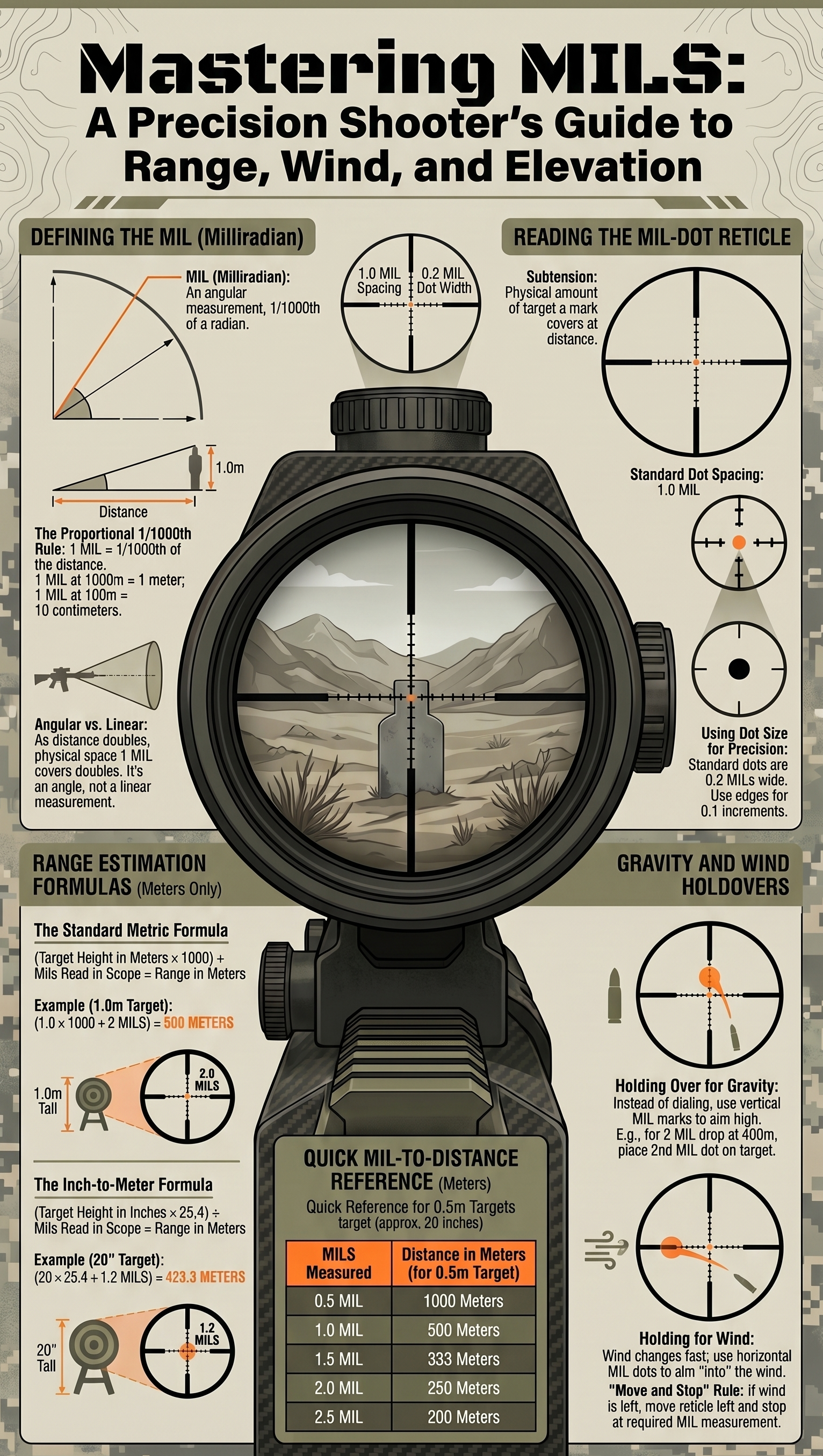
Mastering MILs: A Practical Guide to Range, Wind, and Elevation
A MIL, short for milliradian, is an angular unit of measurement used by precision shooters, hunters, and long-range marksmen to estimate distance, adjust elevation, and compensate for wind. One MIL equals 1/1000th of a radian, which means it scales predictably with distance. In practical terms, 1 MIL equals 1 meter at 1,000 meters, or 10 centimeters at 100 meters. This proportional relationship is what makes MIL-based optics so useful for field shooting and range estimation.
MIL-dot and MIL-based reticles allow the shooter to measure the apparent size of a target through the scope. Once the target's known size is compared against the number of MILs it occupies in the reticle, distance can be estimated using a simple formula:
Standard Metric Formula
First vs. Second Focal Plane
Understanding first focal plane (FFP) and second focal plane (SFP) scopes is critical for accurate MIL use. In an FFP scope, the reticle scales with magnification — MIL measurements remain accurate at every zoom level. In an SFP scope, the reticle appears the same size regardless of magnification, so MIL measurements are only accurate at one designated power setting, typically the scope's highest magnification.
For range estimation and holdovers, this distinction matters. Using the wrong magnification on an SFP optic produces incorrect measurements and missed shots at distance.
Holdovers for Elevation and Wind
MILs are commonly used for holdovers instead of dialing turrets. The vertical MIL marks in the reticle compensate for bullet drop at distance. The horizontal marks allow the shooter to hold into the wind based on conditions, distance, and ballistic data — especially useful when engaging targets at varying distances or when time doesn't allow for turret adjustments.
A reliable MIL system depends on three things: knowing the target size, reading the reticle accurately, and applying verified ballistic data. MILs are not guesswork — they are a repeatable measurement system. Whether used for range estimation, elevation correction, or wind holds, mastering MILs gives shooters a faster and more consistent way to make accurate adjustments in the field or on the range.
For best results, confirm your rifle, ammunition, optic, and ballistic data through live-fire practice. A MIL reticle is only as effective as the shooter's ability to read it correctly and apply it responsibly.
Download the Cheat Sheet
Print-ready — save or print for range use. All formulas and reference tables in one sheet.