9mm Ammo Price History: Trends & What to Expect in 2026
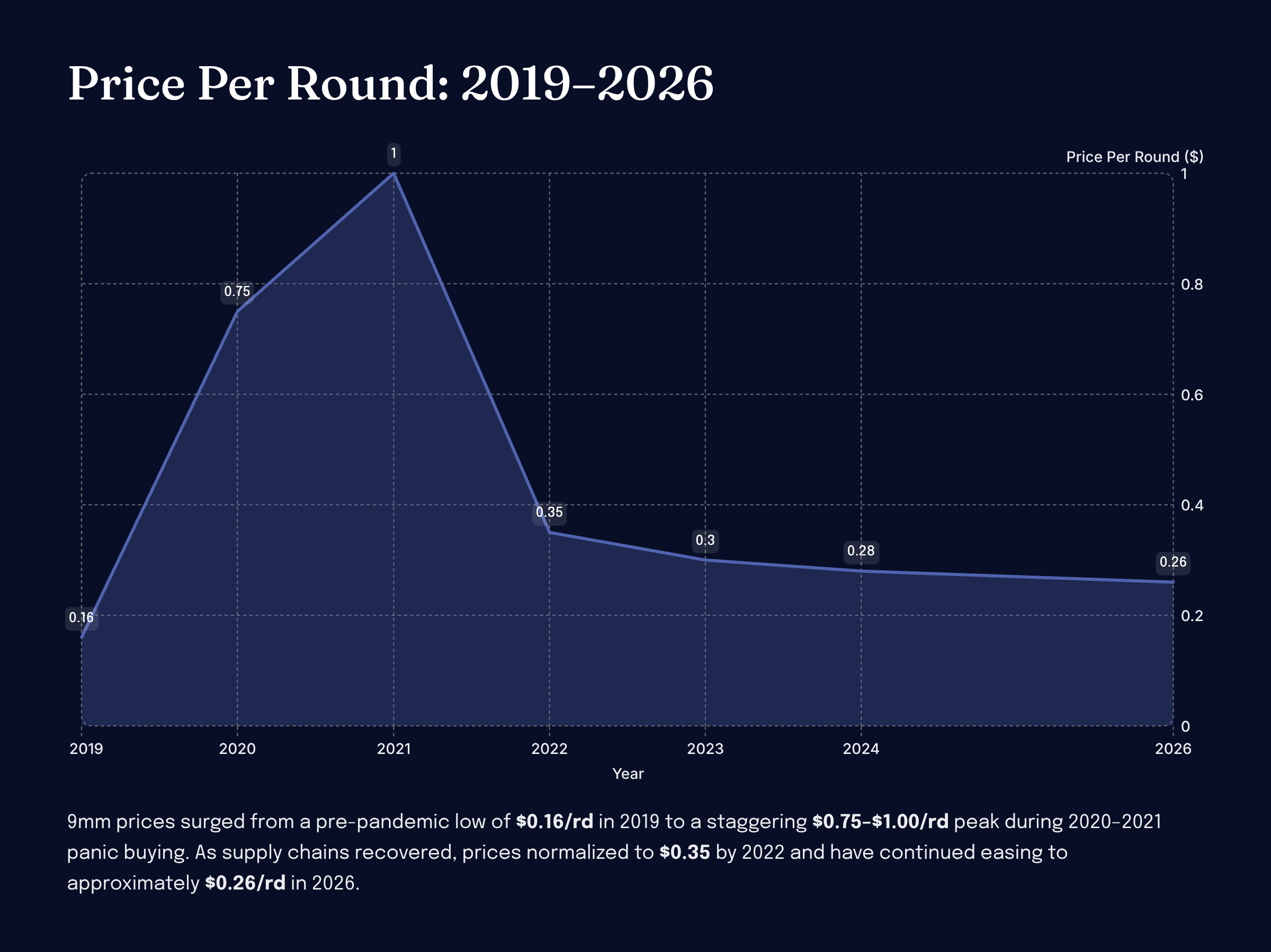
From pre-COVID lows near 16¢ a round, to the 2021 shortage that pushed 9mm past 75¢, and back down to roughly 26¢ today — here's the complete price history, what actually moves the market, and where prices are headed for the rest of 2026.
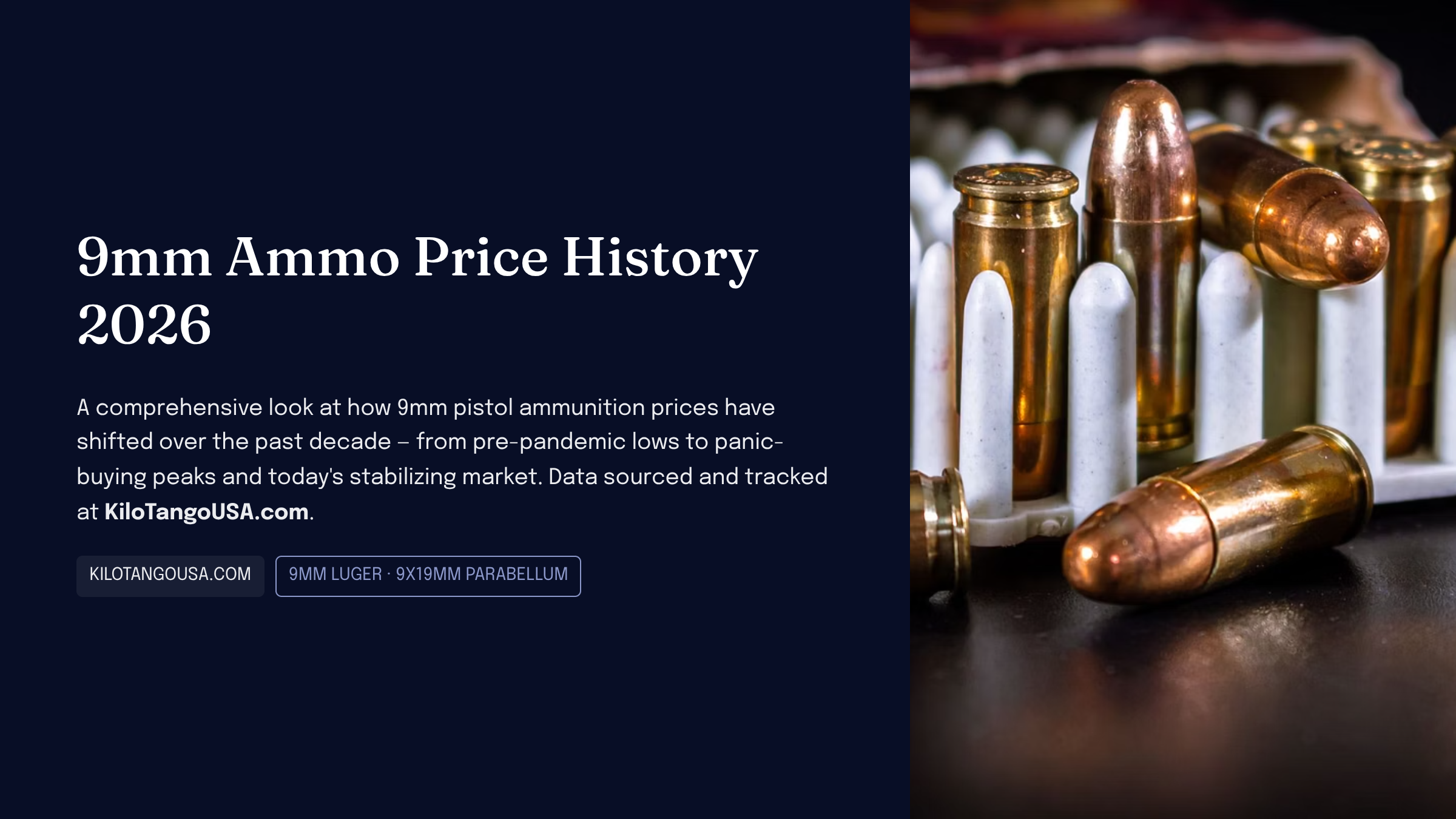
No caliber has lived a more dramatic decade than 9mm Luger. It's the most popular cartridge in America — the round that feeds the Glock 19, the SIG P320, the S&W Shield, and millions of carry pistols and home-defense guns — which makes it the single best barometer for the entire ammunition market. When 9mm spikes, everything spikes. When 9mm normalizes, the whole market exhales.
If you've bought 9mm at any point since 2020, you've felt the whiplash. A box of fifty that cost about $8 before the pandemic shot past $25 at the 2021 peak, then drifted back to roughly $13 today. That's not normal price movement for a manufactured commodity — it's the fingerprint of a genuine supply-and-demand shock, and understanding it tells you a lot about when to buy.
This guide walks the full timeline, decade by decade and dip by dip: where 9mm started, why it exploded, how far it has fallen, and — the part everyone actually wants — where prices are likely headed through the rest of 2026. We'll also show you exactly how to track live prices and get alerted the moment 9mm hits a new low, so you stop guessing and start buying at the bottom.
9mm Price History at a Glance
Here is the arc of cheap bulk 9mm FMJ — the cheapest in-stock per-round price a normal shopper could actually find — across the last several years. These are representative figures for budget brass/steel training ammo, not premium defensive loads, which always cost more.
| Era | Approx. Price / Round | Per Box of 50 | What Was Happening |
|---|---|---|---|
| Pre-COVID (2018–2019) | ~$0.16–0.20 | ~$8–10 | Calm, oversupplied market; modern lows |
| COVID peak (2020–2021) | ~$0.75–1.00 | ~$38–50 | Record demand, empty shelves |
| Correction (2022) | ~$0.35 | ~$18 | Production catches up, panic fades |
| Stabilization (2023–2024) | ~$0.28 | ~$14 | Demand normalizes, inventory healthy |
| Current (2025–2026) | ~$0.24–0.26 | ~$12–13 | Near pre-2020 levels again |
Representative cheapest-in-stock bulk FMJ figures, Kilo Tango tracking and historical retail archives. Per-round prices change daily — check live 9mm listings before buying.
The Pre-COVID Baseline: 9mm Was Boringly Cheap
For most of the 2010s, 9mm was the cheap, abundant workhorse of the handgun world. After the 2013 post-Sandy Hook scare faded, the market settled into a long, calm oversupply. By 2018 and 2019, cheap bulk FMJ regularly sold for $0.16 to $0.20 per round — roughly $8 to $10 a box of fifty — and case quantities sometimes dipped even lower on sale. Steel-case promotional ammo could be found under fifteen cents a round.
This was the era that anchored everyone's expectations. An entire generation of shooters learned that 9mm "should" cost about eight bucks a box. That mental anchor is exactly why the 2020 spike felt so violent — and why 2026 prices, which have nearly returned to that baseline, feel like such a relief.
The pre-2020 floor near 16¢ was set by raw-material and manufacturing costs — brass, copper, lead, powder, primers and labor. Ammo can't sustainably sell below what it costs to make. That floor is the gravity every price spike eventually falls back toward, and it's why 2026 prices look the way they do.
2020–2021: The Great Ammo Shortage
Then came the perfect storm. In 2020, a cascade of events collided to produce the most severe ammunition shortage in modern memory. Demand didn't just rise — it detonated.
- A record wave of first-time buyers. An estimated 8+ million Americans bought their first gun in 2020 alone. Every one of them needed ammo, and many bought far more than usual out of uncertainty.
- Pandemic anxiety and civil unrest. Lockdowns, economic fear, and a summer of unrest drove a defensive-buying surge that emptied shelves nationwide within weeks.
- An election year. Election cycles reliably push ammo demand up on fears of future restrictions. 2020 layered that on top of everything else.
- Constrained supply. Factories couldn't expand fast enough, and COVID disrupted labor and the supply of primers, powder, brass and copper — the exact inputs needed to make more.
The result: 9mm that had sold for sixteen cents a round was suddenly $0.75 to over $1.00 per round when you could find it at all — and for long stretches, you couldn't. Shelves sat empty. Online listings sold out in minutes. Per-round prices for a basic training round more than quadrupled. It was the single sharpest move in modern ammo pricing, and it rewrote everyone's sense of what 9mm "costs."
The shooters who paid the most in 2020–2021 were the ones who bought at the very top, convinced prices would keep climbing forever. They didn't. Within 18 months prices had fallen by more than half. The enduring lesson: never buy at scarcity prices during a panic — that's precisely when you overpay most.
2022–2024: Correction and Stabilization
Markets correct, and ammo is no exception. Through 2022, the forces that drove the spike reversed. Manufacturers had spent two years running flat-out and adding capacity, and that new supply finally hit the market just as the panic-buying frenzy burned itself out. First-time buyers had stocked up. The election had passed. Demand cooled from a sprint to a walk.
Prices fell fast. By mid-2022, cheap bulk 9mm had dropped from its peak to around $0.35 per round — still above the old baseline, but less than half the peak. Through 2023 and into 2024, the market kept normalizing. Inventory returned to healthy levels, "out of stock" stopped being the default, and per-round prices settled near $0.28 for cheap FMJ.
This stabilization phase is important because it marked the return of normal price competition. With shelves full again, retailers had to fight for buyers on price — exactly the environment in which an ammunition search engine earns its keep, because the gap between the cheapest and most expensive listing widens when stores are competing rather than rationing.
2025–2026: Cheap Again
Which brings us to now. In 2026, 9mm is genuinely cheap again. Cheapest-in-stock bulk FMJ regularly lands in the low-$0.20s per round, with representative figures around $0.24 to $0.26 — within striking distance of the pre-2020 baseline, and in real (inflation-adjusted) terms, arguably as cheap as 9mm has ever been.
Premium defensive loads — Federal HST, Speer Gold Dot, Hornady Critical Defense — remain pricier, typically $0.80 to $1.50 per round, because they're engineered to a different standard. But for high-volume practice, the most popular caliber in America is back to being one of the best values in shooting. If you've been waiting for "prices to come down," they already did.
Cheap bulk 9mm FMJ: roughly $0.24–0.26/round. Mid-grade brass-case range ammo: ~$0.28–0.32/round. Premium self-defense JHP: ~$0.80–1.50/round. Always compare on price per round, and check live listings — the cheapest store changes daily.
What Actually Moves Ammo Prices
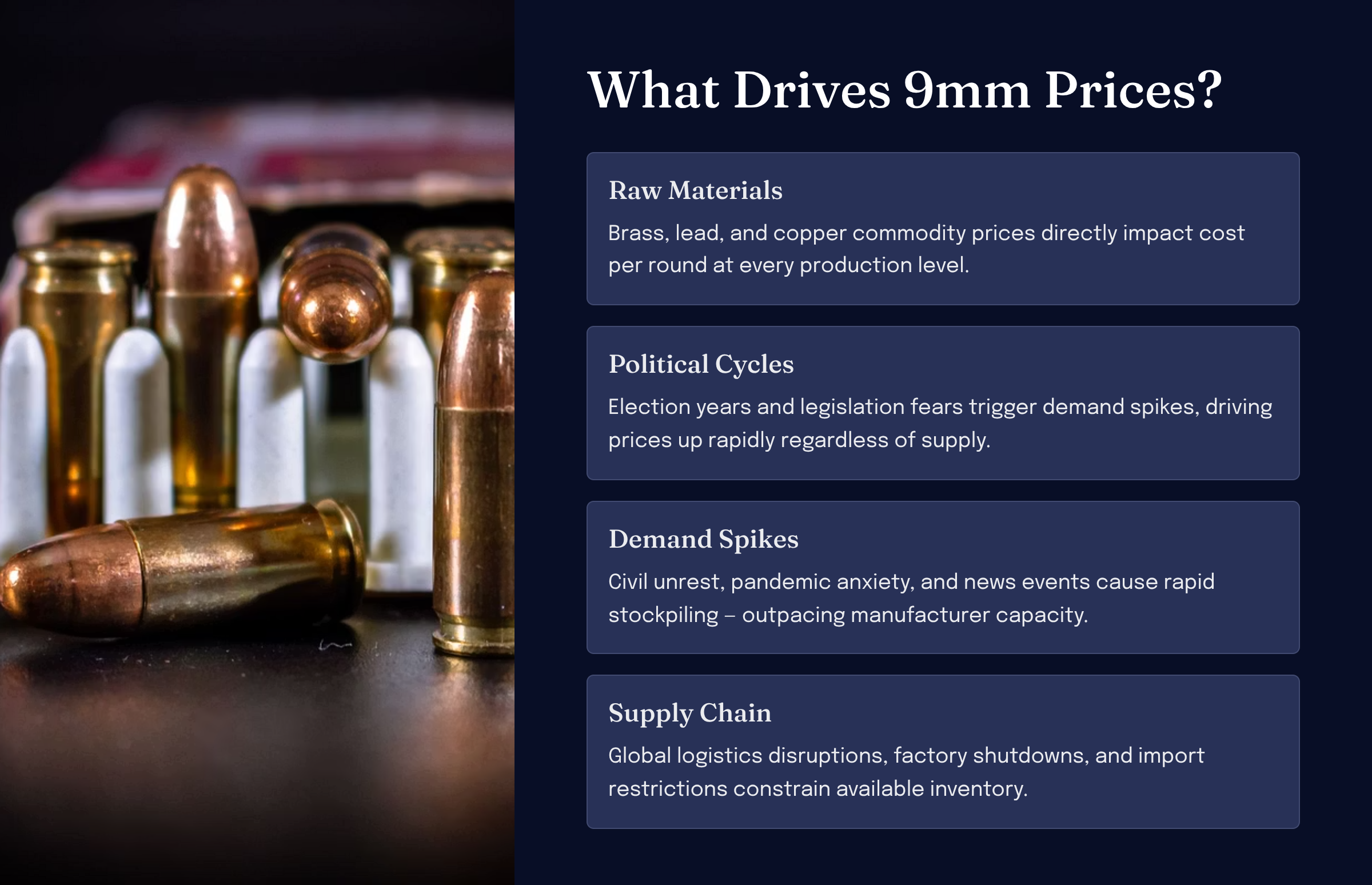
To forecast prices, you have to understand the levers. Four forces move ammunition pricing more than anything else.
1. Raw materials & manufacturing cost
Every round needs brass or steel for the case, copper and lead for the bullet, powder, and a primer — all global commodities with their own price cycles. These costs set the hard floor. When copper or lead spikes, ammo can't get much cheaper no matter how soft demand is. This is why 9mm can't return to 2010 prices: the inputs cost more now.
2. Demand spikes
Demand is the volatile lever — it can double overnight, while supply takes years to expand. New gun buyers, range activity, and stockpiling behavior all swing demand. Because factories can't instantly scale, a sudden demand surge is what produces the violent price spikes, every single time.
3. Political & election cycles
Ammo demand is politically reflexive. Talk of new restrictions, high-profile events, and especially presidential election years reliably push demand — and prices — up, as buyers stock up against feared future limits. These cycles are predictable enough that savvy buyers stock up before the political calendar heats up.
4. Supply-chain & production capacity
How much ammo factories can physically produce — and how smoothly primers, powder and metals flow to them — sets the ceiling on supply. The 2020 shortage was as much a supply-chain story as a demand story. When the chain is healthy, as it is in 2026, prices stay low and stable.
9mm Price Prediction for the Rest of 2026
No one can predict ammo prices with certainty — a single political event can rewrite the curve in a week. But based on the current market, here's the realistic outlook.
The base case is "flat to slightly lower." With supply chains healthy, factories running normally, and demand calm, 9mm is sitting near its practical floor. Expect cheap bulk FMJ to hover in the $0.22 to $0.28 per round range, with routine sales dipping into the high teens. Dramatic drops are unlikely — there isn't much room left between today's prices and the cost of making the ammo.
The upside risk is a demand shock. The one thing that reliably ends a calm market is a sudden surge in demand — a political flashpoint, new legislative threats, or another wave of first-time buyers. Because 2026 demand is calm now, the asymmetry favors buying: there's little room to fall and meaningful room to spike. That's the textbook setup for accumulating a supply at today's prices rather than waiting.
Treat any ammo price prediction — including this one — as a scenario, not a guarantee. The smart move isn't to time the exact bottom; it's to buy a reasonable supply while the market is calm and cheap, then top up on dips. Don't bet on prices falling much further from here.
The Best Time of Year to Buy Ammo
Beyond the big multi-year cycles, ammo has a softer seasonal rhythm worth knowing.
- Summer is usually cheapest. Between spring and fall hunting seasons, demand softens and retailers discount to move inventory. Mid-year is often the calmest, cheapest window of the year for bulk handgun ammo.
- Black Friday and the holidays. The single biggest sale event of the year. Bulk-case deals and premium-ammo discounts are common from late November through year-end.
- Hunting-season ramp-ups push prices up. Demand climbs heading into fall, especially for rifle and shotgun ammo, but handgun pricing feels it too.
- Election years and political flashpoints push prices up. The least predictable driver, and the one most likely to undo a good seasonal price.
The honest takeaway: seasonality is real but unreliable. The dependable way to buy at the bottom isn't to circle a month on the calendar — it's to track the live price and let an alert tell you the moment your caliber dips below its recent best.
How to Track 9mm Prices & Buy at the Bottom
History is useful, but you buy ammo in the present. The only way to consistently pay the least is to know what 9mm costs right now across every major retailer — and to be told the moment it drops. That's exactly what Kilo Tango does.
We continuously track live per-round 9mm prices across Sportsman's Guide, Ammunition Depot, Lucky Gunner, Guns.com and OpticsPlanet, normalize them to a true price per round, and surface the cheapest in-stock listing. Set a free price-drop alert on the 9mm page, and we'll email you the instant the tracked price hits a new low — so you buy at the bottom of the dip instead of guessing.
Buy 9mm at the Bottom of the Next Dip
9mm is cheap again — but the cheapest store changes daily and prices still swing on sales and restocks. Search live per-round prices across every major retailer on Kilo Tango, set a free price-drop alert, and we'll email you the moment 9mm hits a new low.
Frequently Asked Questions
Will 9mm ammo prices go back down?
9mm prices have already come down dramatically from their 2021 peak — from roughly $0.75–$1.00 per round at the height of the shortage to around $0.26 for cheap bulk FMJ in 2026. Could they fall further? Only slightly; pricing now sits near the practical floor set by raw-material and manufacturing costs, so the dramatic drops are likely behind us. The useful question isn't whether prices fall but when they dip — they still swing several cents on sales and restocks. Setting a price alert lets you buy on those dips instead of guessing.
Is now a good time to buy 9mm ammo?
Yes. In 2026, 9mm is near its cheapest in real terms in years — bulk FMJ runs roughly $0.20–$0.26 per round. With prices close to the manufacturing floor, the downside of buying now is small while the upside risk of waiting is a demand- or politics-driven spike. Buy a reasonable supply at today's calm prices and top up on dips rather than panic-buying during the next scare.
Why did ammo get so expensive in 2020 and 2021?
It was a textbook demand shock. A record surge of first-time gun buyers, pandemic uncertainty, civil unrest and an election cycle all hit at once, pushing demand far beyond what manufacturers could produce — while COVID simultaneously constrained labor and the supply of primers, powder, brass and copper. With shelves empty nationwide, 9mm climbed from roughly $0.16–$0.20 per round to $0.75 or more. As production caught up and demand normalized, prices fell back toward pre-2020 levels.
What is the cheapest 9mm has ever been?
In the years just before 2020, cheap bulk 9mm FMJ occasionally dipped to around $0.16–$0.18 per round on sale — the modern low — with steel-case promos sometimes lower. In 2026, bulk 9mm has returned close to that range, with cheapest in-stock listings frequently in the low-$0.20s per round.
What time of year is ammo cheapest?
Ammo tends to be cheapest in summer — demand softens between hunting seasons — and during big sale events like Black Friday. Hunting-season ramp-ups and political flashpoints push prices up. Because the pattern is seasonal but not guaranteed, the most reliable way to catch a low is to track the price and set an alert rather than wait for a specific month.