Best 9mm Ammo for Self Defense (2026)
9mm is the most popular defensive caliber in America — and the most crowded ammo aisle. We rank the five proven hollow-point loads serious carriers actually trust, by expansion, penetration, reliability and price.
The 9mm Luger is, by a wide margin, the most popular self-defense cartridge in the United States — and for good reason. Modern hollow-point engineering has erased the old "9mm versus .45" debate: today's premium 9mm defensive loads expand reliably, penetrate to the depth real-world defense demands, and do it with manageable recoil and high magazine capacity. Law enforcement agencies across the country, including the FBI, have standardized on 9mm precisely because it delivers the best balance of terminal performance, controllability, and round count.
But walking into a gun store or browsing the 9mm aisle online is overwhelming. Dozens of "defense," "personal protection," and "tactical" boxes compete for your money, and the marketing copy is nearly identical. This guide cuts through it. We rank the five 9mm defensive loads that have earned the trust of armed professionals and serious civilians — explain exactly what makes them work — and show you how to verify the right one for your pistol before you bet your life on it.
This guide is informational, not legal advice. Hollow-point ammunition is restricted in some jurisdictions — most notably New Jersey. Always confirm your state and local laws (see the State Laws guide) before buying or carrying defensive ammo.
Why 9mm Dominates Self-Defense
Three factors put 9mm at the top. First, capacity: the compact cartridge lets a standard full-size pistol hold 15–17+ rounds, and even slim subcompacts carry 10+ — a decisive advantage when seconds and shots count. Second, controllability: lower recoil than .40 S&W or .45 ACP means faster, more accurate follow-up shots, which matter far more than caliber theory in an actual encounter. Third, modern terminal performance: advances in bullet design mean a quality 9mm JHP now meets the same FBI penetration and expansion benchmarks that once favored larger calibers.
The FBI's 2014–2015 return to 9mm is the clearest endorsement. Their testing concluded that with modern duty ammunition, 9mm produces wound ballistics statistically comparable to larger calibers, while being easier to shoot well and cheaper to train with. When the largest law enforcement agency in the country makes that call, civilian carriers should pay attention. The lesson isn't that caliber is irrelevant — it's that shot placement and bullet quality beat raw caliber size, and 9mm makes good placement easier.
What Makes Good Self-Defense Ammo
Before the rankings, understand the three properties every defensive load is judged on. Get these straight and the marketing noise falls away.
1. Reliable expansion
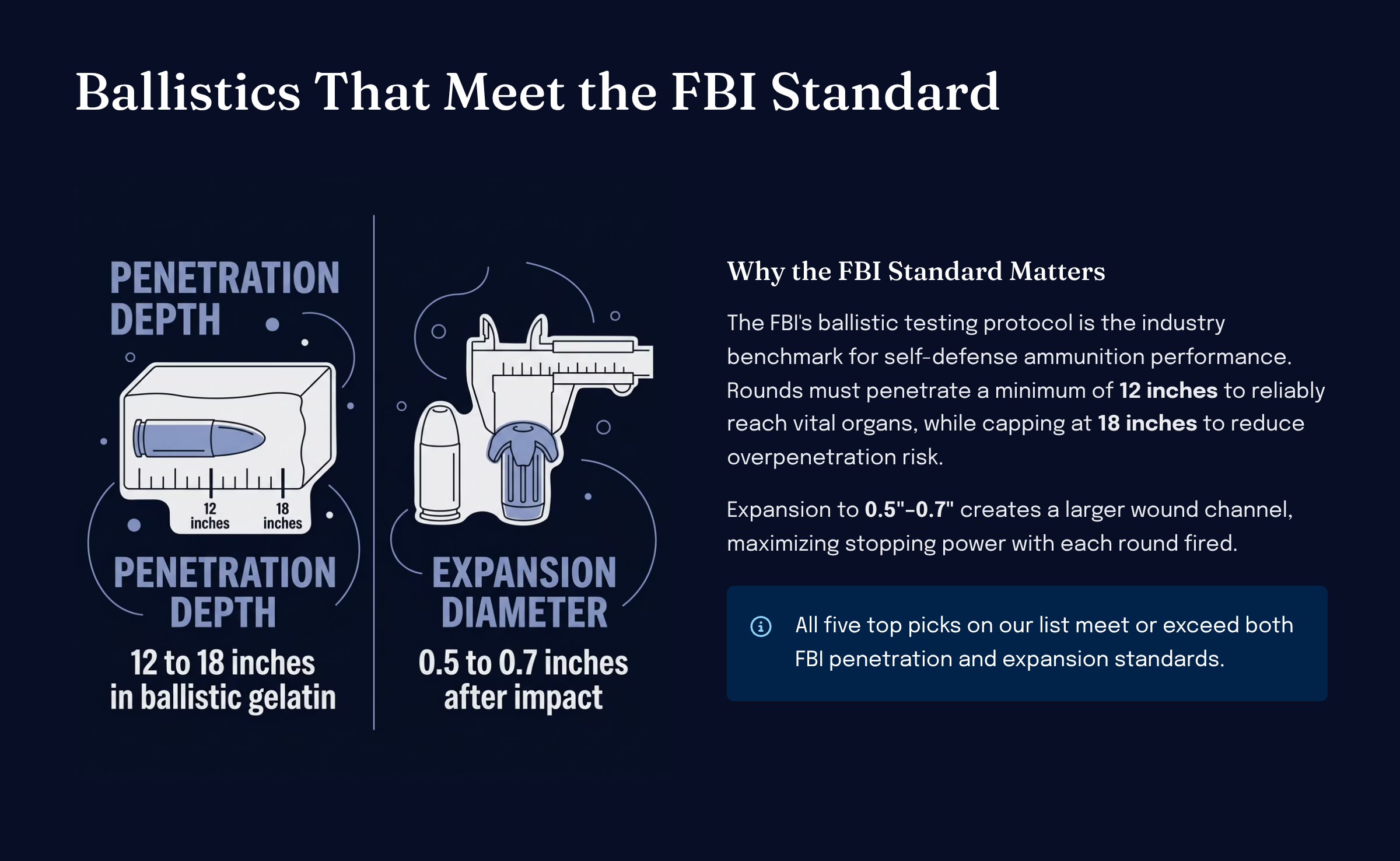
A defensive hollow point must expand consistently — mushrooming to roughly 1.5–2x its original diameter — to create a larger wound channel and transfer energy efficiently. Critically, it must expand through barriers like heavy clothing and denim, which can plug the hollow cavity and cause cheaper designs to behave like non-expanding FMJ. The best loads are engineered specifically to defeat clothing and still open up.
2. Adequate penetration
The FBI standard is 12 to 18 inches of penetration in calibrated ballistic gelatin. Too little (under 12") risks failing to reach vital structures, especially at bad angles or through an arm; too much (over 18") risks over-penetration and danger to bystanders. The goal is the sweet spot: deep enough to stop a threat, controlled enough to stay inside it. Expansion and penetration are a balancing act — a bullet that expands violently may not penetrate enough, and vice versa.
3. Absolute reliability
None of the above matters if the round doesn't fire and cycle every single time. Defensive ammo must feed, fire, extract, and eject flawlessly in your specific pistol, from clean and dirty, with your carry magazines. This is non-negotiable and the reason testing matters more than any spec sheet. A "perfect" load that chokes in your gun is worthless; a slightly-less-fancy load that runs 100% is what you carry.
Reliability first, then penetration, then expansion. A load that runs flawlessly and penetrates 14" but expands modestly beats a "wonder bullet" that occasionally fails to feed. Never sacrifice reliability for ballistic bragging rights.
Top 5 Best 9mm Self-Defense Loads
These five loads have been validated by years of agency adoption, independent gel testing, and real-world use. Any of them is an excellent choice; the order reflects overall track record, availability, and value — but the right pick is the one that runs best in your gun.
Federal HST
The gold standard of duty and carry ammo. The HST's unique hollow-point design delivers large, consistent expansion and reliably hits the 12–18" penetration window — even through heavy clothing — without fragmenting. It's the load many agencies issue and many instructors carry personally. Available in 124gr, 124gr +P, and 147gr. If you want a single "just buy this" answer, it's HST.
124gr / 147gr · ~$0.90–$1.30/rd · FBI-spec expansionSpeer Gold Dot
The original bonded-core defensive bullet and a law-enforcement mainstay for decades. Its jacket is electrochemically bonded to the core, so the bullet holds together and retains weight through barriers — outstanding for consistent penetration. The G2 variant refines the design further. Proven, trusted, and widely issued. A co-equal to HST for most carriers.
124gr / 147gr · ~$0.85–$1.25/rd · bonded coreHornady Critical Defense
Built around the patented FTX bullet with a soft polymer tip filling the hollow cavity. That tip prevents clothing from plugging the bullet, ensuring reliable expansion — a smart solution to the heavy-clothing problem. Loaded to standard pressure with low flash powders, it's an excellent choice for compact carry guns and recoil-sensitive shooters. (Critical Duty is the heavier-barrier sibling for full-size duty use.)
115gr / 124gr · ~$0.80–$1.20/rd · FTX polymer tipSig Sauer V-Crown
Sig's stacked dual-cavity hollow point produces wide, consistent expansion and strong weight retention at a competitive price. It has earned a strong reputation in independent gel testing and is frequently available in value-priced multi-packs, making it one of the better cost-to-performance defensive loads on the market. A legitimate top-tier option, often easier on the wallet.
115gr / 124gr / 147gr · ~$0.75–$1.10/rd · dual cavityWinchester Defender
Winchester's PDX1 Defender uses a bonded jacket and a segmented hollow point engineered for both expansion and penetration. It was selected by the FBI in years past and remains a proven, widely available duty-grade load. Dependable performance from one of the most established names in American ammunition, and easy to find in stock.
124gr / 147gr · ~$0.85–$1.25/rd · bonded PDX1
9mm Defensive Ammo Comparison
A quick-reference comparison of the five loads. Velocity and expansion figures are manufacturer and independent-test typicals for standard-pressure 124gr offerings where available; prices reflect representative per-round cost in 2026 and vary by retailer — always search live 9mm prices before buying.
| Load | Bullet Weight | Muzzle Velocity | Expansion | Price / Round |
|---|---|---|---|---|
| Federal HST | 124 / 147 gr | ~1,150 / 1,000 fps | Excellent (.60"+) | $0.90–$1.30 |
| Speer Gold Dot | 124 / 147 gr | ~1,150 / 985 fps | Excellent, bonded | $0.85–$1.25 |
| Hornady Critical Defense | 115 / 124 gr | ~1,140 / 1,110 fps | Very good, FTX | $0.80–$1.20 |
| Sig V-Crown | 115 / 124 / 147 gr | ~1,165 / 1,165 / 985 fps | Very good, dual-cavity | $0.75–$1.10 |
| Winchester Defender | 124 / 147 gr | ~1,200 / 1,000 fps | Excellent, bonded | $0.85–$1.25 |
Representative figures, 2026. Actual velocity depends on barrel length; expansion depends on the test medium and barrier. Prices vary by retailer and quantity. Verify performance in your own firearm.
State Restrictions on Hollow Points
Hollow-point ammunition is legal in the overwhelming majority of states, but a few impose meaningful restrictions you must know before you buy or carry.
- New Jersey is the strictest. State law generally prohibits civilian possession and transport of hollow-point ammunition except in limited circumstances — such as keeping it at your home or premises, or transporting it directly to and from a range or place of purchase. Carrying loaded JHP outside these exemptions can be a serious offense. Review the details on our New Jersey ammo laws page before buying.
- Massachusetts doesn't ban hollow points outright but tightly regulates the purchase of all ammunition through its licensing and dealer framework — you generally need the appropriate firearms license to buy any ammo, JHP included.
- Other jurisdictions have local nuances around magazine capacity, ammunition registration, or purchase permits that can indirectly affect defensive ammo.
Because these rules change and vary by locality, always confirm current law for your exact location. Start with Kilo Tango's State Laws guide, which breaks down ammunition rules state by state.
If you live in or travel through a restrictive state, verify the law before ordering hollow points online — shipping defensive ammo into a jurisdiction that restricts it can create legal problems even if you never carry it.
FMJ vs. Hollow Point for Self Defense
Some shooters consider carrying FMJ (full metal jacket) for defense — usually to save money or because they live somewhere hollow points are restricted. Understand the trade-off clearly. FMJ does not expand; it punches a caliber-sized hole and keeps going. That creates two problems for defensive use: it transfers energy poorly (less effective at stopping a threat), and it over-penetrates, passing through the target and walls and endangering bystanders or family in adjacent rooms.
Hollow points solve both: expansion increases effectiveness and the bullet slows inside the target, reducing the odds it exits and strikes something — or someone — behind it. For defense, JHP is the clear choice everywhere it's legal. Reserve FMJ for the range, where its lower cost makes it ideal for the high-volume practice that actually builds the skill that matters most. For a deeper breakdown of every bullet type, see our Ammo Types Decoded guide.
How to Test Your Carry Ammo
Choosing a top-5 load is step one. Step two — the step most people skip — is proving it works in your gun. No defensive load is trustworthy until you've verified it. Here's the protocol:
- Fire 100–200 rounds with zero malfunctions. Buy enough of your chosen load to run a serious test. Any failure to feed, fire, extract, or eject resets the count. You want a flawless streak before you trust it.
- Use your actual carry setup. Same pistol, same magazines, same conditions you'd carry in. Magazines are a common failure point — test the exact ones you'll rely on.
- Test clean and dirty. Fire some from a freshly cleaned gun and some after a few hundred rounds of fouling. Real carry guns aren't always pristine.
- Confirm point of impact. Heavier and lighter loads can shift where the gun hits relative to your sights. Verify your defensive load impacts where you aim at typical defensive distances (3–10 yards).
- Check function from slide-lock and on the move. Reloads and shooting from non-ideal positions stress the gun differently than slow-fire off a bench.
Once a load passes, buy enough to carry and rotate, and re-verify if you change anything — guns, magazines, springs, or even a new lot of ammo. Reliability is earned through testing, not assumed from a brand name.
Defensive JHP is expensive, so don't burn it all on routine practice. Train with matching-weight FMJ for volume, validate your carry load with a focused 100–200 round test, then practice the fundamentals with FMJ and re-verify your JHP periodically.

Search Live 9mm Self-Defense Prices
Premium hollow points like HST, Gold Dot and V-Crown swing widely in price between retailers and go on sale more often than people expect. Search live 9mm prices across every major store on Kilo Tango, and set a free price-drop alert so you stock your carry load at the lowest cost.
Frequently Asked Questions
What is the best 9mm ammo for self defense?
Federal HST is the most widely recommended 9mm defensive load for its consistent expansion and FBI-spec penetration. Speer Gold Dot, Hornady Critical Defense, Sig V-Crown and Winchester Defender are all excellent alternatives. The genuinely best load is the premium hollow point that feeds and shoots reliably in your specific pistol — confirm it with a 100–200 round test before carrying.
Is FMJ or hollow point better for self defense?
Hollow point (JHP) is strongly preferred. It expands to transfer energy efficiently and reduces dangerous over-penetration. FMJ doesn't expand, over-penetrates, and is best kept to the range. Use FMJ to practice and JHP to carry. See our Ammo Types Decoded guide for more.
What grain 9mm is best for self defense?
124gr and 147gr are the most popular defensive weights. 124gr (and 124gr +P) balances velocity and penetration; 147gr is heavier, subsonic, and favored for short barrels and suppressors. 115gr is lighter and faster but less preferred for carry. In a quality JHP, bullet construction matters more than weight alone.
Are hollow points legal in my state?
Hollow points are legal in nearly all states. New Jersey is the notable restriction, generally limiting civilian possession and transport to specific circumstances. Massachusetts regulates all ammo purchases through licensing. Always verify your state and local laws — start with our State Laws guide and New Jersey page.
How many rounds should I test before carrying a defensive load?
Run at least 100–200 rounds of your chosen load through your actual carry pistol with zero malfunctions before trusting it. Test from clean and dirty, use your real carry magazines, and confirm point of impact matches point of aim. Reliability in your specific gun is the most important factor.