Cheapest Place to Buy Ammo Online in 2026
We compared live per-round prices across the biggest online ammo retailers. Here's where 9mm, .223, .308 and .22LR are actually cheapest right now — and the hidden fees that quietly erase the savings.
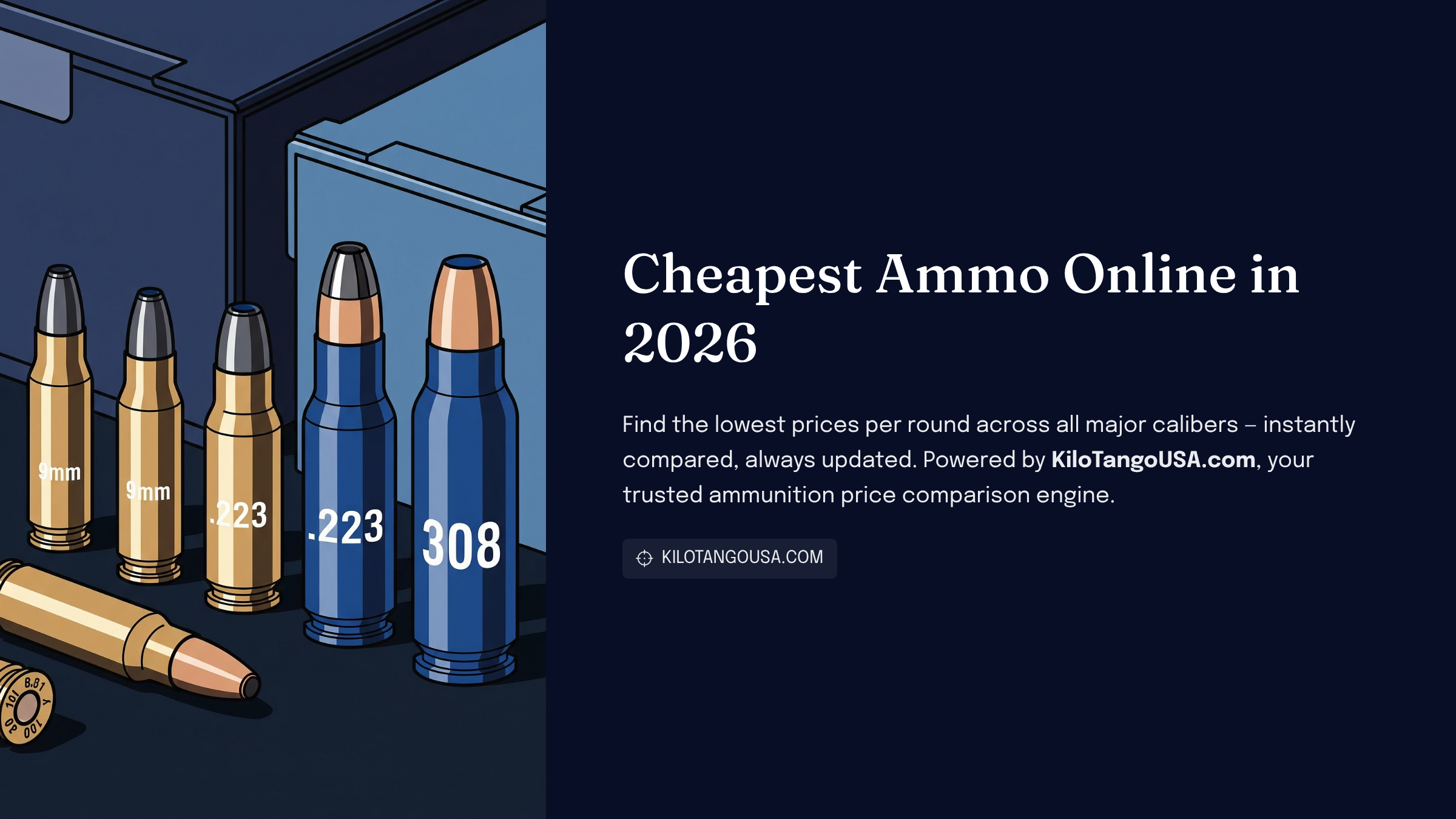
If you've shopped for ammunition at any point in the last five years, you've watched the price of a box swing like a stock chart. The good news for 2026: ammo is cheap again. The pandemic-era shortages that pushed 9mm past fifty cents a round and emptied retailer shelves nationwide are long over. Manufacturers caught up, demand normalized, and prices have fallen back to — and in some cases below — where they sat before 2020.
The catch is that "cheap" is wildly inconsistent from one retailer to the next. On any given day, the exact same box of 115-grain 9mm FMJ might be $11.99 at one store and $17.99 at another, before either one adds shipping or a hazmat surcharge. Loyalty shopping a single retailer can cost you 30–50% more over a year of buying without you ever noticing. The shooters who pay the least aren't finding a secret store — they're comparing prices across every store at once and buying when the number is right.
That's exactly what Kilo Tango was built to do. Below, we break down where ammo is actually cheapest online in 2026, with real per-round numbers pulled from live retailer catalogs, the hidden fees that turn a great price into a mediocre one, and the tactics that consistently get you the lowest cost per round.
How We Compared
Kilo Tango is an ammunition search engine, not a store. We don't sell, ship, or hold inventory — we continuously pull live product and pricing data from major online retailers and normalize it so you can compare apples to apples. That normalization matters more than it sounds. A "$24.99" listing tells you nothing until you know whether it's a box of 50 or a box of 20, what the bullet weight is, and whether it's brass or steel case.
For this table we converted every in-stock listing to a single, honest metric: price per round (PPR), calculated from the total price divided by the round count. PPR is the only number that lets you compare a 1,000-round case against a 50-round box fairly. We then grouped listings by caliber and bullet type — separating cheap bulk training ammo (FMJ) from premium defensive loads (hollow points), because mixing them produces meaningless averages.
The retailers in this guide — Lucky Gunner, AmmoDepot, OpticsPlanet, Guns.com, and Sportsman's — were chosen because they carry deep, consistently-stocked catalogs across the most popular calibers and report reliable pricing. The figures below reflect Kilo Tango's tracking as of June 2026. Ammo pricing is volatile by nature, so treat these as representative snapshots, not permanent quotes — and check the live listing pages before you buy.
A $13.99 box of 50 (28¢/round) is a worse deal than a $119 case of 500 (24¢/round), even though the case has a scarier sticker price. Always shop on price per round, not the headline price. Buying in bulk is the single biggest lever on your cost.
Find the Lowest Ammo Prices — Instantly
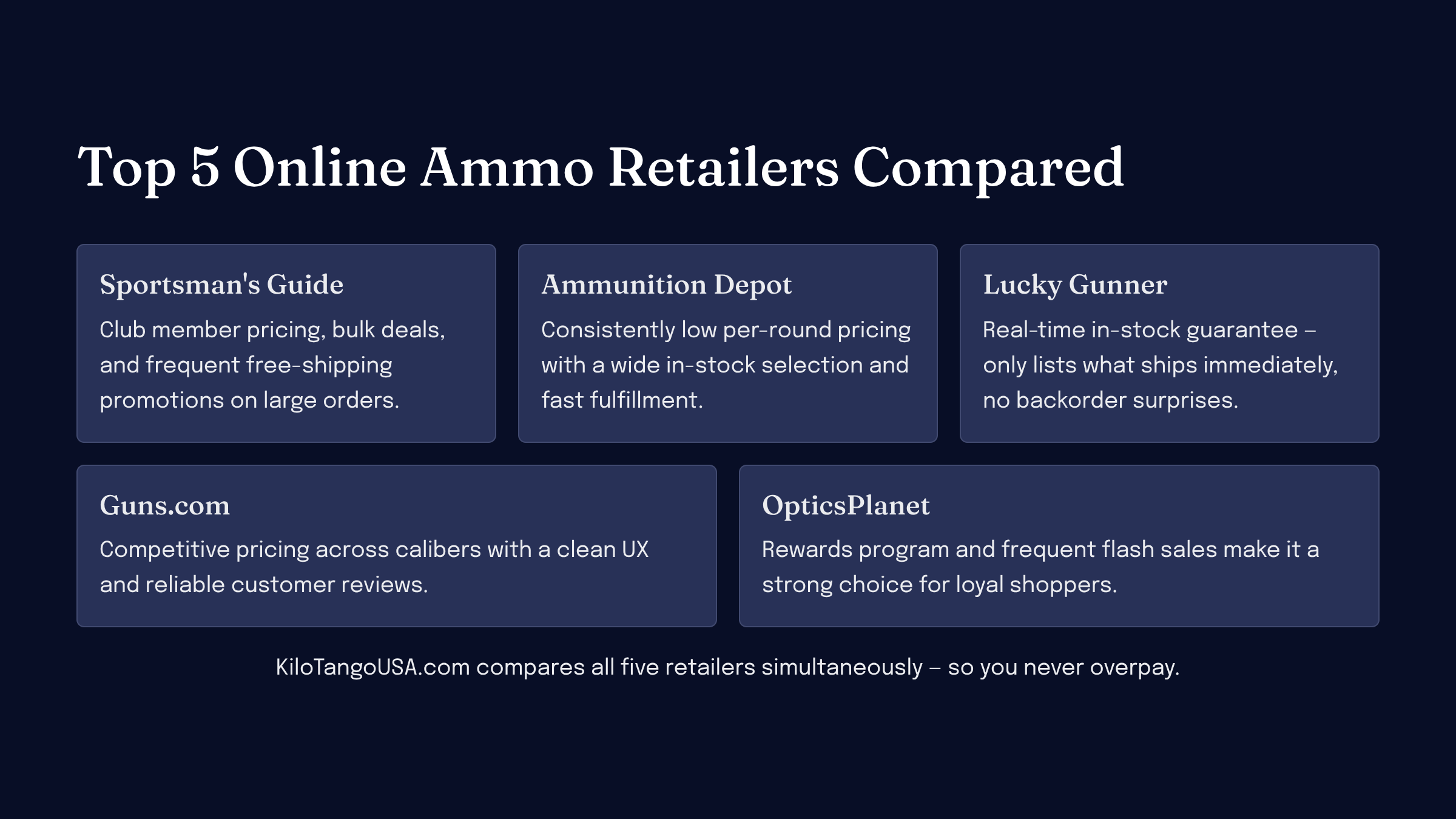
Instead of manually opening a dozen tabs and price-checking five or more retailers one caliber at a time, let Kilo Tango do it the moment you ask. We continuously track live per-round prices across Sportsman's Guide, Ammunition Depot, Lucky Gunner, Guns.com, OpticsPlanet and more — then surface the cheapest in-stock listing for the exact caliber you want.
Because no single store is cheapest on everything, every day, the only reliable way to pay the least is to compare all of them at the moment you buy. That's the whole point of Kilo Tango: one search across every major retailer, normalized to the real price per round, updated continuously — so you never overpay out of habit.
A "top 5" list is out of date the instant someone runs a sale or restocks a pallet — a live search isn't. Rather than trusting last month's rankings, check who's actually cheapest on your caliber right now. It takes seconds, and the answer is always current.
Live Price Search: 9mm, .223, .308 & .22LR
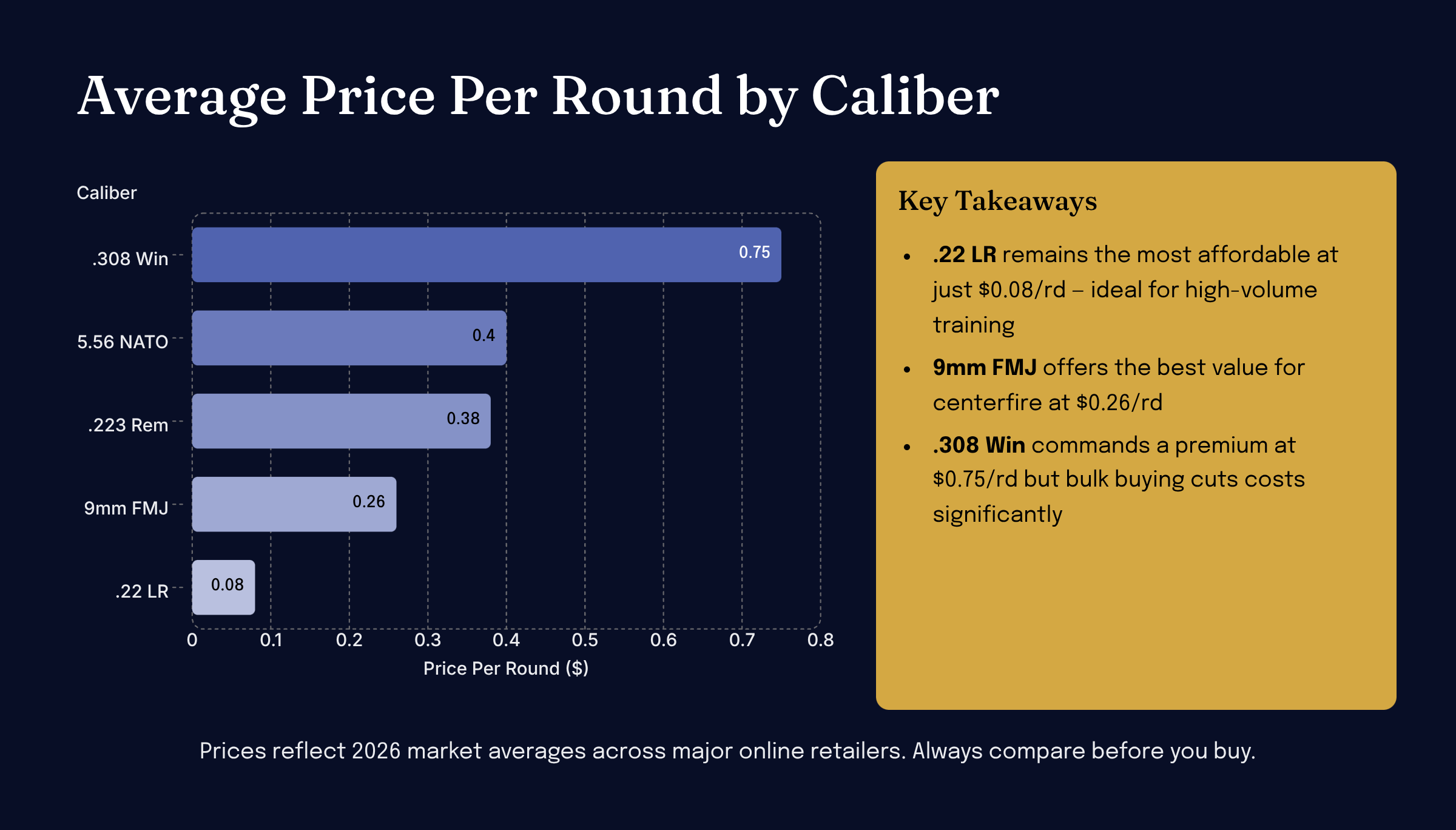
Below are representative cheapest in-stock per-round prices for bulk FMJ training ammo across the five retailers, based on Kilo Tango's June 2026 tracking. These are the budget tier — the cheapest brass or steel case quantity available — not premium defensive loads. Use them to calibrate what a genuinely good deal looks like.
| Retailer | 9mm FMJ | .223 / 5.56 | .308 Win | .22 LR |
|---|---|---|---|---|
| Lucky Gunner | $0.21 | $0.38 | $0.76 | $0.06 |
| AmmoDepot | $0.21 | $0.40 | $0.78 | $0.08 |
| OpticsPlanet | $0.26 | $0.37 | $0.82 | $0.07 |
| Guns.com | $0.23 | $0.43 | $0.80 | $0.09 |
| Sportsman's | $0.24 | $0.45 | $1.19 | $0.10 |
Representative cheapest in-stock bulk FMJ per-round prices, Kilo Tango tracking, June 2026. Prices change constantly — check live listings before buying. Premium hollow-point and match loads cost significantly more (see below).
A few things jump out. First, the spread is real: the cheapest 9mm (21¢) is roughly 24% below the most expensive entry on this table (26¢) — and that gap widens dramatically on premium loads and during sales. Second, .22LR is absurdly cheap again, back to 6–10¢ per round, making it the best value in shooting for high-volume practice. Third, .308 carries the widest variance of any caliber here, because it spans cheap surplus-style FMJ all the way up to precision match ammo — which is exactly why shopping it on price per round matters most.
What about self-defense and premium ammo?
The table above is training ammo. Premium 9mm defensive hollow points — Federal HST, Speer Gold Dot, Hornady Critical Defense — typically run $0.80 to $1.50 per round, and match-grade .308 can exceed $2.00 per round. That's expected: defensive and match ammo is engineered to a different standard. The smart play is to buy cheap FMJ for volume practice and reserve premium ammo for carry and qualification — and even then, compare, because premium loads go on sale too.
Hidden Costs That Erase Your Savings
The per-round price is only half the equation. Three fees can quietly turn the cheapest listing into the most expensive total — and they're the number-one reason a "great deal" disappoints at checkout.
1. Shipping
Ammo is heavy. A case of 1,000 rounds of 9mm weighs over 25 pounds, and shipping is priced by weight. Many retailers offer free shipping above a threshold (often $99–$200), so a near-cheapest listing with free shipping frequently beats the absolute-cheapest listing that charges $15 to ship. Always look at the delivered total, not the listing price.
2. Hazmat fees
Because ammunition ships as a regulated material, some retailers tack on a flat hazmat surcharge, typically $0–$30 per order. The critical insight: it's almost always a flat fee, not per-item. A $25 hazmat fee spread across 50 rounds adds 50¢/round; spread across 1,000 rounds it adds just 2.5¢/round. This is one more reason bulk buying wins. Increasingly, the big specialists waive hazmat entirely — a meaningful tiebreaker.
3. Minimum orders & quantity tiers
The headline per-round price you see is often the bulk-case price. Buy a single box and you'll pay a much higher rate. Conversely, some of the best per-round deals require buying 500 or 1,000 rounds at once. Make sure the advertised price matches the quantity you actually intend to buy.
Compare on (item price + shipping + hazmat) ÷ rounds, never on listing price alone. A 23¢/round listing with free shipping and no hazmat usually beats a 21¢/round listing that adds $15 shipping plus a $25 hazmat fee on a small order.
How to Actually Get the Best Deal
Paying the least for ammo isn't luck — it's a handful of repeatable habits.
- Buy in bulk. The single biggest lever. Cases of 500–1,000 rounds slash per-round cost and dilute flat shipping and hazmat fees. If you shoot regularly, a case of practice ammo almost always beats buying boxes.
- Compare every retailer, every time. The cheapest store changes daily. Loyalty costs money. Use an ammunition search engine so you're always buying from whoever is lowest today, not whoever you bought from last time.
- Shop on delivered price per round. Add shipping and hazmat into the math before you judge a deal. The lowest sticker price is frequently not the lowest total.
- Watch for sales and holidays. Black Friday, tax season, and major shooting-sports events trigger real discounts. Premium defensive ammo in particular goes on sale far more often than people expect.
- Don't panic-buy. The shooters who overpaid most in 2020–2021 were the ones buying at the peak. Prices dip and recover constantly. Buy on dips, keep a reasonable supply, and never pay scarcity prices when the market is calm — as it is now.
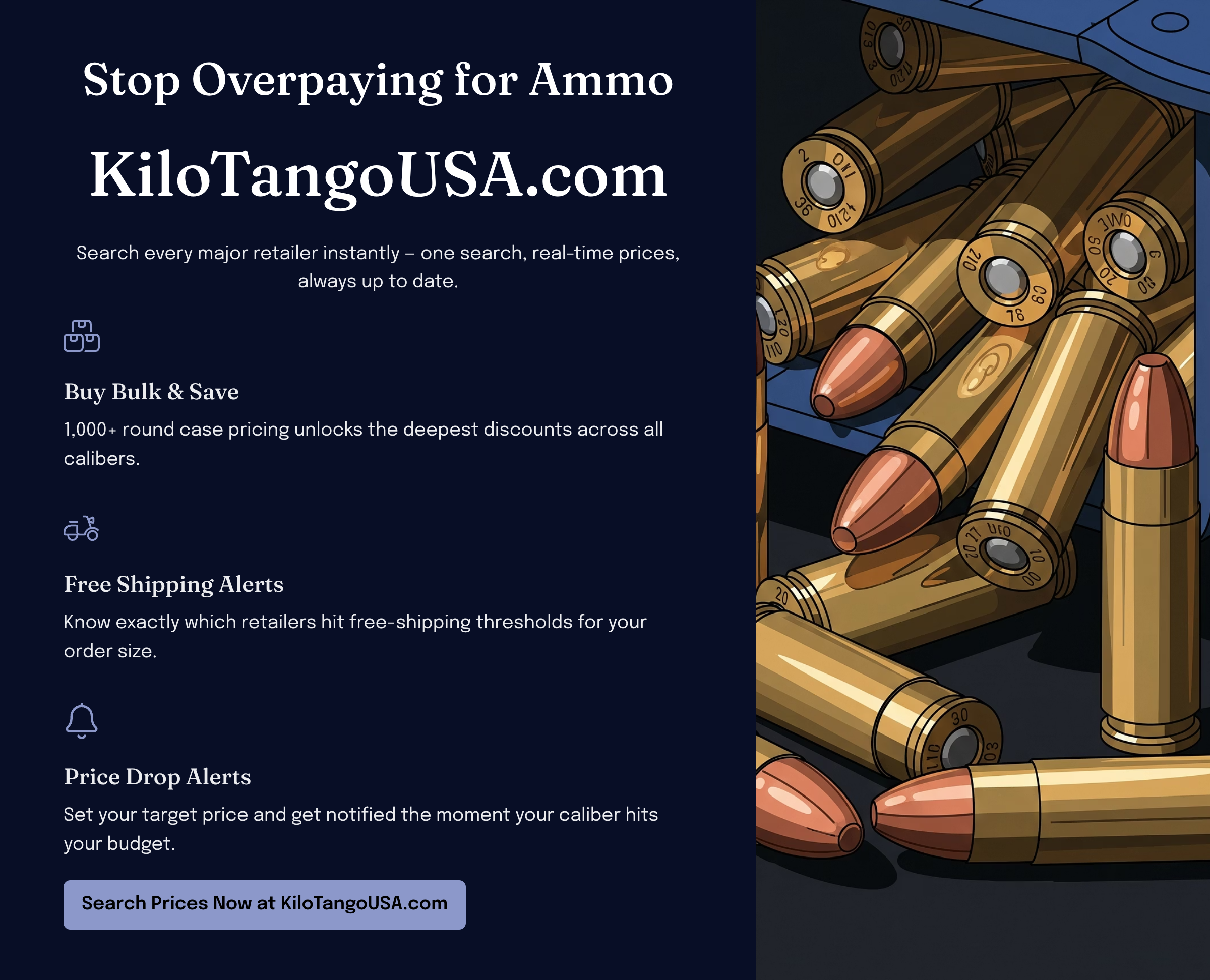
- Set a price alert. Instead of refreshing listings, let the price come to you. Kilo Tango can email you the moment a caliber drops below the current best price — so you buy at the bottom of the dip automatically.
If you only need a single box, a local shop can beat online once shipping and hazmat are added. Online bulk pricing pulls ahead around the 500-round mark. Match the channel to the quantity.
Find Today's Cheapest Ammo in Seconds
Stop loyalty-shopping a single store. Search live per-round prices across every major retailer on Kilo Tango, then set a free price-drop alert and let the deal come to you — we'll email you the moment your caliber hits a new low.
Frequently Asked Questions
What is the cheapest place to buy ammo online?
There's no single cheapest retailer — the best price moves daily as stores run sales and restock. In Kilo Tango's 2026 tracking, Lucky Gunner, AmmoDepot, OpticsPlanet, Guns.com and Sportsman's consistently post the lowest per-round prices on bulk ammo, but which one wins on any given day depends on the caliber and current inventory. The reliable way to find the cheapest ammo is to search live prices across all of them at once rather than loyalty-shopping a single store.
How much should 9mm ammo cost in 2026?
As of mid-2026, cheap bulk 9mm FMJ training ammo runs roughly $0.20–$0.26 per round (about $10–$13 per box of 50), down sharply from the $0.50+ seen at the 2021 peak. Premium self-defense hollow points cost more — typically $0.80–$1.50 per round. Bulk cases of 500–1,000 rounds deliver the lowest per-round cost.
Is it cheaper to buy ammo online or in a store?
Online is almost always cheaper per round for bulk purchases, even after shipping, because online retailers carry far larger inventories and compete nationally. Local stores can win on small quantities where shipping and hazmat would dominate. The break-even is usually around 500 rounds — above that, online bulk wins; below it, the fees can erase the savings.
What is a hazmat fee on ammo?
A hazmat fee is a flat surcharge (commonly $0–$30) that some retailers add because ammunition ships as a regulated hazardous material. Many large retailers now waive it, and because it's flat rather than per-item, spreading it across a bulk order lowers your effective per-round cost.
How can I get notified when ammo prices drop?
Kilo Tango lets you set a free price-drop alert for any caliber. Enter your email on a caliber page — such as 9mm, .223/5.56, .308 or .22LR — and we'll email you when the tracked price falls below the current best deal. It's the easiest way to buy at the bottom of a dip.
People Also Ask
Is it legal to buy ammo online?
Yes, it's legal to buy ammunition online in most of the United States, and it ships directly to your home in the majority of states. Federal law doesn't require an FFL to receive ammo, but a handful of states add their own rules — California requires an in-state licensed vendor and an eligibility check, New York routes sales through a background-check system, and Massachusetts, Connecticut, New Jersey and Illinois have permit or ID requirements. Always confirm the rules in your state before ordering.
Does ammo ship directly to my door?
In most states, yes — online retailers ship straight to your home via standard ground carriers, with ammunition packaged as an ORM-D / limited-quantity material. The main exceptions are restrictive states such as California, which requires delivery through a licensed in-state vendor for a face-to-face transfer and eligibility check. Check your state's rules to know whether it ships to your door or to a local dealer.
How much can I save buying ammo in bulk?
Buying in bulk is the single biggest lever on cost per round, commonly saving 20–40% versus single boxes. A 1,000-round case lowers the base per-round price and spreads flat shipping and hazmat fees across far more rounds — a $25 hazmat fee adds 50¢/round on a box of 50 but only 2.5¢/round on a case of 1,000. Our bulk ammo buying guide breaks down the math.
Is steel-case ammo worth it to save money?
Steel-case ammo is cheaper than brass and runs reliably in most modern semi-automatic rifles, making it a legitimate way to cut practice costs. The trade-offs: steel cases aren't reloadable, can be slightly dirtier, and some ranges restrict them. For high-volume plinking the savings are real; for defensive ammo or reloading, stick with brass. See steel case vs brass for the full head-to-head.
When is the best time to buy ammo?
The best time to buy is on a price dip, not a fixed date — but sales cluster around Black Friday and Cyber Monday, tax season, and major shooting-sports events, when real discounts appear even on premium defensive ammo. The worst time to buy is during a demand panic, when prices spike. Rather than timing it manually, set a free price-drop alert and buy when your caliber hits a new low.
How many rounds of ammo should I keep on hand?
There's no legal or universal number, but a common guideline is enough to cover your regular practice plus a reserve. Many recreational shooters keep 500–1,000 rounds of their primary practice caliber and a few hundred rounds of defensive ammo, buying on dips to maintain the supply. Ammo stored cool and dry lasts for decades, so building a reasonable stock when prices are low helps you avoid paying scarcity prices later.