Best .223/5.56 Ammo for AR-15 (2026)
The AR-15 is America's rifle — and feeding it well means matching the right .223/5.56 load to the job. Here are the best loads for range, home defense, varmint hunting and long range, plus the .223-vs-5.56, grain-weight and twist-rate facts every owner should know.
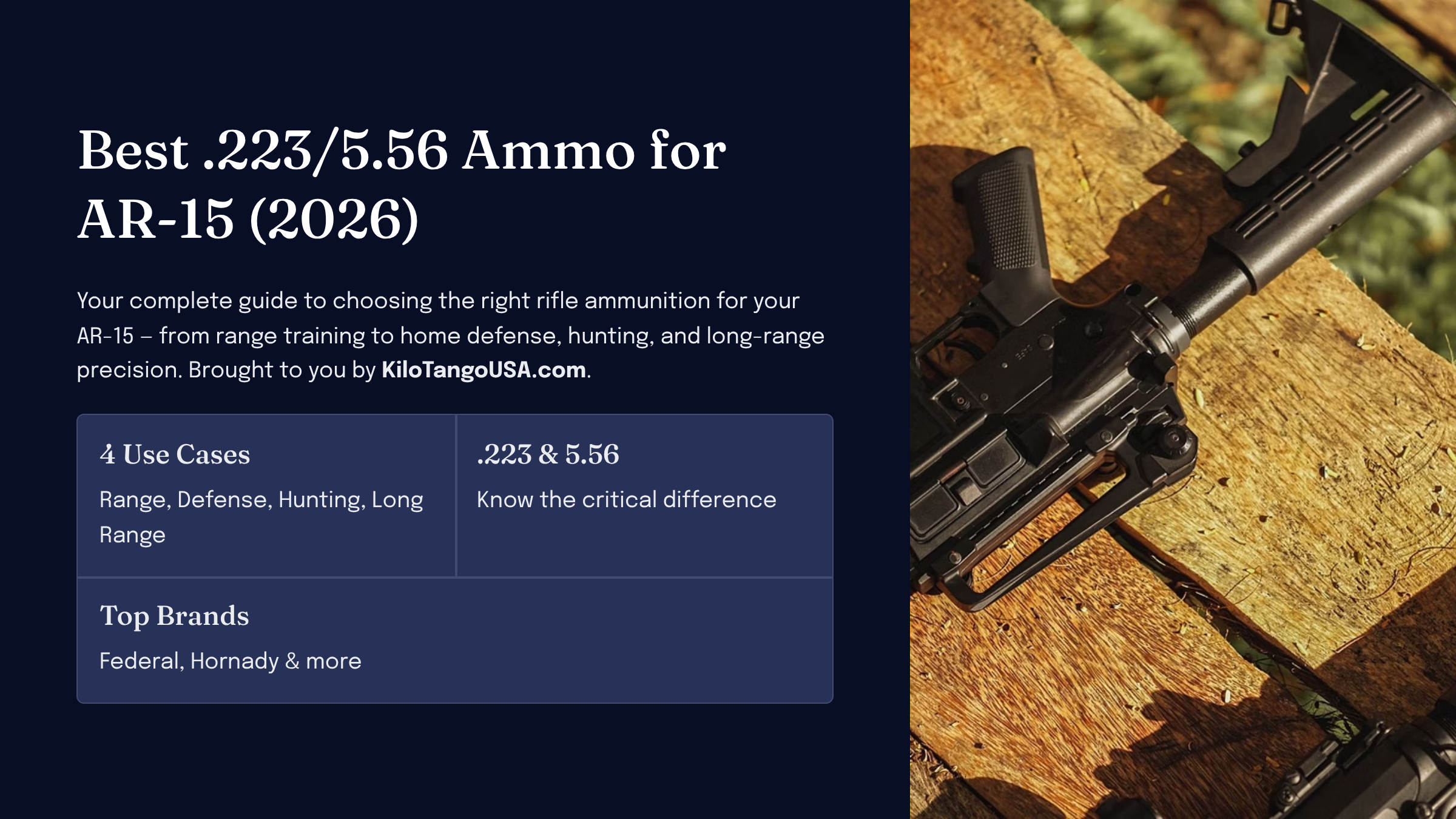
The AR-15 is the most popular rifle in America, and the .223 Remington / 5.56 NATO cartridge it's built around is one of the most versatile centerfire rounds ever made. But that versatility cuts both ways: the same rifle that punches paper at the range, takes coyotes in the field, and stands ready for home defense needs different ammo for each of those jobs. Buy the wrong load and you're either overpaying, under-performing, or — in the case of home defense — taking on real safety risk.
This guide cuts straight to the best .223/5.56 loads for four jobs — range, home defense, varmint/hunting, and long range — then explains the three things every AR-15 owner needs to understand to choose correctly: the .223-vs-5.56 difference, grain weight, and barrel twist rate. When you're ready to buy, search live .223/5.56 prices across every major retailer on Kilo Tango.
.223 Remington vs 5.56 NATO: The Critical Difference
These two cartridges look identical and will physically chamber in the same rifle — but they are not the same, and getting this wrong can be dangerous. The 5.56 NATO is loaded to higher pressure than .223 Remington and is designed for a chamber with a slightly longer throat (the "leade"). The practical rule comes down to your barrel:
- 5.56 NATO chamber → safe with BOTH. A rifle chambered in 5.56 has the extra room and pressure tolerance to fire both 5.56 and .223 with no issue. Most "AR-15s" sold today are 5.56-chambered.
- .223 Remington chamber → .223 ONLY. Firing high-pressure 5.56 in a tight .223 chamber can spike pressures to unsafe levels. Don't do it.
- .223 Wylde chamber → safe with BOTH. This hybrid chamber is specifically designed to safely shoot 5.56 while delivering match-grade accuracy with .223. Many quality and precision ARs use it.
The simple takeaway: .223 ammo is safe in a 5.56 chamber; 5.56 ammo is risky in a .223 chamber. Check the markings stamped on your barrel before you buy. If it reads "5.56" or ".223 Wylde," you can run anything. If it reads ".223 Rem," buy .223 only.
Never assume — read the caliber roll-marked on your barrel. If you can't confirm it's a 5.56 or .223 Wylde chamber, default to .223 Remington ammunition, which is safe in every chamber. When in doubt, ask a gunsmith.
Best .223/5.56 for the Range
For high-volume practice, you want reliable, accurate-enough, affordable FMJ. These are the bulk-buying favorites that run clean and shoot straight without breaking the bank.
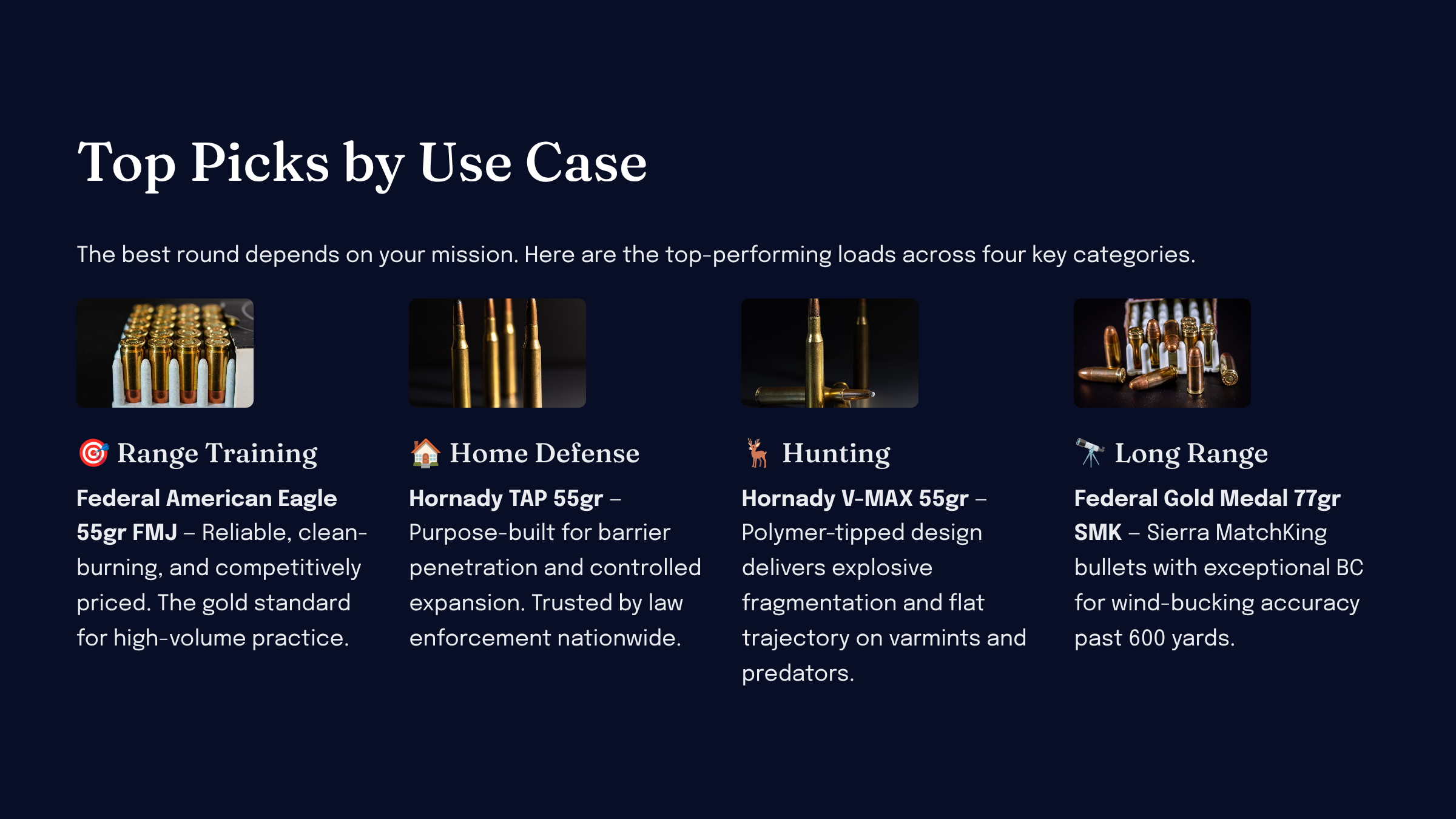
Federal American Eagle 55gr FMJ
The benchmark American range load. Clean-burning, reliably accurate, brass-cased, and reloadable — it runs flawlessly in virtually every AR-15 and is the safe default for stockpiling practice ammo. If you want one box to fill your range bag, this is it.
55gr FMJ · brass case · range/trainingPMC Bronze 55gr
A perennial value pick. PMC Bronze is clean, consistent, brass-cased, and almost always among the cheapest quality range loads available. Outstanding cost-to-reliability ratio for plinking and drills.
55gr FMJ · brass case · budget valueWolf Gold 55gr (budget)
Don't let the Wolf name fool you — Wolf Gold is brass-cased (not the steel-case Wolf), made to a quality spec, and frequently the lowest-priced brass .223 on the market. A great choice when you want brass-case reliability at near steel-case prices.
55gr FMJ · brass case · lowest costBest .223/5.56 for Home Defense
Home defense is where load selection matters most. You want a bullet that expands or fragments reliably and limits over-penetration through interior walls — the opposite of cheap FMJ and M855, which punch straight through drywall and keep going. Controlled-expansion soft points and bonded bullets are the answer.
Hornady TAP 55gr
Purpose-built law-enforcement and personal-defense ammo. The TAP line uses rapidly-expanding bullets engineered to dump energy quickly and reduce wall penetration relative to ball ammo — a top-tier defensive choice with a proven track record.
55gr expanding · LE/defense · controlled penetrationSpeer Gold Dot 62gr
The bonded-bullet specialist applied to the carbine. Gold Dot's bonded core holds together for consistent, controlled expansion and dependable performance — a trusted duty load that translates well to home defense.
62gr bonded soft point · duty-gradeFederal Fusion 62gr
A bonded soft point built for terminal performance and weight retention. Fusion delivers reliable expansion with controlled penetration, making it both an effective defensive load and a capable medium-game option.
62gr bonded SP · expansion + retentionPlain FMJ and M855 green tip over-penetrate interior walls and pose a serious danger to others in the home and neighbors. Always use a purpose-built expanding defensive load indoors.
Best .223/5.56 for Varmint & Hunting
For coyotes, prairie dogs, and other varmints, you want explosive, rapidly-fragmenting bullets that deliver dramatic terminal effect on small game. Polymer-tipped varmint rounds are purpose-made for exactly this.
Hornady V-MAX 55gr
The gold standard varmint round. The polymer-tipped V-MAX bullet is flat-shooting and designed for explosive, rapid fragmentation on impact — devastating on varmints and predators. Match-grade consistency at varmint-round prices.
55gr polymer tip · explosive expansionNosler Varmageddon 55gr
Built for the same job with Nosler's varmint-specific tipped and hollow-point designs. Flat-shooting, accurate, and engineered for rapid expansion — a strong, often more affordable alternative to V-MAX for high-volume varmint work.
55gr tipped · varmint-specificNote that .223/5.56 is excellent for varmints and predators but is on the light end for larger game — many states restrict its use for deer. With a quality bonded or controlled-expansion bullet (like Fusion) and good shot placement it can work where legal, but always check your state's hunting regulations first.
Best .223/5.56 for Long Range & Precision
For ringing steel at distance and squeezing out the cartridge's accuracy potential, heavy match bullets are the way — but they demand a fast barrel twist (more on that below).
Federal Gold Medal 77gr SMK
The match-shooter's reference load. Built around the legendary Sierra MatchKing 77-grain bullet, it offers superb long-range accuracy and a high ballistic coefficient that bucks wind and holds energy downrange. Requires a 1:8 or 1:7 twist barrel.
77gr Sierra MatchKing · match-grade · 1:8 or 1:7Hornady Black 75gr BTHP
A heavy boat-tail hollow point tuned for semi-auto rifles. Excellent accuracy and downrange performance at a more accessible price than premium match loads, and a great way to get into heavy-bullet precision shooting.
75gr BTHP · precision value · 1:8 or 1:7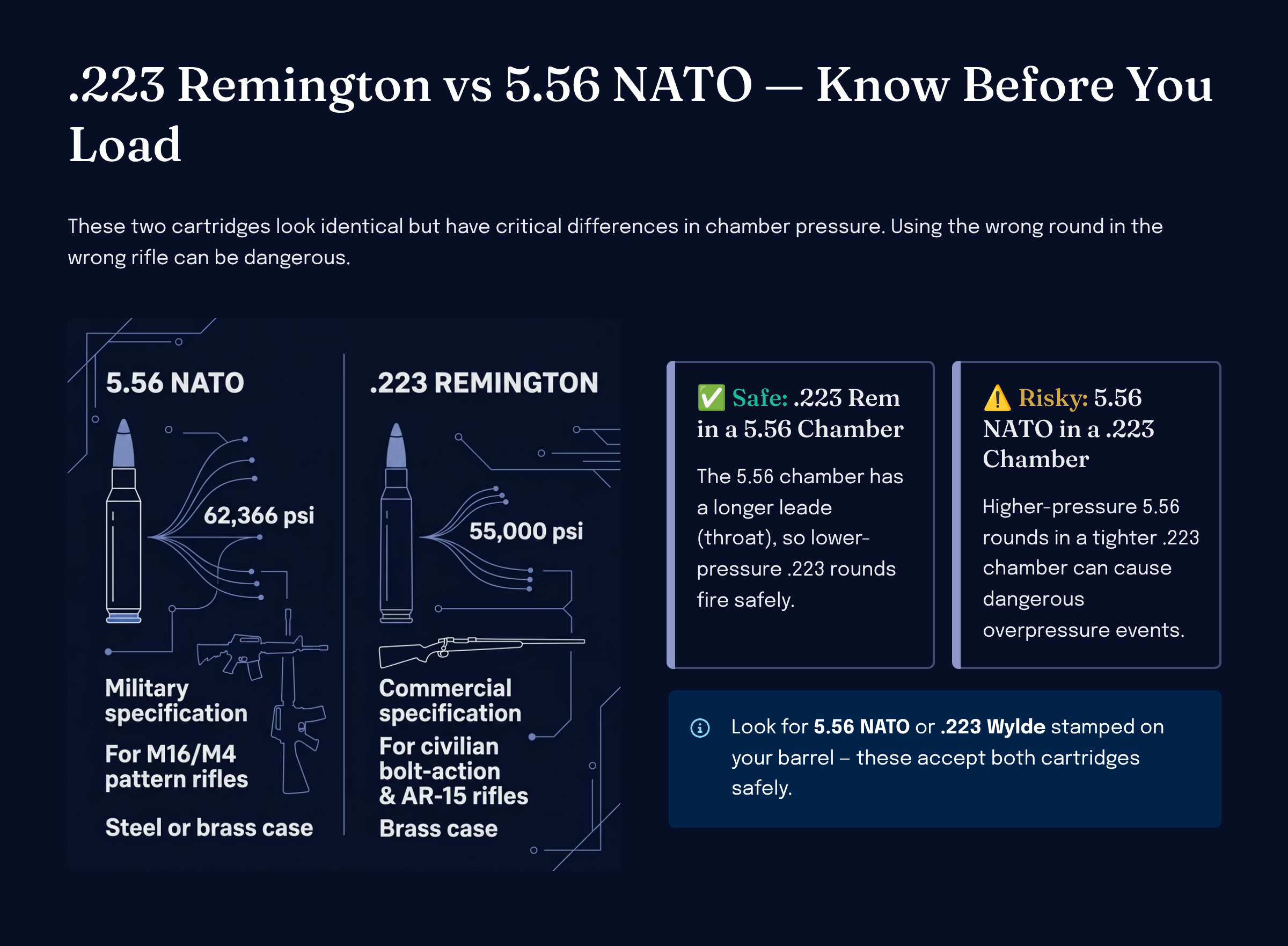
.223/5.56 Grain Weight Breakdown
Like 9mm, .223/5.56 comes in different bullet weights, and each suits a different purpose. The three you'll see most:
- 55 grain — the standard. The original and most common weight. Cheapest, most available, flat-shooting, and versatile. Ideal for range, plinking, and varmint work, and stabilizes in nearly any twist rate. The default for most shooting.
- 62 grain (M855 / green tip) — barrier penetration. The military ball weight, M855 features a steel penetrator tip (green-painted). Better at punching through barriers and holding energy at range. Common as bulk general-purpose ammo, but the steel core makes it a poor home-defense and some-range choice.
- 77 grain (match) — accuracy & distance. Heavy match bullets with high ballistic coefficients for the best long-range accuracy and wind resistance. The choice for precision, but they require a fast twist barrel to stabilize.
| Grain Weight | Type | Best For | Twist Needed |
|---|---|---|---|
| 55 gr | FMJ / V-MAX | Range, varmint, general | 1:9, 1:8, 1:7 |
| 62 gr | M855 / bonded SP | Barrier, defense (bonded) | 1:8, 1:7 |
| 75–77 gr | Match BTHP / SMK | Long range, precision | 1:8, 1:7 |
General guidance, 2026. Twist compatibility varies by exact bullet and barrel length; always confirm your rifle stabilizes a given load by checking groups on paper.
Barrel Twist Rate Matters
Your barrel's twist rate — how many inches the rifling takes to complete one full rotation — determines which bullet weights it can stabilize. Too slow a twist for a heavy bullet and your groups open up into "keyholes"; the right twist and a heavy match bullet flies true. Here's the cheat sheet:
- 1:7 twist — fast. Stabilizes the heaviest bullets (62–77gr+) best. Standard on military-spec rifles. Can be slightly aggressive on very light varmint bullets but handles everything practically.
- 1:8 twist — the versatile sweet spot. Stabilizes everything from 55gr up through 77gr match. If you're buying one barrel to do it all, 1:8 is the smart pick.
- 1:9 twist — older standard. Great with light-to-medium 55–62gr bullets but typically won't stabilize 75–77gr match loads reliably. Fine for range and varmint, limiting for long-range.
Shooting 55gr range and varmint ammo? Any twist works. Want to shoot 75–77gr match for long range? You need 1:8 or 1:7. Don't know your twist? Most modern AR-15s are 1:7 or 1:8 and will handle the heavy stuff — but check your barrel markings to be sure.
Putting It All Together
The AR-15's strength is flexibility, and feeding it well is simple once you know the rules: verify your chamber (5.56 or .223 Wylde runs both; .223 runs .223 only), buy 55gr brass FMJ for the range, controlled-expansion soft points for home defense, polymer-tipped V-MAX for varmints, and heavy 75–77gr match for long range if your twist supports it. Get those four boxes and your rifle is ready for anything.
Steel-case ammo is fine for cheap plinking in a quality rifle but trades some cleanliness and barrel life for the savings — keep brass for reliability-critical and match use. Whatever you choose, .223/5.56 prices swing widely between retailers and sales are frequent, so pick your load by job, then search live .223/5.56 prices before you buy.
Search Live .223/5.56 Prices
From bulk 55gr range ammo to premium 77gr match and bonded defensive loads, .223/5.56 prices vary a lot between retailers and go on sale often. Search live prices across every major store on Kilo Tango and set a free price-drop alert so you stock your AR-15 at the lowest cost.
Frequently Asked Questions
Can my AR-15 shoot both .223 and 5.56?
It depends on your chamber. A 5.56 NATO chamber safely fires both 5.56 and .223. A .223 Remington chamber should fire .223 only — 5.56 in a tight .223 chamber can create unsafe pressure. Many ARs use a .223 Wylde chamber designed to safely shoot both. Check your barrel markings: 5.56 or .223 Wylde means you can run both.
What's M855 green tip?
M855 is a 62gr 5.56 NATO load with a steel penetrator tip, marked by green paint. It's a military ball round developed for better barrier penetration at range. It's popular as affordable bulk ammo but isn't allowed at steel-core-prohibited ranges and over-penetrates, making it a poor home-defense choice. It is not armor-piercing "black tip" M995.
Is steel case bad for my AR?
Steel case isn't dangerous and runs fine in most ARs, but it doesn't extract as cleanly as brass and can increase fouling and wear over very high round counts, and some bimetal-jacket loads accelerate barrel wear and aren't range-legal. It's fine for cheap plinking in a quality rifle; for reliability-critical or match use, choose brass.
What grain .223 is best for an AR-15?
55gr is the standard, cheapest, versatile choice for range and general use and works in nearly any twist. 62gr (including M855) adds barrier penetration and likes 1:8/1:7 twists. 77gr match is best for accuracy and long range but needs a fast 1:8 or 1:7 twist. Match the weight to your barrel's twist rate.
What's the best .223/5.56 for home defense?
Use controlled-expansion soft points or bonded bullets that expand reliably and limit over-penetration — Hornady TAP, Speer Gold Dot 62gr, and Federal Fusion 62gr are top picks. Avoid plain FMJ and M855 green tip indoors, as they over-penetrate walls.