FMJ vs Hollow Point: What's the Difference?
Two bullet types account for almost everything you'll ever buy — full metal jacket and hollow point. They look similar in the box but behave completely differently on impact. Here's how each works, how they compare, and exactly when to use each.
Walk down any ammo aisle and you'll see two letters over and over: FMJ and JHP. They're the two bullet types that account for nearly every round most shooters will ever buy — and they are built for completely different jobs. One is cheap practice ammo. The other is what you bet your life on. Confusing them is one of the most common — and consequential — mistakes new gun owners make.
The difference comes down to a single design choice: whether the bullet is built to expand when it hits something. That one factor changes how the round penetrates, how much energy it transfers, how safe it is to use indoors, how much it costs, and even whether it's legal where you live. This guide breaks it all down in plain English so you know exactly which to buy and when. When you're ready, search live ammo prices across every major retailer on Kilo Tango.
What Is FMJ (Full Metal Jacket)?
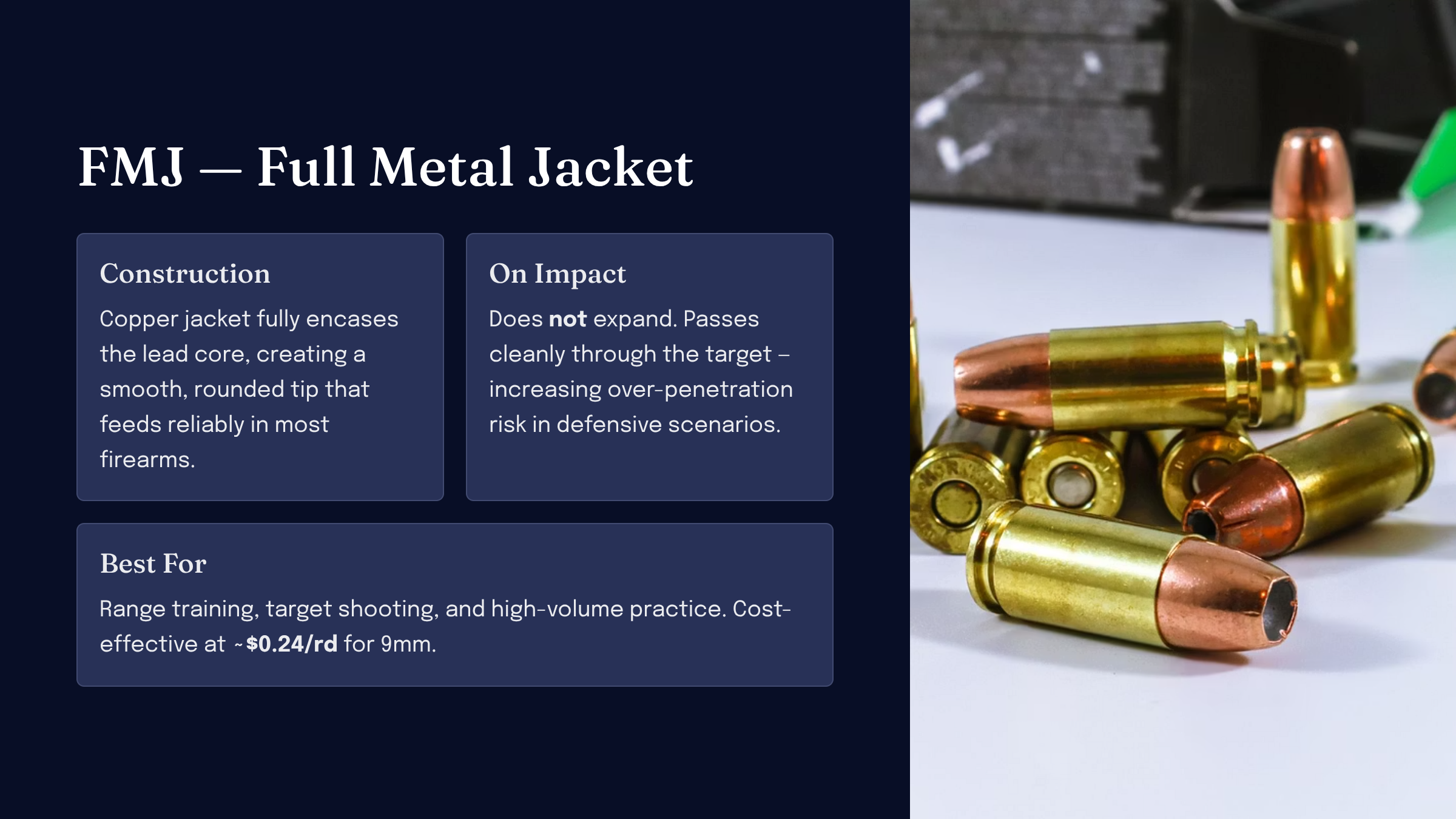
FMJ stands for Full Metal Jacket. It's a bullet with a soft lead core completely wrapped in a harder metal jacket — almost always copper. That jacket holds the bullet together and keeps the soft lead from fouling the barrel, which makes FMJ reliable, clean-feeding, and cheap to mass-produce.
The defining trait of FMJ is that it does not expand. When it hits a target, it stays roughly the same shape and diameter, punches a caliber-sized hole, and keeps going — often passing completely through. That "pass-through" behavior is exactly what makes FMJ great for the range (it feeds reliably and is inexpensive) and poor for defense (it doesn't transfer much energy and tends to over-penetrate). FMJ is the most common and affordable ammunition you can buy, which is why it dominates practice and training.
- Construction: lead core fully jacketed in copper
- On impact: does not expand; punches through
- Cost: cheapest — the practice standard
- Best for: range, target practice, training, competition, bulk buying
What Is JHP (Jacketed Hollow Point)?
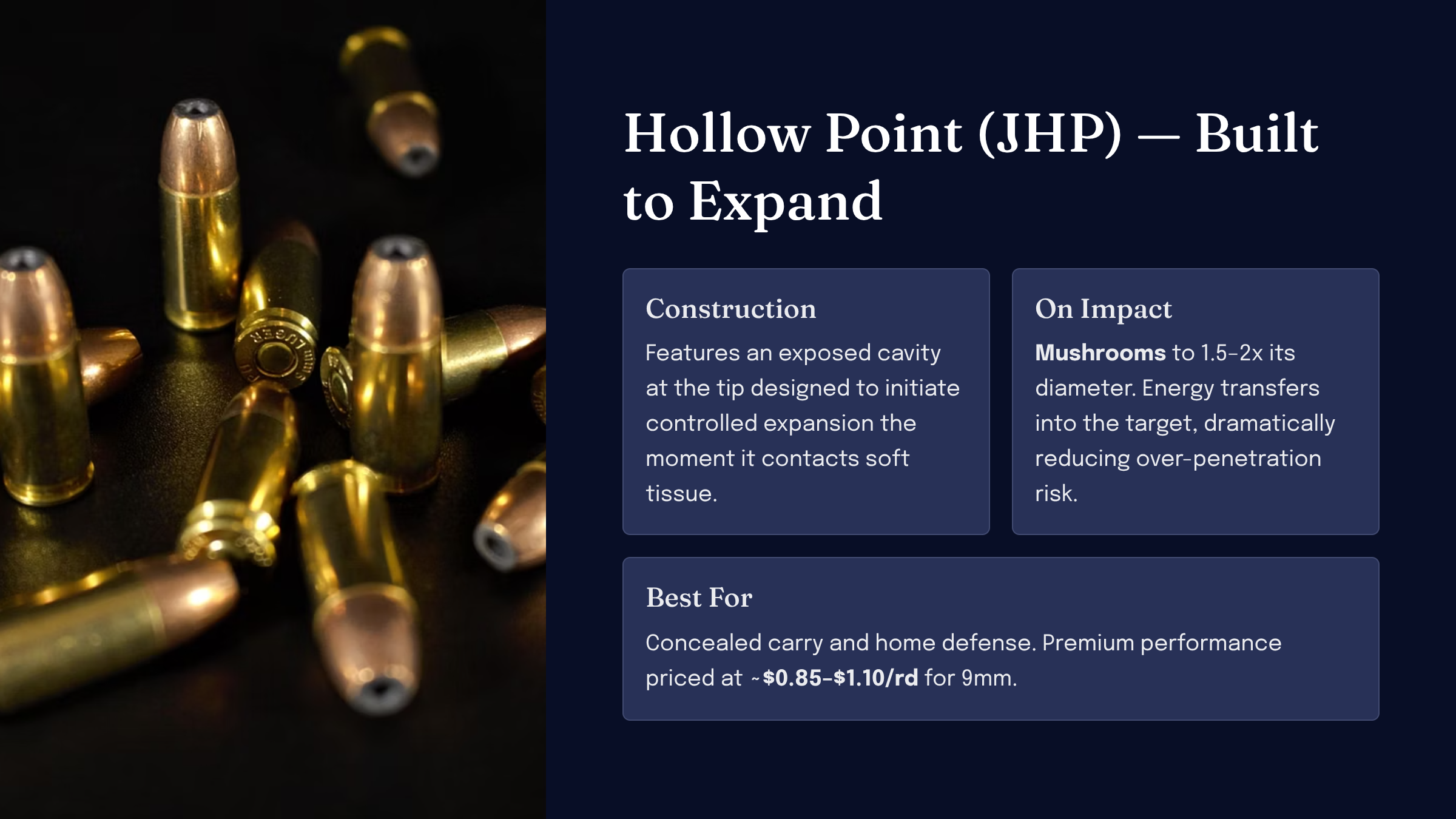
JHP stands for Jacketed Hollow Point. It's a jacketed bullet with one critical difference: a hollow cavity carved into the nose. That cavity is engineered so that when the bullet strikes a target, it mushrooms outward — peeling open into a wider, flatter shape, often 1.5 to 2 times its original diameter.
That expansion does two important things. First, it transfers energy efficiently, creating a larger wound channel and stopping a threat more effectively. Second, it slows the bullet down dramatically, so it's far more likely to stop inside the target rather than passing through and endangering whatever — or whoever — is behind it. This controlled expansion and reduced over-penetration is precisely why JHP is the universal choice for self defense, concealed carry, and home defense. It costs more than FMJ because of its more complex, precision-engineered construction.
- Construction: jacketed bullet with a hollow nose cavity
- On impact: expands/mushrooms, transfers energy, slows and stops in target
- Cost: more expensive — typically 2–4× FMJ
- Best for: self defense, home defense, concealed carry
FMJ vs Hollow Point: Direct Comparison
Here's how the two stack up across the factors that actually matter when you're choosing a box.
| Factor | FMJ (Full Metal Jacket) | JHP (Hollow Point) |
|---|---|---|
| Construction | Lead core, full copper jacket | Jacketed with hollow nose cavity |
| Expansion | None — stays intact | Mushrooms 1.5–2× diameter |
| Penetration | Deep — over-penetrates | Controlled — stops in target |
| Energy transfer | Lower | Higher |
| Cost | Cheapest | 2–4× more |
| Best use | Range & training | Self & home defense |
General head-to-head, 2026. Exact performance depends on caliber, load, and bullet design — premium defensive JHP is engineered to balance expansion and the 12–18" penetration the FBI considers ideal.
When to Use Each
Use FMJ for the range
For target practice, training, plinking, and competition, FMJ is the obvious choice. It's cheap enough to shoot in volume, feeds reliably, and its pass-through behavior is irrelevant against paper and steel. The skill that actually keeps you safe — accurate, fast, confident shooting — is built through repetition, and FMJ is what makes that repetition affordable. Buy it in bulk and shoot a lot of it.
Use JHP for defense
For self defense, home defense, and concealed carry, hollow point is the answer everywhere it's legal. Its expansion stops threats more effectively, and — critically — its reduced over-penetration makes it far safer to fire indoors, where an FMJ round could pass through a wall and strike a family member or neighbor. Load your carry gun and home-defense firearm with a proven premium JHP, and read our best 9mm self-defense ammo guide for specific recommendations.
FMJ doesn't expand, so it transfers energy poorly and over-penetrates — passing through a target and through interior walls. Indoors, that's a serious danger to others in the home. For defense, always choose hollow point where it's legal. Reserve FMJ for the range.
Train with inexpensive FMJ to build skill, then validate a matching-weight JHP defensive load with a 100–200 round reliability test before you trust it. Practice with FMJ, carry JHP, and re-verify periodically. You get the best of both: cheap volume and dependable defense.
Other Bullet Types to Know
FMJ and JHP cover the vast majority of shooting, but a few specialty types fill specific niches:
- Soft Point (SP): a jacketed bullet with exposed lead at the tip. It expands more slowly and modestly than a hollow point and penetrates deeper — popular for hunting medium and large game where deep penetration matters.
- Frangible: made of compressed metal powder designed to disintegrate into dust on hard surfaces. Used for steel-target training at close range and in environments where ricochet and over-penetration must be minimized.
- Wadcutter: a flat-faced bullet that cuts clean, round holes in paper for easy scoring. A precision target round, most common in revolver calibers and competition.
For a complete breakdown of every bullet type — including +P, TMJ, and specialty defensive designs — see our full Ammo Types Decoded guide.
Legal Considerations
FMJ is legal essentially everywhere in the United States, but hollow points carry restrictions in a few jurisdictions you must know before buying or carrying.
- New Jersey is the strictest. State law generally restricts civilian possession and transport of hollow-point ammunition to limited circumstances — such as keeping it at your home or property, or transporting it directly to and from a range or place of purchase. Carrying loaded JHP outside those exemptions can be a serious offense. Review the details on our New Jersey ammo laws page before buying.
- Most other states allow both FMJ and hollow points freely, though a few (like Massachusetts) regulate all ammunition purchases through licensing and dealer requirements.
Because these rules change and vary locally, always confirm current law for your exact location. Start with Kilo Tango's State Laws guide, which breaks down ammunition rules state by state.
If you live in or travel through a restrictive state, verify the law before ordering hollow points online — shipping JHP into a jurisdiction that restricts it can create legal problems even if you never carry it.
The Simple Rule
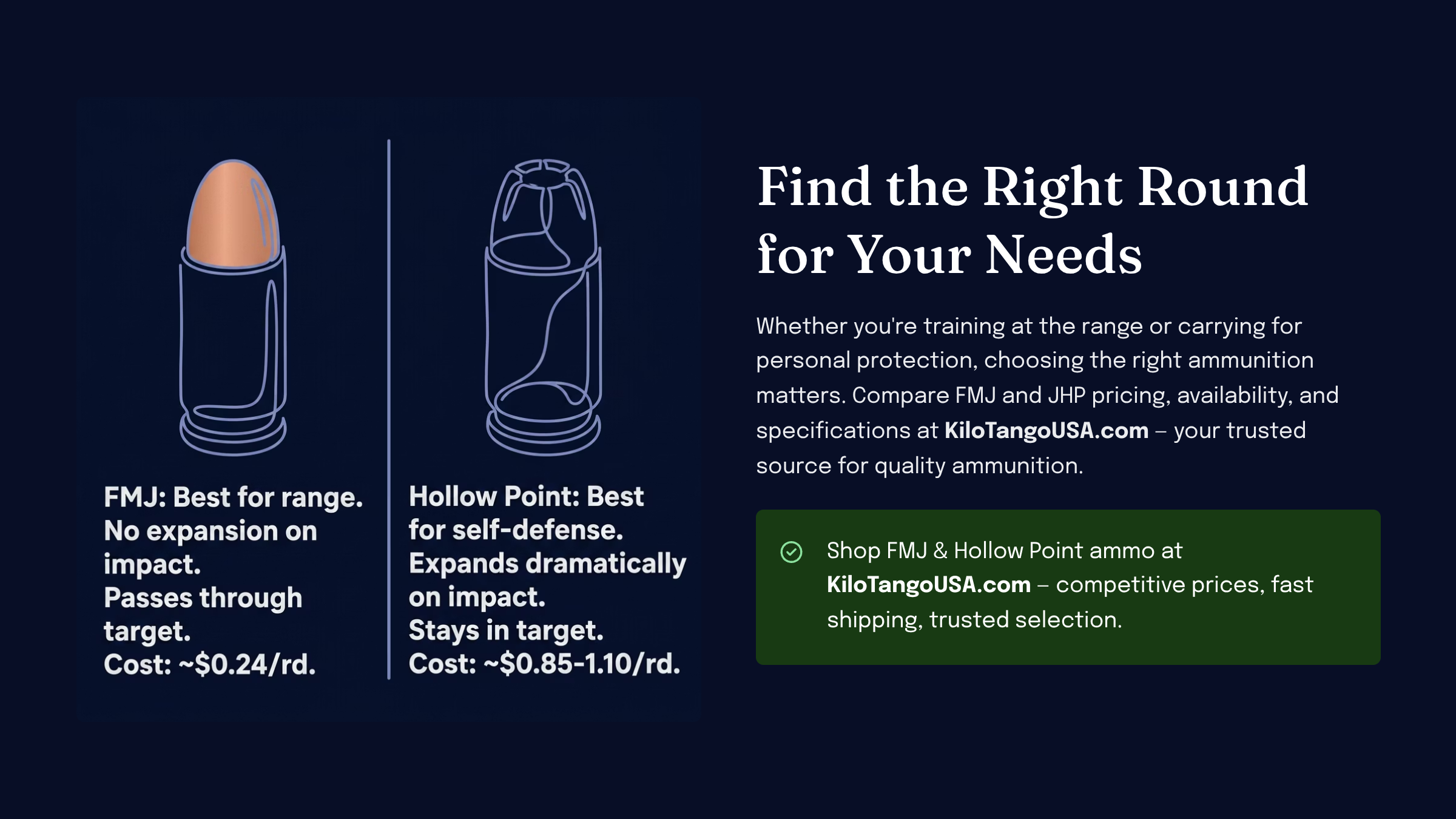
If you remember nothing else: FMJ is for the range, hollow point is for defense. Full metal jacket is cheap, reliable practice ammo that punches through. Jacketed hollow point is premium defensive ammo that expands to stop threats effectively while reducing dangerous over-penetration. Train with the first, carry the second, and check your state's hollow-point laws before you buy.
Both types swing widely in price between retailers, and defensive JHP especially goes on sale more often than people expect. Decide which you need for the job, then search live prices across every major store before you buy.
Search Live Ammo Prices
Whether you're stocking up on bulk FMJ for the range or premium hollow points for carry, prices vary a lot between retailers and go on sale often. Search live prices across every major store on Kilo Tango and set a free price-drop alert so you buy at the lowest cost.
Frequently Asked Questions
Is hollow point ammo more expensive?
Yes. Jacketed hollow point defensive ammo typically costs two to four times as much per round as FMJ range ammo because of its more complex, precision-engineered construction. That's why most shooters train with cheap FMJ and reserve premium JHP for carry and home defense.
Can I use FMJ for home defense?
You can, but it isn't recommended. FMJ doesn't expand, so it transfers energy poorly and tends to over-penetrate through targets and interior walls, endangering others in the home. Hollow point is strongly preferred for home defense. Use FMJ only if hollow points are legally restricted where you live.
Are hollow points legal?
Hollow points are legal in nearly all U.S. states. New Jersey is the notable restriction, generally limiting civilian possession and transport to specific circumstances. A few states have permit or dealer requirements. Always verify your state and local laws — start with our State Laws guide and New Jersey page.
What does FMJ mean?
FMJ means Full Metal Jacket — a soft lead core fully wrapped in a harder metal jacket, usually copper. The jacket keeps the bullet intact so it doesn't expand, punching a caliber-sized hole and continuing through. It's the cheapest, most common ammo and ideal for range practice.
What does JHP mean?
JHP means Jacketed Hollow Point — a jacketed bullet with a hollow nose cavity that mushrooms on impact, transferring energy efficiently and slowing the bullet so it stops inside the target instead of over-penetrating. This makes JHP the preferred choice for self defense and concealed carry.