9mm Grain Weight Guide: 115gr vs 124gr vs 147gr
Every box of 9mm lists a grain weight — and it changes how the round shoots, recoils, sounds, and costs. Here's exactly what 115gr, 124gr, and 147gr mean, and which to buy for the range, for carry, and for a suppressor.
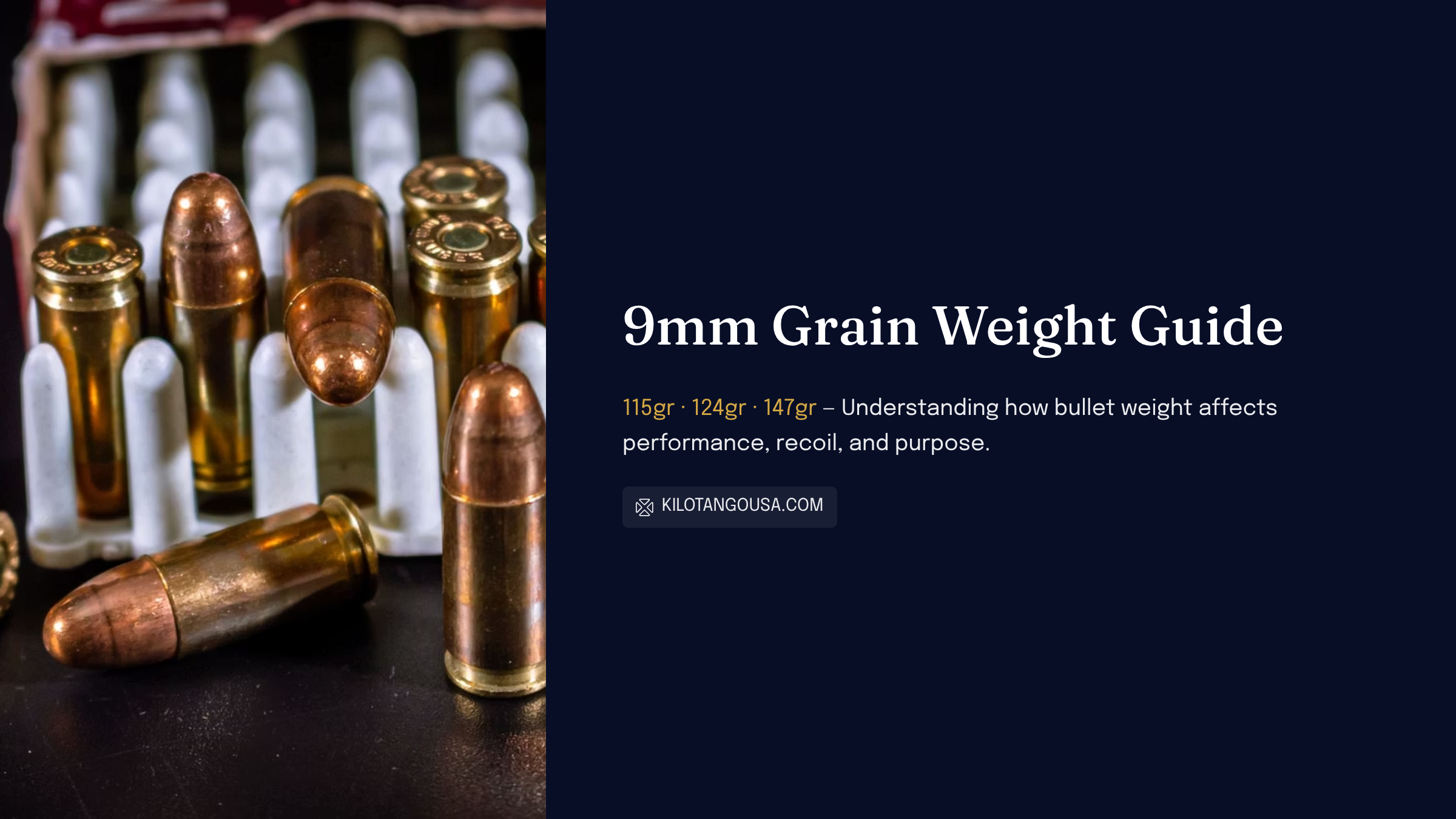
Pick up two boxes of 9mm from the same shelf and you'll see the same caliber — 9mm Luger — but different numbers stamped on the front: 115gr, 124gr, or 147gr. Those numbers are the single most confusing thing about buying 9mm, and there's almost no authoritative, plain-English explanation of what they actually mean for the average shooter. This guide fixes that.
Grain weight is the weight of the bullet, and it quietly controls how your 9mm feels in the hand, how fast it flies, how loud it is, how it behaves through a suppressor, and how much it costs per round. Choose the right weight and your range days get cheaper and your carry gun gets more controllable. Choose wrong and you're overpaying, fighting unnecessary recoil, or carrying a load that isn't ideal for the job. By the end of this guide you'll know exactly which 9mm grain weight to buy for the range, for self defense, and for a suppressor — and you'll be able to search live 9mm prices by grain weight with confidence.
What "Grain" Actually Means
A grain (abbreviated "gr") is a unit of weight, and on an ammo box it refers to the weight of the bullet itself — the metal projectile that leaves the barrel. It does not describe the powder charge, the case, or the number of bullets in the box. One grain equals 1/7,000th of a pound, a tiny unit borrowed from the old apothecary system that the ammunition world never let go of.
So a 115gr bullet weighs 115/7,000ths of a pound — about 7.45 grams — and a 147gr bullet weighs roughly 9.5 grams. That's the entire mystery: the number is just how heavy the chunk of lead and copper is. Everything else — velocity, recoil, sound, point of impact — flows from that one figure plus how much powder the manufacturer loads behind it.
Grain weight is not the amount of gunpowder in the cartridge. It's the weight of the bullet only. A "147gr" round does not have more powder than a "115gr" round — it usually has less, because a heavier bullet needs less push to stay within safe pressure.
For 9mm Luger, the three weights that dominate every store shelf are 115 grain, 124 grain, and 147 grain. You'll occasionally see oddballs like 100gr, 135gr, or even 65gr exotic defensive loads, but 99% of the 9mm you'll ever buy is one of those three. Let's break down each.
115 Grain: The Range Favorite
115gr is the lightest common 9mm weight and, by volume, the most produced. Because the bullet is light, manufacturers can drive it fast — typically around 1,150–1,180 fps at the muzzle — and it's almost always the cheapest 9mm you can buy, which makes it the default for high-volume range and target practice.
The trade-off is felt recoil. Lighter, faster bullets produce a sharper, snappier "crack" of recoil rather than a slower push. Many shooters barely notice, but on long range sessions a snappier impulse can be more fatiguing and can slow down precise follow-up shots compared to heavier loads. For new shooters learning the fundamentals, that's a minor concern next to the savings — 115gr FMJ is what you should be feeding your gun for practice.
- Best for: range, target practice, plinking, high-volume training, new shooters on a budget
- Velocity: ~1,150–1,180 fps (supersonic)
- Recoil feel: snappy, sharp
- Price: cheapest of the three — the go-to for bulk buying
124 Grain: The Balanced Standard
124gr is the original and arguably "true" weight of the 9mm cartridge, and it's the NATO military standard — the famous 124gr +P "NATO" load (designated M882) is what the U.S. and allied forces issue. That heritage isn't an accident: 124gr sits in the sweet spot between the speed of 115gr and the mass of 147gr.
Velocity runs around 1,100–1,150 fps in standard pressure, and the recoil impulse is widely described as a more rounded "push" than the snap of 115gr — many shooters find 124gr the most controllable and pleasant to shoot accurately. It's an excellent all-rounder: ideal for range practice that mimics your carry load, outstanding in jacketed hollow point form for self defense, and the weight most defensive ammo (Federal HST, Speer Gold Dot, Winchester Defender) is optimized around.
- Best for: everything — range, carry, training that matches your defensive load
- Velocity: ~1,100–1,150 fps standard, faster in +P (supersonic)
- Recoil feel: balanced, a smooth push
- Price: slightly more than 115gr; widely available
The NATO 9mm spec is a higher-pressure 124gr load that produces more velocity and energy than standard 124gr. It's perfectly safe in any modern, quality 9mm pistol rated for +P, but it recoils more and is louder. If you want a hotter range or duty load that mirrors military ball ammo, that's the box to look for.
147 Grain: Heavy, Quiet, Suppressor-Friendly
147gr is the heaviest standard 9mm weight, and it behaves very differently from the lighter two. Because the bullet is heavy, it's loaded to stay subsonic — usually around 950–990 fps, below the roughly 1,125 fps speed of sound. That single fact drives everything that makes 147gr special.
First, recoil is a slow, soft push rather than a snap — many recoil-sensitive shooters strongly prefer it, and it's excellent for fast, flat shooting in competition. Second, and most importantly, because it never breaks the sound barrier, 147gr produces no supersonic "crack." That makes it dramatically quieter through a suppressor, where supersonic rounds otherwise generate a loud downrange snap no can can eliminate. If you shoot suppressed, 147gr subsonic is the default choice. It's typically a touch more expensive than 115gr but the difference is small.
- Best for: suppressed shooting, recoil-sensitive shooters, competition, defensive carry (in JHP)
- Velocity: ~950–990 fps (subsonic)
- Recoil feel: soft, slow push — the mildest of the three
- Price: usually slightly above 115gr
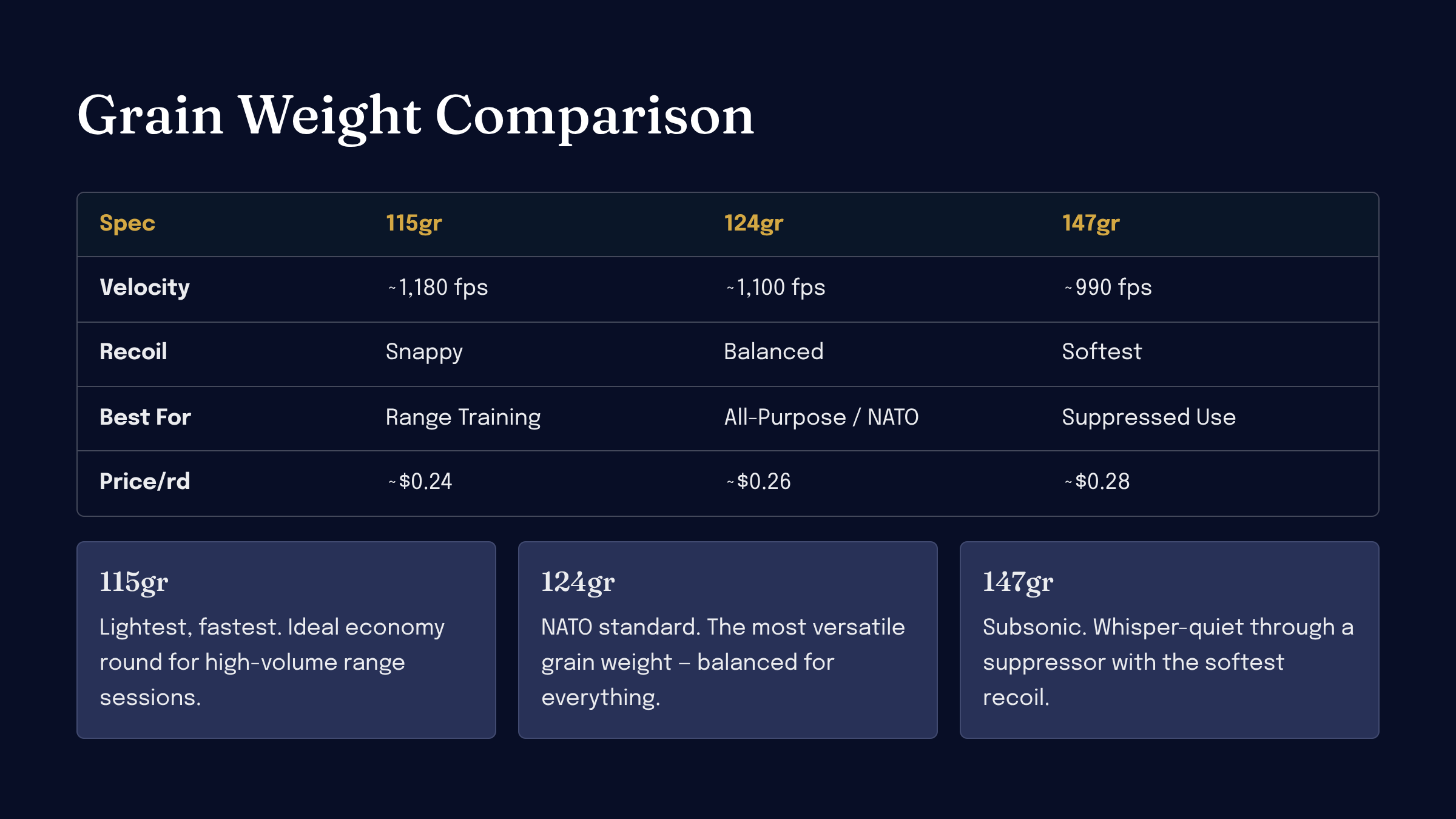
9mm Grain Weight Comparison Table
A quick-reference comparison of the three dominant 9mm weights. Velocity figures are typical standard-pressure values from a full-size barrel and vary by load and manufacturer; prices reflect representative per-round range/FMJ cost in 2026 — always search live 9mm prices before buying, since sales move more than the weight premium.
| Grain Weight | Typical Velocity | Recoil Feel | Best Use Case | Price Range |
|---|---|---|---|---|
| 115 gr | ~1,150–1,180 fps | Snappy / sharp | Range & target | $ — cheapest |
| 124 gr | ~1,100–1,150 fps | Balanced push | All-around / carry | $$ — moderate |
| 147 gr | ~950–990 fps (subsonic) | Soft, slow push | Suppressed / low recoil | $$ — moderate |
Representative figures, 2026. Velocity depends on barrel length and load; recoil feel is subjective; prices vary by retailer and quantity. Verify performance and zero in your own firearm.
Which 9mm Grain Weight Should You Buy?
Forget the idea of one "best" weight — the right answer depends entirely on what you're doing. Here's the straight guidance for the three jobs almost everyone is buying for.
For Range & Target — 115gr FMJ
Cheapest, most plentiful, and plenty accurate for practice. If you're punching paper, plinking steel, or building fundamentals, buy 115gr full metal jacket in bulk and don't overthink it. The snappier recoil is a non-issue for most and the savings add up fast over thousands of rounds. This is the single most-bought 9mm load in America for good reason.
115gr FMJ · lowest cost/round · buy in bulkFor Self Defense — 124gr or 147gr JHP
For carry and home defense, choose a premium jacketed hollow point in 124gr or 147gr — not 115gr. Heavier bullets retain energy and penetrate barriers more consistently, and the best defensive loads are engineered around these weights to meet FBI penetration standards. 124gr is the balanced default; 147gr adds the softest recoil and runs quietest suppressed. Read our best 9mm self-defense ammo guide for specific load picks.
124gr / 147gr JHP · proven defensive designsFor Suppressed Shooting — 147gr Subsonic
If you run a suppressor, 147gr subsonic is the clear pick. Because it never breaks the sound barrier, there's no supersonic crack downrange — just the soft mechanical action of the gun and the muffled report. Pair it with a quality can and you get genuinely hearing-safe, backyard-quiet shooting. Confirm the box says "subsonic" or shows velocity under ~1,050 fps.
147gr subsonic · quietest suppressed option115gr FMJ (full metal jacket) is range ammo — it doesn't expand and tends to over-penetrate, which is dangerous indoors. For defense, always use a quality hollow point, ideally in 124gr or 147gr. See Ammo Types Decoded for the full FMJ-vs-JHP breakdown.
Accuracy, Point of Impact & Mixing Weights
Two practical questions come up constantly once shooters understand the basics. First: does grain weight change accuracy? Not inherently — no weight is "more accurate" on paper. But every individual barrel tends to shoot one weight a little tighter than the others, and 147gr's subsonic flight is favored by some precision shooters because the bullet never transitions back through the speed of sound. The bigger real-world effect is point of impact: switching from 115gr to 147gr can move your group several inches at 25 yards from the very same pistol, because the heavier bullet spends marginally longer in the barrel. Always re-confirm your zero when you change weights — especially for a carry gun.
Second: can you mix grain weights? Yes. Any SAAMI-spec 9mm Luger load is safe in any modern 9mm pistol regardless of weight, and you can mix freely at the range. The only cautions: different weights shift your impact and recoil feel, and very light 115gr can occasionally short-cycle heavily sprung or compensated guns. For defensive carry, don't mix weights in a magazine — pick one proven load and run it exclusively. For more on caliber and load compatibility, see our Glock 19 ammo guide.
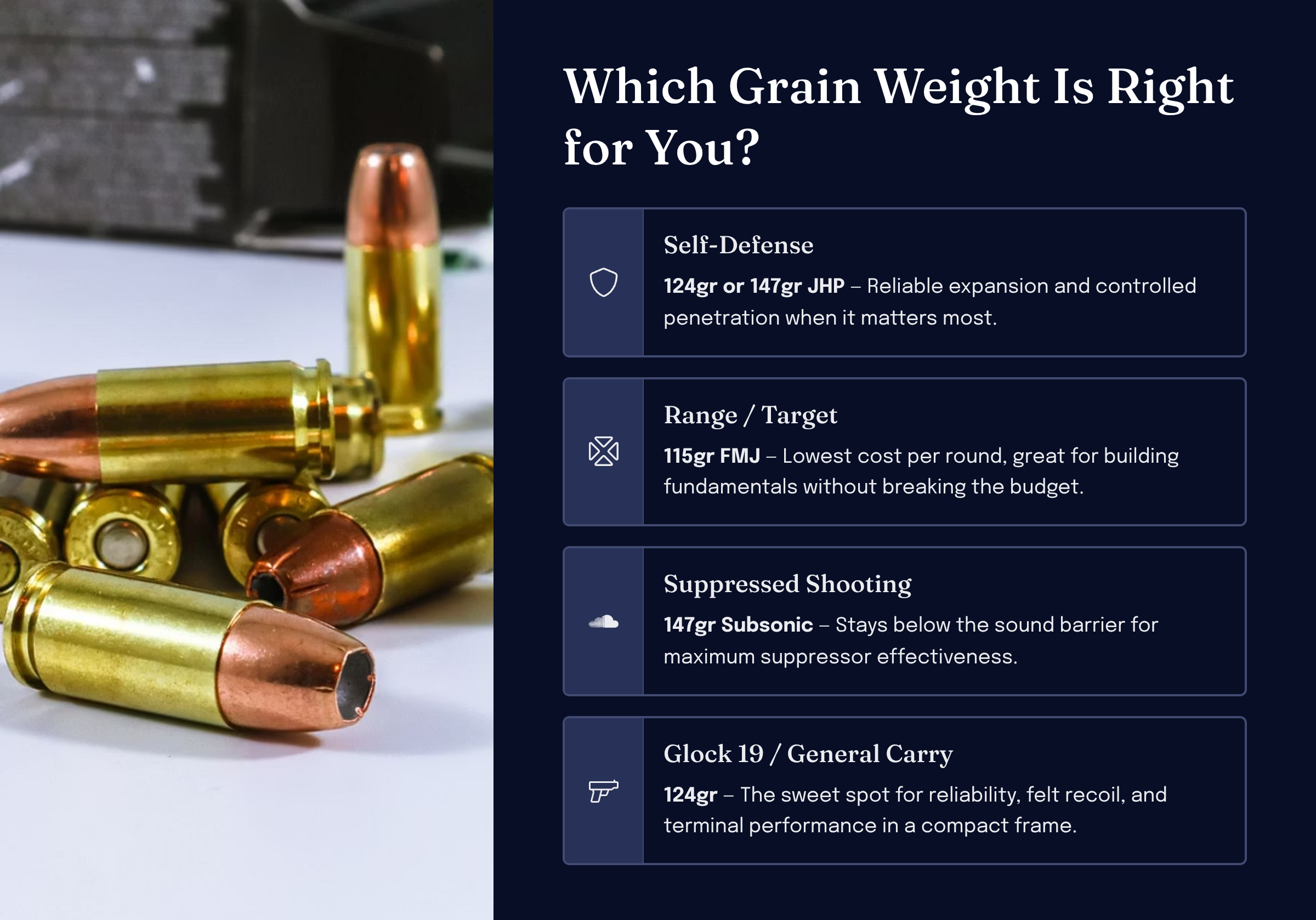
The Simple Rule
If you remember nothing else: train with 115gr FMJ, carry 124gr or 147gr JHP, and run 147gr subsonic if you're suppressed. That covers the vast majority of shooters perfectly. 124gr is the safe "do everything" answer if you want a single weight to practice and carry with, and 147gr is the choice when soft recoil and quiet suppressed shooting matter most.
Grain weight isn't something to agonize over — it's a tool for matching the round to the job. Now that you understand what those numbers on the box actually mean, you can shop by weight on purpose instead of by accident, and let price be your tiebreaker. Premium and bulk 9mm both swing widely between retailers, so the smartest move is to pick your weight, then search live prices across every major store before you buy.
Compare 9mm Prices by Grain Weight
Whether you want bulk 115gr for the range, balanced 124gr for everyday carry, or 147gr subsonic for your suppressor, prices swing widely between retailers and go on sale often. Search live 9mm prices across every major store on Kilo Tango and set a free price-drop alert so you stock up at the lowest cost.
Frequently Asked Questions
Does grain weight affect accuracy?
Not inherently, but each barrel tends to shoot one weight a little tighter, and 147gr's subsonic flight is favored by some precision shooters. The bigger practical effect is point of impact — 115gr and 147gr can hit several inches apart at 25 yards from the same gun — so always re-confirm your zero when you change weights.
Can I mix grain weights?
Yes. Any SAAMI-spec 9mm Luger load is safe in any modern 9mm pistol regardless of weight, and you can mix freely at the range. Just know that weights shift your impact and recoil, and very light 115gr can occasionally short-cycle heavily sprung guns. For carry, don't mix weights in a magazine — run one proven load.
What grain does the military use?
The NATO and U.S. standard 9mm load is 124-grain FMJ (M882), typically a higher-pressure 124gr +P "NATO" load. That's why 124gr is considered the cartridge's original weight. Many duty loads now use 124gr or 147gr jacketed hollow points instead of ball ammo.
What grain weight for a Glock 19?
A Glock 19 runs every common weight reliably. Use 115gr FMJ for cheap range practice, 124gr or 147gr JHP for carry, and 147gr subsonic if you shoot suppressed. See our Glock 19 ammo guide for specific load recommendations.
Is 115gr or 147gr better for self defense?
124gr and 147gr jacketed hollow points are preferred over 115gr for defense, because heavier bullets penetrate barriers more consistently and modern designs meet FBI standards. Reserve 115gr for inexpensive range practice. Bullet construction matters more than weight — choose a proven premium hollow point.