Best 12 Gauge Shotgun Ammo for Home Defense, Hunting & Target (2026)
The 12 gauge is the most versatile firearm in America — but only if you feed it the right shell. Birdshot, buckshot and slugs each do a completely different job. Here are the best 12ga loads for home defense, hunting and the clay range, plus the shot-size knowledge to choose with confidence.
No other firearm in America does as many different jobs as the 12 gauge shotgun. The very same pump or semi-auto sitting in the closet can defend a home at 3 a.m., drop a duck over a marsh at first light, and break a hundred clays on a Sunday afternoon — but it can only do those things if you load the right shell. Unlike a rifle or pistol, where one box of ammo more or less covers the gun's whole range of uses, a shotgun's entire personality changes with the shell you chamber. The hull looks nearly identical from the outside; what's inside is everything.
That's the catch that trips up most new shotgun owners. Grab a value pack of birdshot off the shelf for "home defense," and you've got a marginal defensive tool. Try to shoot trap with 00 buckshot, and you'll miss every bird and get thrown off the line. The shotgun rewards the owner who understands the difference between birdshot, buckshot and slugs — and who matches the load to the task. This guide ranks the best 12ga loads for home defense, hunting and the clay range, then arms you with the shot-size knowledge to choose with confidence. When you're ready to stock up, search live 12ga prices across every major retailer on Kilo Tango.
Shotgun Ammo Types: Birdshot, Buckshot & Slugs
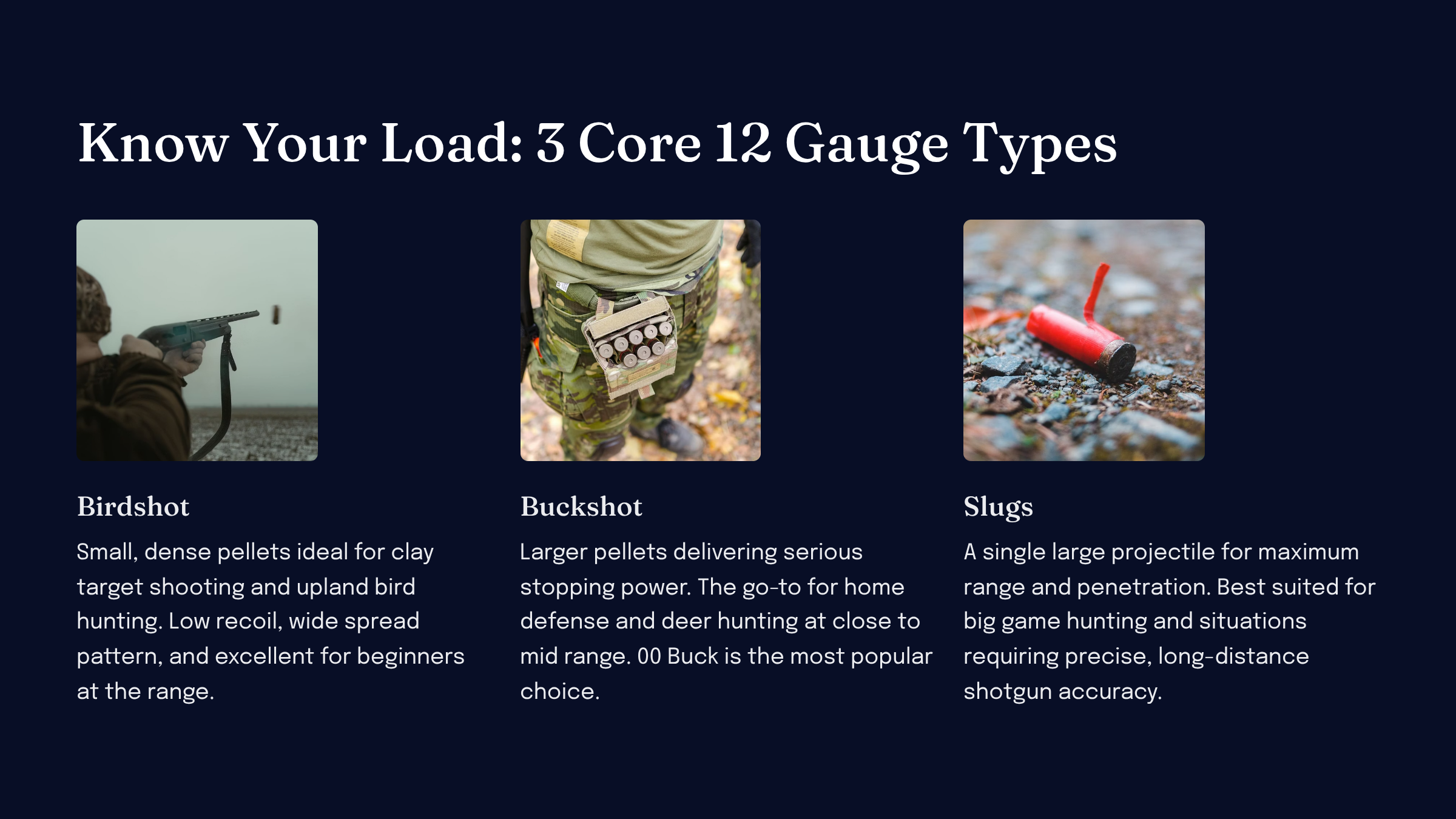
Every 12ga shell falls into one of three families, and the difference comes down to how the payload is divided. As you move from birdshot to buckshot to slugs, the projectiles get larger and fewer — from a cloud of tiny pellets, to a handful of big lead balls, to a single heavy slug. Understanding these three is the foundation of every load choice you'll ever make.
- Birdshot — many tiny pellets (dozens to hundreds), measured by number like #7.5 or #8. Built for birds, clays and small game, where a wide spreading pattern is the whole point. Birdshot has poor barrier penetration and limited stopping power on larger threats, so it's generally not ideal for self-defense — at best a close-range last resort when nothing else is on hand.
- Buckshot — fewer, much larger pellets. The most popular size, 00 ("double-aught") buck, fires roughly 8–9 lead balls about .33" in diameter — each one near pistol-bullet size. This is the gold standard for home defense and for big game at close range, delivering multiple hard-hitting projectiles with a single trigger pull.
- Slugs — a single large projectile, essentially turning the shotgun into a short-range rifle. Slugs offer rifle-like range and deep penetration for big game and maximum stopping power, but that same penetration means real over-penetration risk indoors. They demand precise aim — there's no pattern to forgive a miss.
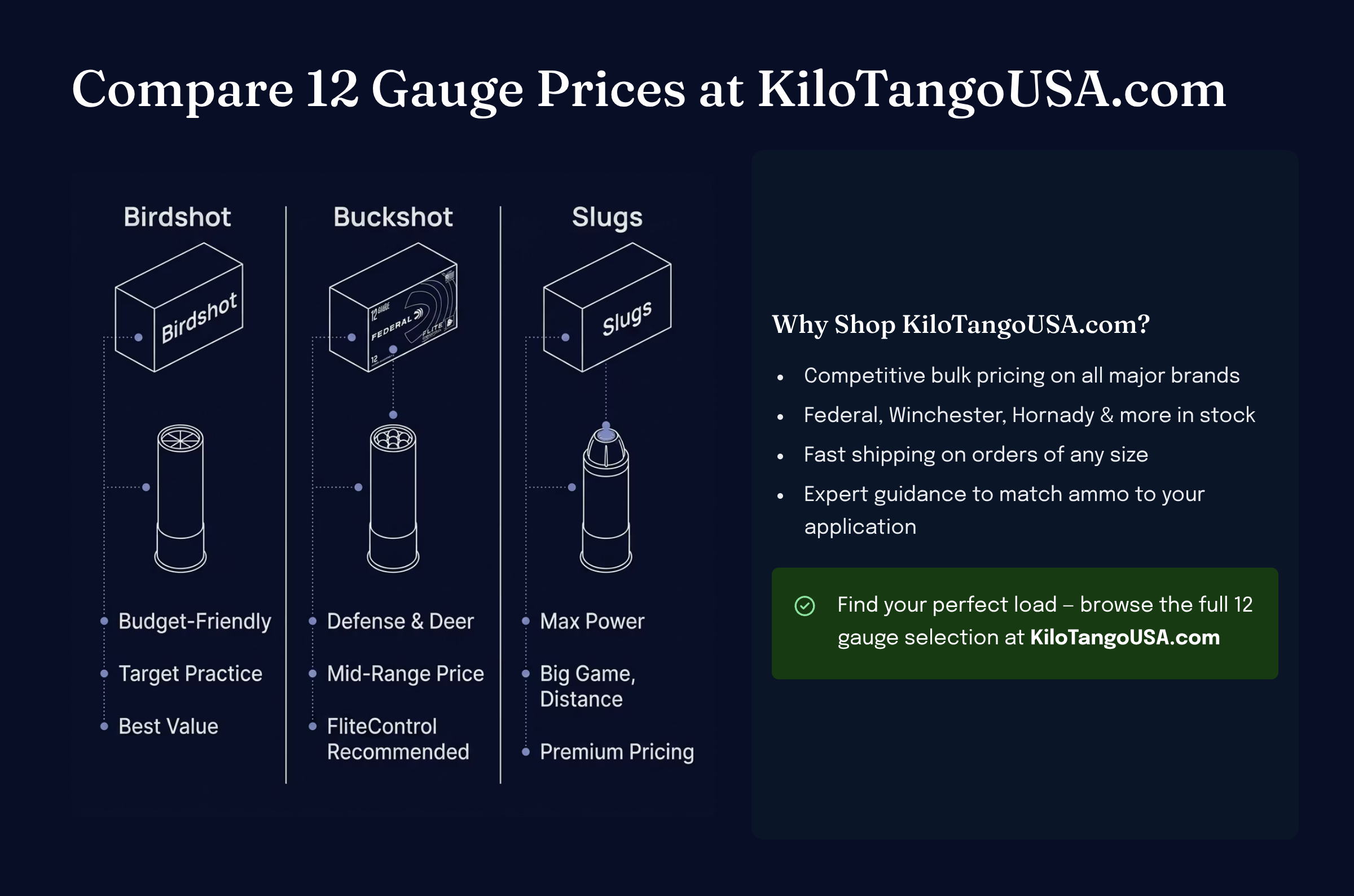
As you move bird → buck → slug, the pellets get bigger and fewer. Birdshot is a cloud of tiny pellets for birds and clays; buckshot is a handful of large balls for defense and big game up close; a slug is one solid projectile for maximum range and penetration. Pick the family first, then the specific load.
Best 12ga Ammo for Home Defense
Home defense is where shotgun ammo choice matters most — and where the wrong shell can either fail to stop a threat or sail through walls into the next room. For the overwhelming majority of defensive situations, the answer is a tight-patterning 00 buckshot load. Multiple large pellets dramatically raise hit probability at across-the-room distances, while a modern patterning wad keeps those pellets together so every one of them stays on target.
Federal Premium FliteControl 00 Buck (LE133/LE132)
The benchmark defensive buckshot, and what the pros run. The patented FliteControl wad stays attached to the pellet column longer before peeling away, keeping the 8–9 pellet pattern remarkably tight — often fist-sized at 15 yards. That tight pattern maximizes hits on the threat while minimizing stray pellets that could endanger others. If you buy one defensive load, buy this.
9-pellet 00 buck · tight FliteControl pattern · TOP PICKHornady Critical Defense 00 Buck
An excellent alternative built around 8 pellets of 00 buck and Hornady's Versatite wad, which works on the same principle as FliteControl to deliver tight, consistent patterns. It's tuned for reduced recoil and reliable feeding, making it a dependable and controllable defensive performer for the home.
8-pellet 00 buck · tight pattern · low recoilFederal Tactical Slugs (TruBall / LE Rifled Slug)
When maximum penetration is the priority — a larger threat, a longer hallway, or a situation where buckshot may not be enough — a quality slug delivers a single hard-hitting projectile. Federal's TruBall system seats the slug precisely for excellent accuracy out of a smoothbore barrel. Treat this as a specialized tool, not a default.
1oz rifled slug · max penetrationOne detail worth seeking out: reduced-recoil 00 buck. Standard buckshot kicks hard, and recoil slows follow-up shots and degrades accuracy under stress. Reduced-recoil loads (sold by Federal, Hornady and others) ease the kick noticeably while still patterning tightly and hitting plenty hard at in-home distances — a smart choice for most defenders, especially smaller-framed shooters.
Both buckshot and slugs will punch through interior drywall and keep going. Pattern your gun on paper to see exactly where the pellets land, know what's behind your target, and strongly consider reduced-recoil 00 buck for better control. If recoil or over-penetration is a concern, a 20 gauge (covered below) is a capable lower-recoil alternative.
Best 12ga Ammo for Hunting
Hunting is where the shotgun's shell-swapping versatility really shines: the same gun handles turkeys, predators and waterfowl simply by changing the load. The rule is to match the shot size and shell to the game you're after — and to know the law, because non-toxic shot is mandatory for waterfowl.
Federal Premium Turkey Loads (3rd Degree / Grand Slam)
Turkey hunting demands a dense, hard-hitting pattern that puts enough pellets into a gobbler's head and neck at range. Federal's premium turkey loads — the layered 3rd Degree and the buffered Grand Slam — are built for exactly that, delivering tight, lethal patterns that make the most of every shot opportunity.
turkey · dense patternWinchester Super-X #4 Buck
A versatile larger-game load. #4 buckshot is an excellent choice for predators like coyotes and, where it's legal, for close-range deer. It throws more pellets than 00 buck while still hitting hard enough for the job, splitting the difference between buckshot reach and pattern density.
#4 buck · predator / deerBirdshot for Waterfowl & Upland
For wingshooting, birdshot rules — but the material matters. Waterfowl require non-toxic shot by federal law, so reach for steel in #2–#4 for ducks and geese. For upland birds like pheasant and dove, lead #6–#7.5 is the classic choice where it's legal. Match the pellet size to the bird.
steel/lead birdshot · waterfowl & uplandTwo things govern hunting loads above all else: the law and the game. Federal regulations require non-toxic shot (steel, bismuth or tungsten) for all waterfowl hunting — lead is prohibited — and many states extend non-toxic requirements to other game and public lands, so always check local rules. Beyond legality, simply match shot size to your quarry: small shot for small, fast birds; larger buckshot for predators and deer-sized game where permitted.
Best 12ga Ammo for Target & Clay
Target and clay loads are the high-volume, low-cost end of the shotgun world. These are light birdshot shells built for breaking clays at trap, skeet and sporting clays — and because you'll burn through them by the case, value and consistency matter as much as raw performance.
Federal Top Gun 7.5 Shot
The everyman's clay load. Top Gun is affordable, clean-burning and reliable, with consistent patterns that break birds without breaking your budget. It's the go-to value choice for a casual day at the range or a high-volume practice session.
#7.5 · value claysWinchester AA
The premium target standard against which others are measured. AA delivers exceptionally consistent patterns and clean ignition, and its tough hulls are prized by reloaders for multiple loadings. When you want the most reliable break on a hard target presentation, AA earns its reputation.
#7.5/#8 · premium targetRemington STS / Gun Club
Two loads for two needs. Premier STS offers competition-grade consistency and superb reloadable hulls for serious clay shooters, while Gun Club provides budget-friendly volume for everyday practice. Together they cover the spectrum from the registered-shoot line to the casual range bag.
#7.5/#8 · competition / volumeFor clays, the small shot sizes — #7.5, #8 and #9 — dominate, since you want a dense, wide pattern of tiny pellets to catch a fast-moving target. Trap and sporting clays favor #7.5 and #8; skeet, shot at closer range, often runs #8 or #9. Target loads are also simply the cheapest way to shoot a 12 gauge a lot, which makes them perfect for building skill. If you plan to shoot often, buying by the case saves real money — see our bulk buying guide, and watch retailers like Lucky Gunner and Sportsman's Guide for case-quantity deals on target shells.
Shotgun Shot Size Chart
Shotgun shot sizing confuses nearly everyone at first, because the numbering runs backwards. A smaller number means a bigger pellet, not a smaller one. The scale starts at tiny #9 shot (used for close clays), climbs through the birdshot sizes as the pellets grow and the numbers shrink, crosses into the much larger buckshot sizes, and finally arrives at the single-projectile slug. Once that "smaller number = bigger pellet" rule clicks, the whole chart makes sense.
- Birdshot (#9 down to BB) — runs from the smallest #9 pellets up through BB. Smaller numbers within this range mean larger pellets; lighter shot for clays and small birds, heavier shot for ducks and geese.
- Buckshot (#4 Buck through 000) — a separate, larger scale. #4 buck throws many medium pellets; 00 buck is the defense standard; 000 ("triple-aught") buck is the largest, with the most energy per pellet but the fewest of them.
- Slug — the end of the line: a single solid projectile for maximum range and penetration.
| Shot Size | Pellet | Best Use |
|---|---|---|
| #9 | Tiny | Skeet, close clays |
| #7.5 | Small | Trap, clays, dove |
| #6 | Small–medium | Upland, pheasant |
| #4 (birdshot) | Medium | Waterfowl (steel), rabbit |
| BB | Large birdshot | Geese, predators |
| #4 Buck | ~24 pellets | Predator, defense (more pellets) |
| #1 Buck | Large | Defense (max pellet count of buck) |
| 00 Buck | ~9 × .33" | Home defense standard |
| 000 Buck | Largest buck | Max per-pellet energy |
| Slug | Single projectile | Big game, max penetration |
General reference, 2026. Exact pellet counts and ideal uses vary by manufacturer, shell length and load; always confirm performance with your specific gun.
How a given shell actually patterns also depends on your choke — the constriction at the muzzle that shapes the spread. To match shot, choke and range for every load, see our shotgun choke guide.
12ga vs 20ga vs .410
The 12 gauge isn't the only game in town. The two most common alternatives — 20 gauge and .410 bore — trade payload and power for lower recoil, and each fills a real niche.
- 12 gauge — the most versatile and most powerful of the three, with the widest ammo selection on any shelf, from cheap clay loads to heavy slugs. The trade-off is more recoil. For a do-everything shotgun, it's the default.
- 20 gauge — noticeably lighter recoil and a lighter gun, which makes it a favorite for smaller-framed and recoil-sensitive shooters. It carries a slightly smaller payload than a 12, but a quality 20ga is a very capable home-defense and upland-hunting gun in its own right — an outstanding all-rounder.
- .410 bore — the lightest recoil and smallest payload of the group. It's fun, low-recoil and easy to shoot, but it carries the least margin for defense, demanding precise shot placement to be effective. Best thought of as a low-recoil novelty and small-game gun rather than a primary defensive tool.
The one-line recommendation: choose 12 gauge for maximum versatility, 20 gauge as the lower-recoil all-rounder, and .410 for recoil-sensitive shooters or novelty use.
Putting It All Together
The 12 gauge earns its title as America's most versatile firearm because one gun, fed the right shell, does it all. For home defense, load Federal FliteControl 00 buck — ideally a reduced-recoil version — and you have the best balance of stopping power and hit probability there is. For hunting, match the load to the game: turkey loads for gobblers, #4 buck for predators and close deer, and steel birdshot for waterfowl. For the clay range, Federal Top Gun or Winchester AA in #7.5 or #8 will break birds all day without breaking the bank.
Underpinning every one of those choices is the shot-size chart — remember that the numbers run backwards, and that the family (bird, buck, slug) matters before the exact size. Finally, no chart replaces patterning your own gun: every shotgun shoots a little differently, so confirm where your chosen load actually lands on paper. Once you've settled on a shell, search live 12ga prices across every major retailer on Kilo Tango before you buy.
Search Live 12 Gauge Prices
From defensive 00 buckshot and slugs to turkey loads, steel waterfowl shells and bulk clay ammo, 12 gauge prices swing widely between retailers and go on sale often. Search live prices across every major store on Kilo Tango and set a free price-drop alert so you stock your shotgun at the lowest cost.
Frequently Asked Questions
What shotgun ammo is best for home defense?
For most people, a quality 00 buckshot load with a tight-patterning wad — Federal FliteControl 00 Buck is the top pick — offers the best balance of stopping power and hit probability. Reduced-recoil 00 buck improves control. Slugs penetrate more (and over-penetrate more), and birdshot is generally a last resort. Always pattern your specific shotgun and know what's behind your target.
Buckshot vs slugs — which is better for defense?
Buckshot (00) is the standard home-defense choice: multiple pellets increase hit probability at typical in-home distances while patterning tight with a good load. Slugs deliver a single hard-hitting projectile with much greater range and penetration — better for larger threats or longer distances, but they over-penetrate walls and demand precise aim. For inside-the-home defense, 00 buck is usually the better tool.
What does "gauge" mean?
Gauge is an old measure of bore size based on how many lead balls of that bore diameter make one pound. So 12 balls the size of a 12-gauge bore weigh a pound; 20 smaller balls make a 20-gauge pound. Counterintuitively, a SMALLER gauge number means a LARGER bore — a 12 gauge is bigger than a 20 gauge. The .410 is the exception, named by its actual bore diameter in inches, not by gauge.