Steel Case vs Brass Ammo: Is Steel Case Bad for Your Gun?
Steel-case ammo can cost 30-40% less than brass — but does the savings come at the price of your gun's health? Here's the straight answer on what's actually different, what steel case does (and doesn't) do to your firearm, and exactly when the cheaper option makes sense.
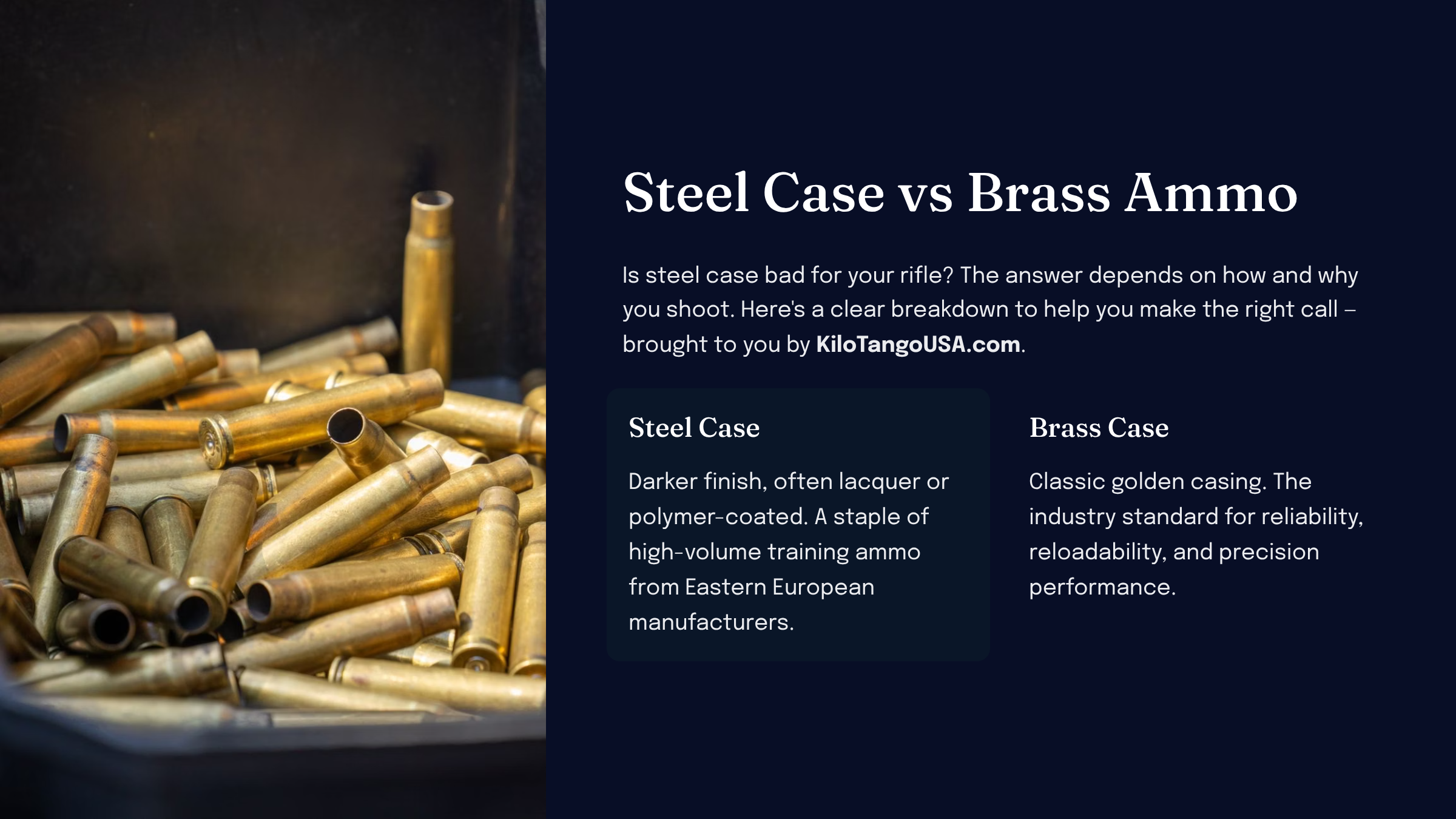
Walk into almost any gun store and ask about steel-case ammo, and you'll hear some version of the same warning: "It'll wreck your gun." The steel-vs-brass debate has been running for decades, and it's become so wrapped in myth, range-counter folklore, and brand snobbery that it's genuinely hard for a new shooter to get a straight answer. Steel case is cheap — noticeably cheaper than brass — and that low price tag has earned it a reputation as the stuff serious shooters avoid. But how much of that reputation is real, and how much is repeated because it sounds right?
The honest answer is that steel-case ammo is mostly fine, with caveats. It's not the gun-destroyer the legends claim, but it isn't identical to brass either — there are real differences in how it extracts, how clean it runs, whether you can reload it, and where you're allowed to shoot it. Understanding those differences lets you make the call that fits your gun and your shooting, rather than parroting a range-counter myth. And since the whole appeal of steel is saving money, it pairs naturally with hunting for the cheapest ammo online in the first place.
What's Actually Different?
The headline difference is right in the name: the cartridge case is made of steel instead of brass. That single material swap drives almost every practical difference you'll notice. Brass is soft, springy, and corrosion-resistant; steel is harder, stiffer, and rusts if left bare — so steel cases get extra treatment and extra engineering to work in a firearm. Here's what actually changes:
- Case metal. Brass is elastic: under firing pressure it expands to seal the chamber, then springs back slightly so it slides out easily on extraction. Steel is stiffer and doesn't obturate (seal and spring back) as well, so a fired steel case grips the chamber walls a little harder than brass does.
- Coating. Because bare steel corrodes and doesn't feed as smoothly, steel cases are coated. Older surplus and budget loads used a lacquer coating; modern steel-case ammo almost always uses a polymer coating that resists corrosion and helps the round feed and extract.
- Bi-metal vs copper jacket. Many — not all — steel-case loads also use a bi-metal (steel-jacketed) bullet rather than a pure copper jacket. This is what trips range magnets and matters for long-term barrel throat wear. The case being steel and the jacket being steel are two separate things.
- Berdan vs Boxer primers. Steel-case ammo is almost always Berdan-primed (two small flash holes, hard to deprime) rather than Boxer-primed (one central flash hole). Combined with the steel case itself, that makes steel-case ammo not practically reloadable.
Steel case, steel core, and bi-metal jacket are three different things. A steel case is just the cartridge body. A steel core (like M855 green tip) is a penetrator inside the bullet. A bi-metal jacket is a steel-lined copper shell around the bullet. Most cheap steel-case range ammo has a steel case and often a bi-metal jacket — but no steel core. Don't let the words blur together.
Pros of Steel Case Ammo
Steel-case ammo exists for one overwhelming reason — it's cheaper — and that reason is a bigger deal than purists like to admit.
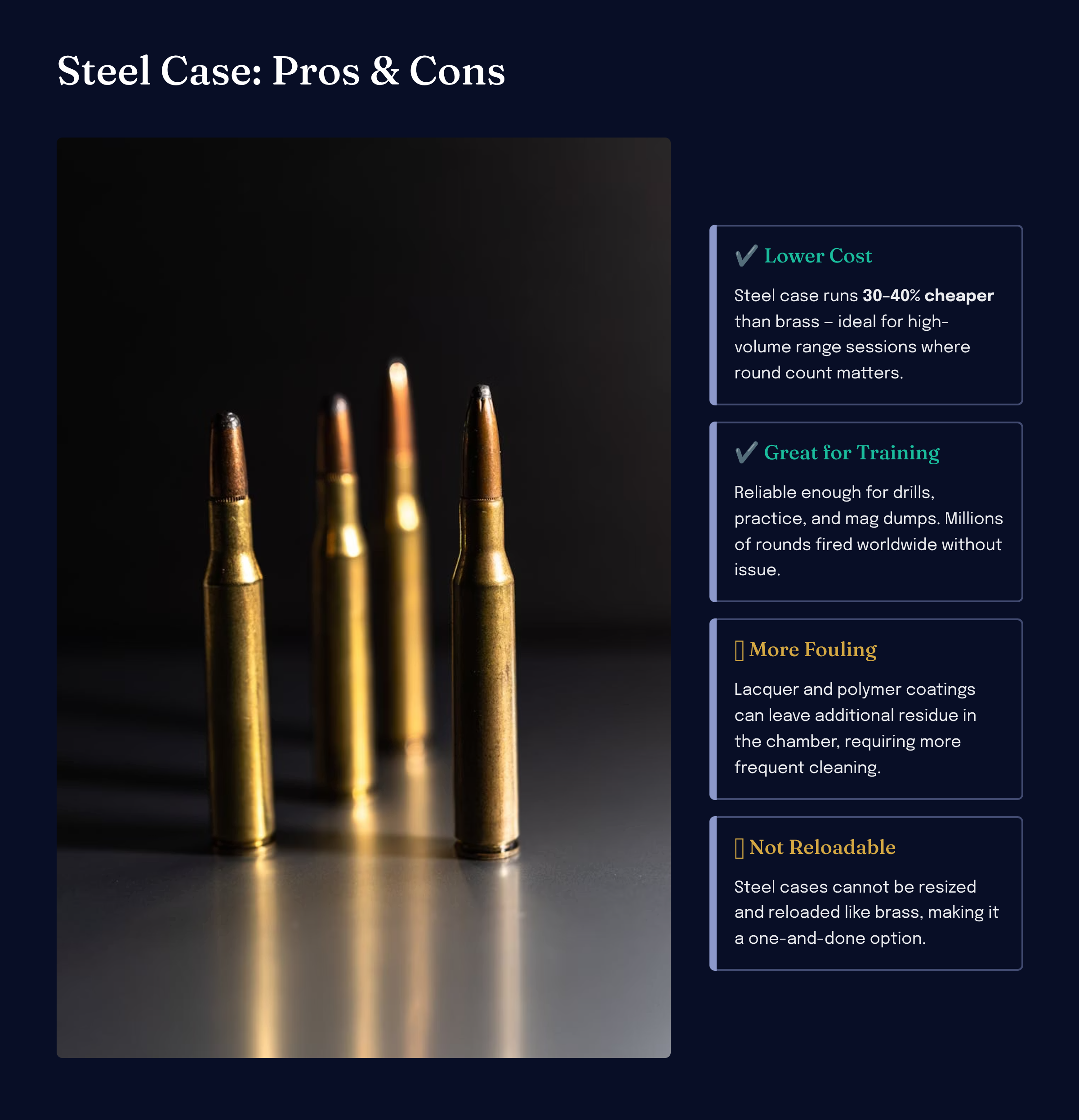
- 30-40% cheaper. This is the headline. Steel cases cost less to produce than brass, and that saving lands directly in your per-round price. Over a case of 1,000 rounds, the difference is real money.
- Totally adequate for training. For plinking, drills, recoil management, and general trigger time, steel-case ammo goes bang and hits the target just fine. You do not need match brass to practice the fundamentals.
- Runs great in guns built for it. AK and SKS-pattern rifles were literally designed around steel-case ammo, with generous chambers and brutally strong extractors. In those platforms, steel isn't a compromise — it's the intended diet.
- More rounds per dollar. The cheaper your ammo, the more you can shoot for the same budget — and volume is how shooting skill actually gets built.
That last point deserves emphasis. A shooter who fires 1,000 rounds of steel-case will almost always out-shoot one who fires 600 rounds of premium brass for the same money. More trigger time has real, measurable value, and steel case is one of the simplest ways to buy more of it. For a huge share of recreational and training shooting, the marginal differences between steel and brass simply don't matter — what matters is rounds downrange.
Cons of Steel Case Ammo
Steel case isn't free of trade-offs. None of them are the gun-destroying disaster of legend, but they're real and worth knowing:
- Harder extraction. Because steel doesn't obturate and spring back like brass, a fired steel case grips the chamber more tightly. Usually that's fine, but it can occasionally cause sticky extraction or even a stuck case — most often when the gun is hot, dirty, or has a tight chamber.
- More fouling. Steel-case coatings and the dirtier-burning powders often loaded in budget steel ammo tend to leave more residue in the action and chamber, so guns running steel typically need cleaning a little more often.
- Not practically reloadable. Between the Berdan primers and the steel case that won't resize and spring back like brass, reloading steel cases isn't worth the effort. If you reload, steel case is a dead end.
- Bi-metal jacket wear and range bans. Bi-metal (steel) jackets are harder than copper and accelerate barrel throat wear over very high round counts. They're also why many indoor ranges ban steel-case ammo — magnets at the firing line catch the steel, and steel-core/steel-jacket rules keep it off the line.
- Extractor wear over time. The harder extraction can mean slightly more wear on the extractor over tens of thousands of rounds — a long-term consideration, not a near-term problem.
Tight-chambered and precision guns are the ones that genuinely dislike steel case. A close-tolerance match chamber or a precise semi-auto pistol depends on the case sealing and releasing cleanly — exactly what steel does worst. Run steel hot and dirty in a tight chamber and a stuck case becomes a real possibility. In a loose, robust action it's a non-issue; in a precision gun, don't risk it.
When Steel Case Is the Right Call
For the right shooter and the right gun, steel case is a smart, money-saving choice. It shines when:
- You're shooting high volume. If you're going to burn through thousands of rounds on fundamentals and drills, the per-round savings add up fast and the trade-offs barely register.
- It's a budget range day. When the goal is trigger time, not tight groups, paying premium-brass prices is just wasting money.
- You're feeding an AK-pattern (or similar) rifle. Guns with loose chambers and robust extractors — AKs, SKSs, and the like — were built for steel case and run it without complaint.
- You're just blasting for fun. Plinking steel targets, ringing gongs, having a good time — none of that requires match accuracy, and steel case delivers plenty for the job.
When to Choose Brass
There are jobs where brass is the clear answer and the small premium is absolutely worth it:
- Self-defense and carry. Reliability is non-negotiable when your life is on the line — you want the cleanest extraction and the most consistent ignition you can get, which means quality brass-cased defensive ammo. (See our picks for the best 9mm self-defense ammo.)
- Precision and match shooting. Brass delivers the consistency and accuracy that tight groups demand. When you're chasing accuracy, the variability and harder extraction of steel work against you.
- Tight-chambered guns. Many modern semi-auto pistols and some AR chambers are cut close, and they simply run more reliably on brass that seals and releases cleanly.
- Anyone who reloads. Brass cases with Boxer primers can be reloaded many times over, turning each case into a reusable component. Steel case throws that value away.
The Real Cost Math
Here's how steel and brass stack up across the factors that actually matter:
| Factor | Steel Case | Brass Case |
|---|---|---|
| Price per round | ~30-40% less | Higher |
| Reloadable | No | Yes |
| Cleanliness | More fouling | Cleaner-burning |
| Barrel wear | Slightly more (bi-metal) | Minimal |
| Range legality | Sometimes banned (indoor) | Always allowed |
| Best use | High-volume training | Defense, precision, reloading |
General guidance, 2026. Exact pricing and range rules vary by retailer, region and venue — always confirm before you buy or head to the line.
Now the honest math. The per-round savings on steel are real, and the dreaded "wear" is badly overblown for normal shooters — you'd need to put tens of thousands of rounds through a barrel to even measure a difference attributable to steel. For the vast majority of people, steel case will never wear out a gun before something else does. But here's the twist: if you reload, brass that you reuse five or more times can actually be cheaper per shot than steel, because you're amortizing the case cost across many firings. So the right answer genuinely depends on two questions — do you reload, and what gun are you feeding? Volume shooter with an AK and no reloading press? Steel wins. Reloader with a precision rifle? Brass wins, and it isn't close.
Common Steel & Brass Brands
On the steel-case side, the classic names are Tula, Wolf, and Barnaul — long the go-to budget options. Note that import availability for these has shifted significantly in recent years, so steel-case stock and pricing can be unpredictable; always check what's actually available right now before you plan around a particular brand.
On the brass side, the dependable mainstream names include Federal, Winchester, Hornady, and PMC — clean-burning, reloadable, and available in everything from bulk FMJ to premium defensive loads. Retailers like Lucky Gunner and Sportsman's Guide are useful for comparing both steel and brass side by side, since they carry the full spread and let you see the real price gap for yourself.
The Bottom Line
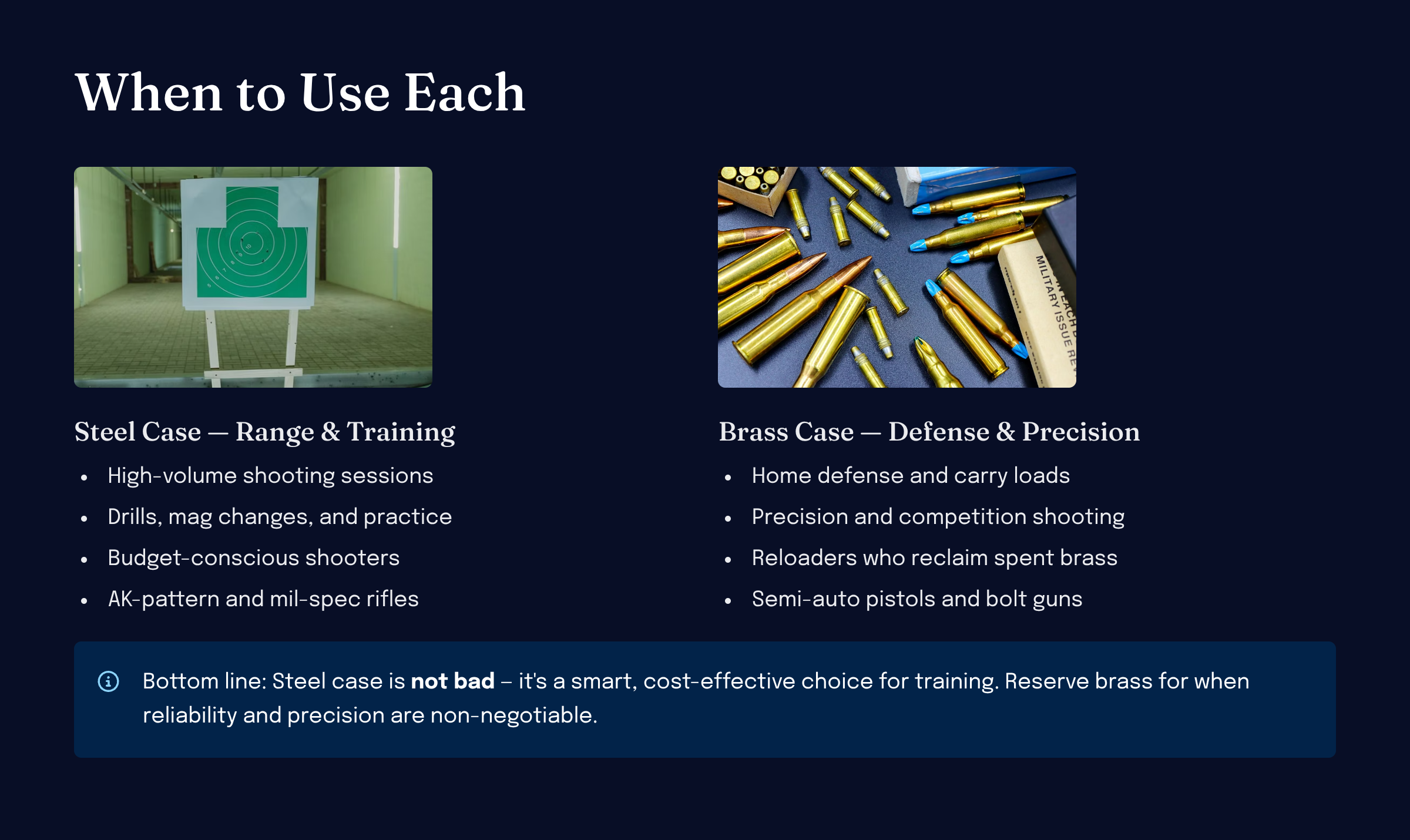
Steel case is not bad for your gun in any meaningful way for the average shooter running a quality firearm for training. The gun-store warnings are mostly myth: the wear is overblown, the reliability is fine in robust guns, and the savings are real. For high-volume practice, budget range days, and platforms built for it, steel case is a legitimate way to shoot more for less.
Reserve brass for the jobs that demand it — self-defense and carry, precision and match shooting, and any time you reload. Match the case to the mission, and you'll never overpay or under-perform. When you're ready to stock up either way, search prices across every major retailer first.
Compare Steel & Brass Prices
Steel for high-volume training, brass for defense and precision — and the real savings only show up when you search live prices side by side. Search across every major retailer on Kilo Tango and set a free price-drop alert so you stock up at the lowest cost.
Frequently Asked Questions
Will steel case ammo damage my gun?
For the average shooter, no. Steel case runs reliably in quality firearms and any extra wear takes tens of thousands of rounds to even measure. The real caveats are bi-metal jackets (slightly faster barrel wear and some range bans) and occasional harder extraction in tight or dirty chambers. It will not "ruin" a modern gun used for normal training.
Do ranges allow steel case ammo?
Many outdoor ranges allow it, but a lot of INDOOR ranges ban steel-case or bi-metal/steel-jacketed ammo because magnets at the firing line catch the steel and because steel components raise ricochet/spark concerns on steel backstops. Always check the range's posted rules — bring brass if you're unsure.
Can you reload steel case ammo?
Practically, no. Most steel cases use Berdan primers (hard to deprime) and the steel itself doesn't resize and spring back like brass, so it's not worth reloading. If you reload, buy boxer-primed brass-cased ammo and save the brass.