Best Concealed Carry Ammo: Top JHP Picks for Every Caliber (2026)
The round in your carry gun may be the most important ammo you ever buy. It has to expand reliably, penetrate enough to stop a threat, and feed flawlessly in your pistol — every single time. Here are the proven JHP loads trusted by armed professionals across every major carry caliber, plus how to test and rotate them.
Of all the ammunition you'll ever buy, the rounds that ride in your carry gun matter most. Range ammo just has to go bang and punch paper; carry ammo has a job to do under the worst circumstances of your life. It has to expand reliably, reach a threat's vitals, feed and cycle perfectly, and do it on the first round and every round after. This is not the place to cut corners, chase the cheapest box on the shelf, or experiment with an unproven bargain load. A few dollars saved on defensive ammo is a false economy when your life is the thing on the line.
The defensive-ammo market is loud. Every brand promises devastating "stopping power," dramatic expansion photos, and exotic bullet designs. Most of that is marketing. What actually matters is a real-world track record — loads that have been tested to FBI protocols, carried by police departments, and proven across millions of rounds in the field. This guide focuses on exactly those: the proven JHP (jacketed hollow point) loads that armed professionals trust in each major carry caliber, plus the practical knowledge — testing, rotation, and the law — that turns a good box of ammo into a reliable carry setup. When you're ready, you can search live 9mm prices across every major retailer on Kilo Tango.
What Makes Good Carry Ammo?
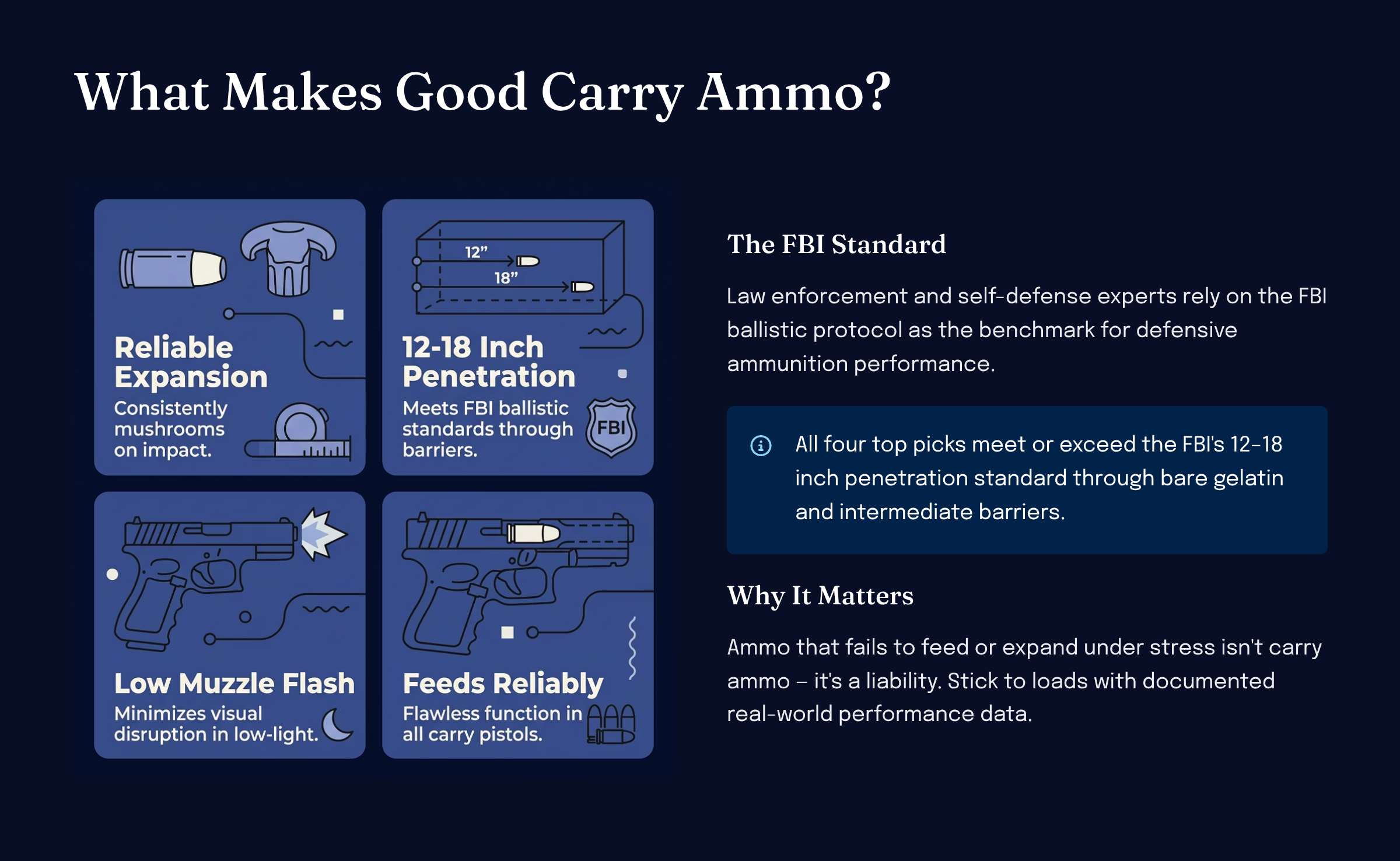
Before naming specific loads, it's worth understanding why the best ones are the best. A quality defensive round rests on four pillars, and a load that fails any one of them isn't fit for carry no matter how good its marketing looks.
- Reliable expansion. A defensive bullet should be a JHP that opens up consistently — even after passing through heavy clothing or a barrier. Expansion is what makes a hollow point effective: the bullet mushrooms to a larger diameter, transferring more energy and creating a wider wound channel. A JHP that clogs with denim and fails to open is just an inefficient FMJ.
- Consistent penetration. The bullet needs to reach vital organs from realistic angles — but not blow straight through. The industry benchmark is the FBI standard of 12 to 18 inches of penetration in calibrated ballistic gel. Too little and the round may not reach what stops a threat; too much and it over-penetrates, endangering bystanders.
- Flawless feeding and reliability. The load has to run perfectly in your gun. Hollow points have a wider, flatter nose profile than the round-nose FMJ many pistols were designed around, and some guns are picky about which JHPs they feed cleanly. The most lethal bullet on paper is useless if it jams.
- Low muzzle flash. Many defensive encounters happen in low light. Premium carry loads use flash-suppressed powders so you aren't momentarily blinded by a fireball at the exact moment you most need to see — a detail cheap practice ammo ignores entirely.
The FBI's 12-to-18-inch penetration window exists because both extremes are problems. Under-penetration means the bullet may stop short of the organs and blood vessels that actually end a threat — especially through an arm, heavy clothing, or at an angle. Over-penetration means the round exits the threat with enough energy to injure someone behind them. The best carry loads are engineered to land squarely in that window, expanding to slow themselves down at the right depth.
This is also why defensive ammo is always JHP and never FMJ. Full metal jacket rounds don't expand, so they punch a narrow channel and tend to sail right through — exactly the over-penetration the FBI window warns against. For the full breakdown of why the bullet type matters so much, see our guide on FMJ vs hollow point.
Best 9mm Carry Ammo
9mm is the dominant carry caliber in America for good reason: modern premium loads erased the old "stopping power" gap, and 9mm offers higher capacity, lower recoil, and lower cost than the bigger bores. These three loads are the proven benchmarks the entire industry is measured against.
Federal HST 147gr
Arguably the gold standard of 9mm defensive ammo. The HST delivers consistent, large-diameter expansion and ideal penetration depth virtually every time, with excellent reliability and weight retention. It's a duty-grade benchmark carried by countless police agencies — if you want one load you can trust without overthinking it, this is it.
147gr JHP · duty standardSpeer Gold Dot 124gr
A bonded JHP with a long, proven law-enforcement track record. Gold Dot's bonded core (the jacket is chemically welded to the lead) holds together and performs exceptionally through barriers like auto glass and heavy clothing, retaining weight for deep, reliable penetration. A duty-grade load trusted nationwide.
124gr bonded JHP · LE provenHornady Critical Defense 115gr
Built around Hornady's signature FTX bullet — a polymer tip plugs the hollow cavity so it resists clogging when fired through clothing, ensuring reliable expansion. The lighter 115gr bullet means a bit less recoil, making it a great, controllable choice for compact and subcompact carry guns.
115gr FTX · clothing-resistant9mm is deep enough a topic to deserve its own treatment — for a five-load ranked deep-dive, see our deep-dive on 9mm defense ammo.
Best .380 ACP Carry Ammo
The .380 ACP rules the pocket-pistol world: tiny, light guns that hide anywhere. The tradeoff is velocity. The .380 is on the marginal end for defensive performance, which makes load selection more important here, not less — many .380 hollow points either expand and stop short, or penetrate deep but never open. The goal is a load that balances the two.
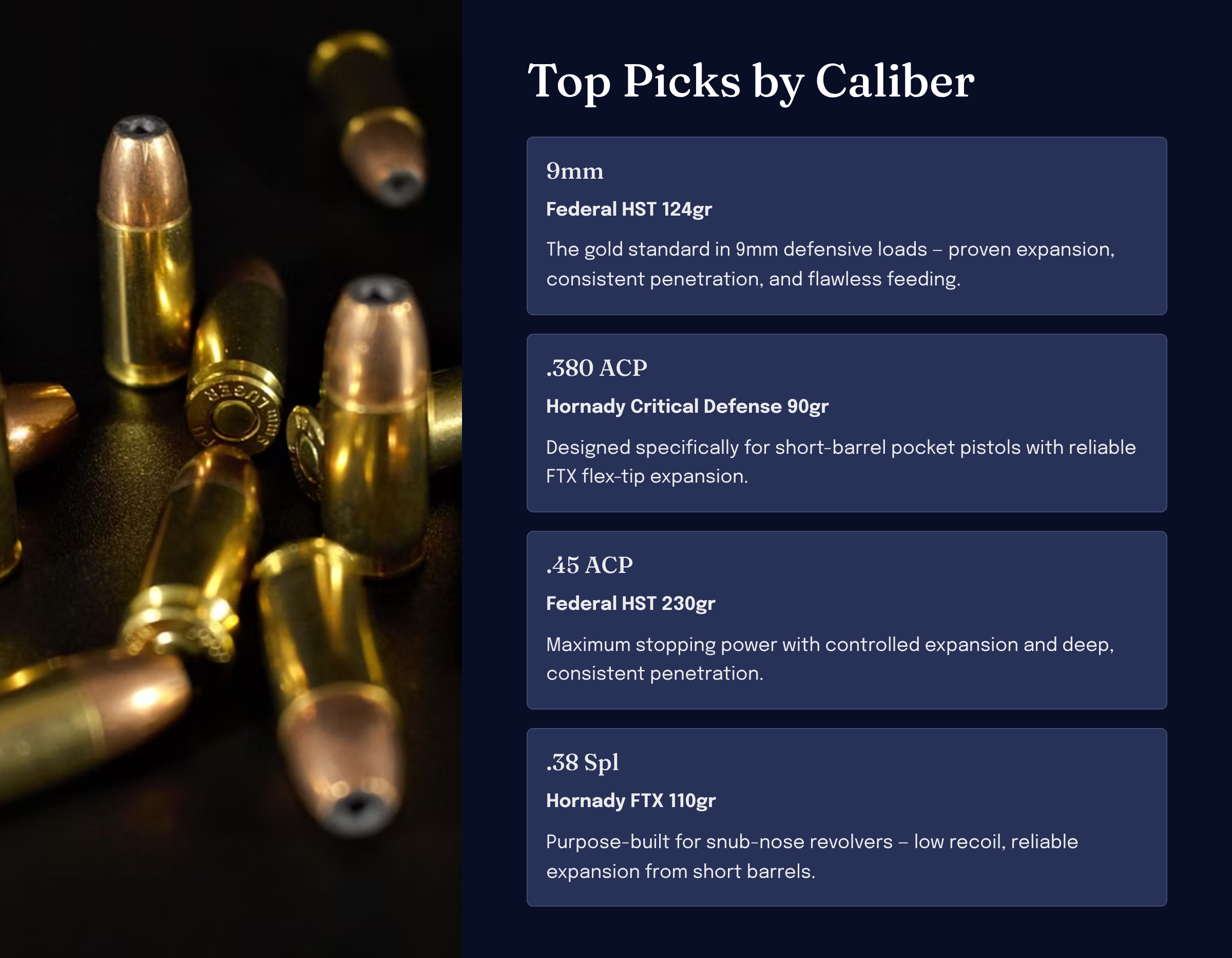
Hornady Critical Defense 90gr
Purpose-built for the .380's modest velocity. The FTX polymer-tip design is the key: it forces reliable expansion at lower speeds where many ordinary .380 JHPs simply fail to open at all. For most pocket-.380 shooters, this is the default benchmark defensive load.
90gr FTX · reliable .380 expansionFederal Hydra-Shok Deep 99gr
Engineered specifically to address the .380's penetration shortfall from short barrels. The heavier 99gr bullet and redesigned core deliver deeper, more consistent penetration to better reach vitals — a strong choice if you'd rather prioritize depth in a marginal caliber.
99gr · deeper penetrationThe .380 always involves an expansion-versus-penetration tradeoff — pick the priority that fits your gun and split, and accept that no .380 load does everything a 9mm does. For more options and the full picture, see our best .380 ACP ammo guide.
Best .45 ACP Carry Ammo
The .45 ACP has a devoted following for a simple reason: it starts big. A larger-diameter bullet already makes a wider hole before any expansion, and when you pair that big bore with a premium expanding load, the results are formidable. The trade-offs are lower capacity and more recoil, but for those who carry .45, these are the loads to feed it.
Federal HST 230gr
The .45 ACP HST is a benchmark in the caliber just as it is in 9mm. It delivers massive, reliable expansion to a large recovered diameter with ideal penetration depth and excellent weight retention. If you want the proven top pick for a .45 carry gun, start here.
230gr JHP · benchmarkSpeer Gold Dot 230gr
The bonded Gold Dot brings its law-enforcement pedigree to the .45. Dependable, controlled expansion with strong weight retention thanks to the bonded core, plus consistent penetration — a trusted, duty-grade alternative to the HST.
230gr bonded JHP · LE provenThe .45's appeal is that it starts big — and a premium HST or Gold Dot only makes it bigger. With either load, a .45 carry gun is running the best ammo the caliber has to offer.
Best .38 Special Carry Ammo
The .38 Special snub-nose revolver remains one of the most popular concealed-carry guns ever made — simple, utterly reliable, and easy to shoot. But the short barrel of a snubby robs the .38 of velocity, so the load has to be chosen with that specifically in mind. A round tuned for a 4-inch barrel may never expand out of a 2-inch snub.
Hornady Critical Defense 110gr FTX
Specifically tuned for short snub-nose barrels and the .38's velocity. The FTX polymer tip drives reliable expansion even at snubby speeds, and the lighter 110gr bullet keeps recoil manageable in a small, light revolver. It's widely regarded as one of the best all-around snubby loads available.
110gr FTX · snub-nose tunedFederal Nyclad 125gr
A classic revolver defense load with a cult following. The soft, nylon-coated lead hollow point expands reliably even at the low velocities a snub-nose produces, where harder bullets often won't. A proven, gentle-recoiling option that has protected revolver carriers for decades.
125gr Nyclad HP · low-velocity expansionBecause the .38 lives mostly in short-barreled revolvers, velocity is the limiting factor. One way to recover some of it is +P ammunition, which is loaded to higher pressure and can help a short barrel drive expansion — but only if your revolver is rated for +P. For the full explanation, see +P ammo explained.
Test Your Carry Ammo Before You Trust It
This step is non-negotiable and it's the one most people skip. Before you carry a load, prove it runs in your exact gun. Fire a minimum of around 50 rounds — and ideally 100 to 200 — of your exact carry load through your exact carry gun, and confirm 100% reliable feeding, extraction, and ignition with zero malfunctions. Not a similar load, not a different bullet weight from the same brand: the specific cartridge you intend to carry.
Why so strict? Because a pistol that runs flawlessly on round-nose FMJ can still choke on a specific hollow point. The wider nose profile of a JHP feeds differently, and some guns simply don't like a particular load's shape, length, or recoil impulse. The only way to know yours runs the load you trust your life to is to put real rounds through it and watch it work. If you get even a single failure to feed or eject, that load is disqualified for carry in that gun — find one that runs clean instead.
Do not load a box of premium defensive ammo straight into your carry gun and call it good. An untested load is a gamble with the worst possible odds. Shoot at least 50 rounds of your exact carry load through your exact gun first, confirm flawless reliability, then carry it.
How Often to Rotate Carry Ammo
Carry ammo isn't load-it-and-forget-it. The rounds you carry every day live a hard life, and you should rotate and refresh both your chambered round and your magazine carry ammo every 6 to 12 months. There are two specific risks that make this matter.
The first is bullet setback. Every time you unload and reload your carry gun, the chambered round gets stripped from the magazine and slammed into the chamber again. Repeatedly re-chambering the same round can push its bullet deeper into the case. That reduced internal volume raises chamber pressure when fired — potentially to dangerous levels. Rotating that top round (and not re-chambering the same one over and over) prevents setback from creeping up on you.
The second is environmental degradation. Ammo carried daily is exposed to pocket lint, sweat, skin oils, and ambient moisture far more than ammo sitting in a sealed can. Over months, that exposure can corrode cases and primers and compromise reliability. When you rotate, the smart move is simple: shoot up your old carry ammo as practice (it also confirms it still works), then re-test and load a fresh batch. You stay current, you verify function, and your defensive ammo is always in top condition. For more on ammunition shelf life and storage, see does ammo expire.
Always Carry JHP, Never FMJ
It bears repeating as its own point because it's the single most common — and most dangerous — carry-ammo mistake. Carry JHP. Never carry FMJ. Full metal jacket rounds do not expand: they stay narrow, punch a small channel, and tend to over-penetrate, sailing through a threat (and potentially walls and bystanders behind them) with energy to spare. That's the opposite of what a defensive round should do.
A jacketed hollow point is engineered to expand on impact, which does two crucial things at once: it transfers more energy into the threat for a faster stop, and it slows the bullet to reduce over-penetration and the risk to others. FMJ has exactly one legitimate role in your shooting life — cheap, high-volume practice at the range. Train with FMJ, carry JHP, and never confuse the two boxes. For the complete head-to-head, read FMJ vs hollow point.
Legal Considerations
Ammunition law varies by state and even by locality, and a handful of jurisdictions place restrictions on hollow points — the very ammo that's best for defense. The most notable is New Jersey, which has long-standing limits on hollow-point ammunition. The common reading is that hollow points are broadly legal to possess in your home, at the range, and while transporting them to and from those places, but their carry is restricted under some interpretations. The rules are nuanced and enforcement can be strict, so the only safe approach is to verify the current law for your state and your locality before you carry hollow points anywhere.
Don't take a blog's word as legal advice — confirm it. See our breakdown of New Jersey ammo laws for that state specifically, and our overview of state laws for the rest of the country. When you've confirmed your tested load is legal where you carry, stocking it is easy: major retailers such as Lucky Gunner and Ammunition Depot reliably carry the proven defensive loads named in this guide, and you can compare their prices side by side.

Putting It All Together
Choosing carry ammo comes down to a short, proven checklist. Pick the benchmark load for your caliber: in 9mm, Federal HST, Speer Gold Dot, or Hornady Critical Defense; in .380 ACP, Hornady Critical Defense; in .45 ACP, Federal HST; and in .38 Special, Hornady Critical Defense FTX. These are the loads with the track records, not the marketing.
Then do the work that actually makes a load trustworthy: test at least 50 rounds of your exact load through your exact gun, rotate it every 6 to 12 months to beat setback and degradation, always carry JHP and save FMJ for practice, and check your state and local law before you carry hollow points. Get those right and your carry gun is loaded with the best ammo it can run. When you're ready to stock up, search prices across every major retailer on Kilo Tango.
Search Live Carry Ammo Prices
From Federal HST and Speer Gold Dot to Hornady Critical Defense, premium defensive ammo prices vary between retailers and go on sale often. Search live prices across every major store on Kilo Tango and set a free price-drop alert so you stock your carry gun at the lowest cost.
Frequently Asked Questions
How many rounds should I carry?
That's a personal and legal choice, but the more relevant ammo question is how much to test: fire at least 50, ideally 100-200, rounds of your exact carry load through your carry gun to confirm reliability before trusting it. For daily carry, most people run a full magazine plus often a spare; check your local laws on magazine capacity.
Does carry ammo go bad?
The ammo itself lasts for years if stored well, but ammo carried daily degrades faster from sweat, oils, lint and moisture, and the chambered round suffers bullet setback from repeated re-chambering. That's why you rotate carry ammo every 6-12 months — shoot the old rounds and load fresh. See our does ammo expire guide for more on shelf life.
Should I use +P ammo for carry?
+P can help in short-barreled guns (like snub-nose .38s) by recovering velocity for reliable expansion, but only if your firearm is rated for +P. In modern 9mm, premium standard-pressure JHPs like HST already perform excellently, so +P isn't necessary. Check your gun's rating and always test the exact load before carrying it.