+P Ammo Explained: What It Is, When to Use It & Is It Safe?
You've seen "+P" stamped on premium defensive boxes and wondered if it's worth the extra money — or the extra wear on your gun. Here's exactly what +P means, how it differs from +P+, what it actually does for performance, and whether it's safe to run in your firearm.
Few markings on an ammo box cause as much confusion — or as much needless worry — as those two little characters: +P. To some shooters they signal a "hot" load that'll beat up their gun; to others they're a magic upgrade that turns an ordinary caliber into something special. Both impressions are wrong. +P is neither dangerous in the right firearm nor a dramatic leap in performance. It's a precisely defined, standardized, slightly higher-pressure version of a cartridge — nothing more mysterious than that.
Understanding +P matters because it shows up almost entirely on premium defensive ammunition, exactly the rounds you most want to get right. Choose well and you squeeze a little extra performance out of a short-barreled carry gun; choose carelessly and you might run higher-pressure ammo through a firearm that isn't rated for it. This guide explains what +P actually means, how it differs from +P+, what it does (and doesn't do) for performance, which calibers offer it, and whether it's safe for your gun — so you can buy the right best 9mm self-defense ammo with confidence.
What Does +P Mean?
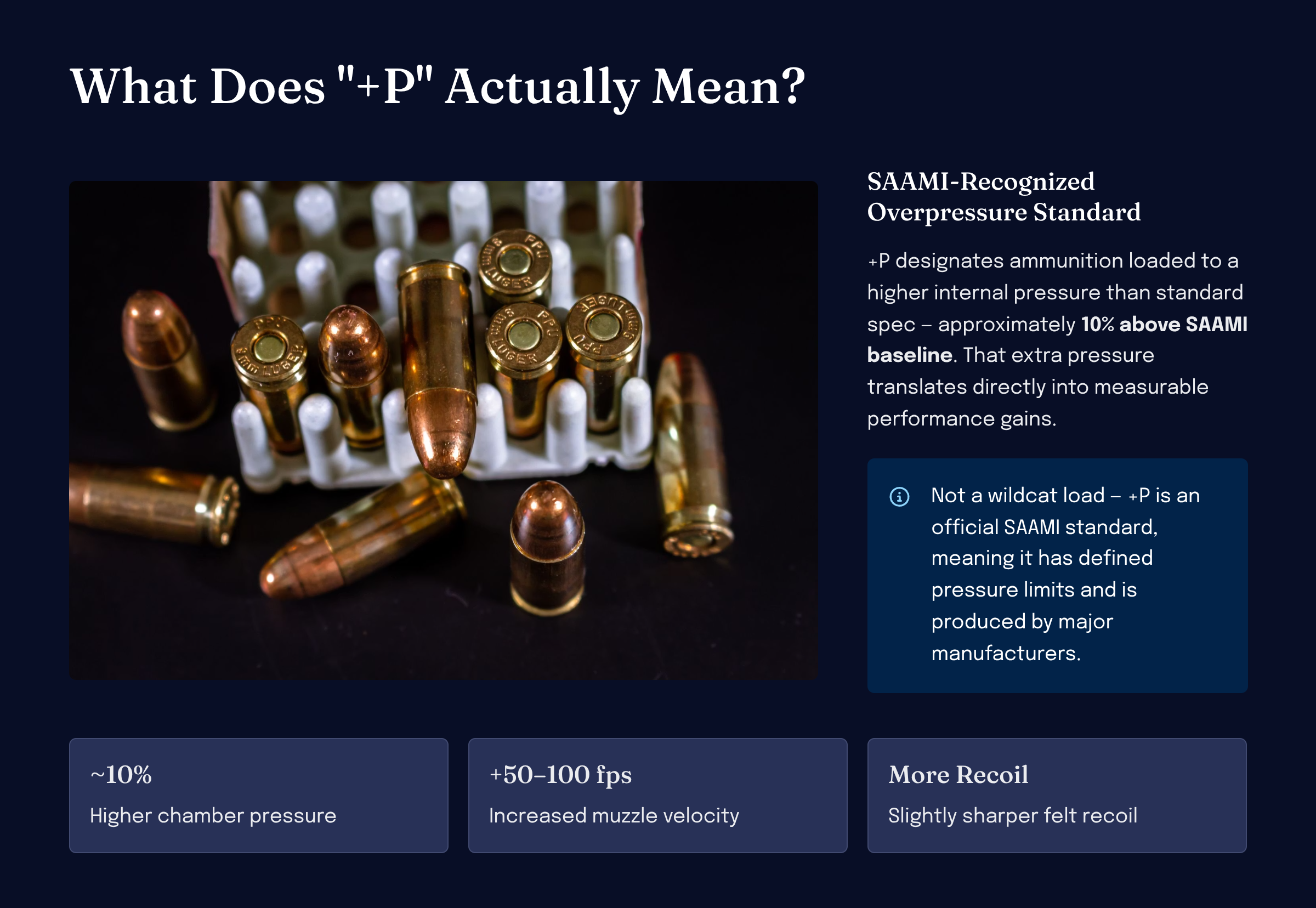
+P stands for "overpressure." It marks a cartridge loaded to a higher pressure than the standard SAAMI specification for that caliber — roughly about 10% more pressure than the standard-pressure load. The key word is standardized: SAAMI (the Sporting Arms and Ammunition Manufacturers' Institute) publishes both the standard maximum pressure for a cartridge and, for certain cartridges, a separate, officially recognized +P maximum. So +P isn't a vague "extra-hot" label a company slaps on a box; it's a defined ceiling that ammo makers load to and test against.
Why bother running more pressure? Because more pressure pushes the bullet faster. More pressure means more velocity, and more velocity usually means more energy on target and a bit more reliable expansion from a defensive hollow point. Those are real benefits. The trade-offs are equally real: more pressure also produces more recoil, more muzzle blast and flash, and slightly faster wear on the firearm. +P is simply a different point on that trade-off curve — a touch more performance in exchange for a touch more punishment to both shooter and gun.
+P is a STANDARDIZED higher-pressure spec — not a random "hotter" load. It's defined and tested by SAAMI to a specific maximum pressure, which is exactly why reputable +P ammo is safe in any firearm rated to handle it.
+P vs +P+: The Critical Difference
This is where most of the real-world confusion — and risk — lives. +P and +P+ look like the same idea with a little more on top, but they are fundamentally different in one crucial way: +P is SAAMI-recognized with a defined maximum pressure; +P+ is not. There is no formal SAAMI standard for +P+. None. That means the actual pressure of a +P+ load is whatever the individual manufacturer decides it should be, and it can exceed the +P limit significantly.
The practical consequence is that +P is a known, bounded quantity you can plan around, while +P+ is essentially a manufacturer-specific load with no universal guarantee. Two boxes of +P+ from different makers can run at meaningfully different pressures. That's why +P+ is often reserved for law-enforcement and duty use, where the agency has vetted a specific load against specific guns. For the average shooter, +P+ is a "use only if your gun's maker explicitly approves that exact load" proposition.
No standard means no guarantee your gun is built for that specific load. Because +P+ pressure varies by manufacturer and isn't capped by SAAMI, never run it unless your firearm's maker explicitly approves it. When in doubt, stick to standard or SAAMI-spec +P.
What +P Actually Does for Performance
Here's the part that deflates the hype: the real-world performance gain from +P is meaningful but incremental, not transformative. In most calibers, +P buys you roughly 50 to 100 fps more velocity than the standard-pressure version of the same load, with modestly more energy and slightly more reliable bullet expansion to show for it. What you'll notice most, though, is the cost side: noticeably more recoil and a louder, flashier report.
The most important mental model is this: +P does not turn one caliber into another. A +P 9mm is still a 9mm — it doesn't become a .357 Magnum because the box has a plus sign on it. The extra 50-100 fps is a genuine but small bump, useful in specific situations (more on those below), not a caliber jump. Set your expectations accordingly and you'll make smarter buying decisions.
| Factor | Standard | +P |
|---|---|---|
| Pressure | SAAMI max | ~+10% |
| Velocity | baseline | ~+50-100 fps |
| Recoil | baseline | noticeably more |
| Expansion | good | slightly more |
| Wear | minimal | slightly faster |
Figures are general 2026 typicals and vary by load, barrel length and caliber. Always check the manufacturer's published velocities for the exact load you're considering.
Which Calibers Have +P?
Not every caliber has a SAAMI +P standard — and that's important, because "+P" only means something when an official higher-pressure spec actually exists. Here's where you'll genuinely find it:
- 9mm Luger — +P is common in premium defensive loads. A widely available, well-supported option in modern handguns.
- .38 Special — +P is very common and genuinely useful here. Because standard .38 Special is a low-pressure cartridge, the +P version delivers a real, worthwhile performance gain (especially from short barrels).
- .45 ACP — +P is available. The gain is more modest since standard .45 ACP already throws a heavy bullet, but it exists and is SAAMI-recognized.
- .380 ACP — there is NO SAAMI +P standard. The .380 is not a SAAMI +P caliber, so be skeptical of any box marketing "+P" .380 — it's outside the standard.
- .40 S&W — no +P. The .40 already operates at high pressure, so there's no SAAMI +P designation for it.
The takeaway: if a box advertises "+P" in a caliber that has no SAAMI +P standard, be skeptical. At best it's marketing for a load at the top of the standard pressure range; it isn't a SAAMI-defined overpressure spec.
Is +P Safe for My Gun?
This is the question that matters most, and the honest answer is: for most modern, quality centerfire handguns, yes — but you must verify your specific gun. The overwhelming majority of contemporary, name-brand defensive pistols and revolvers are rated by their manufacturers to handle SAAMI-spec +P ammunition. Check your owner's manual or the maker's website and you'll usually find a clear statement.
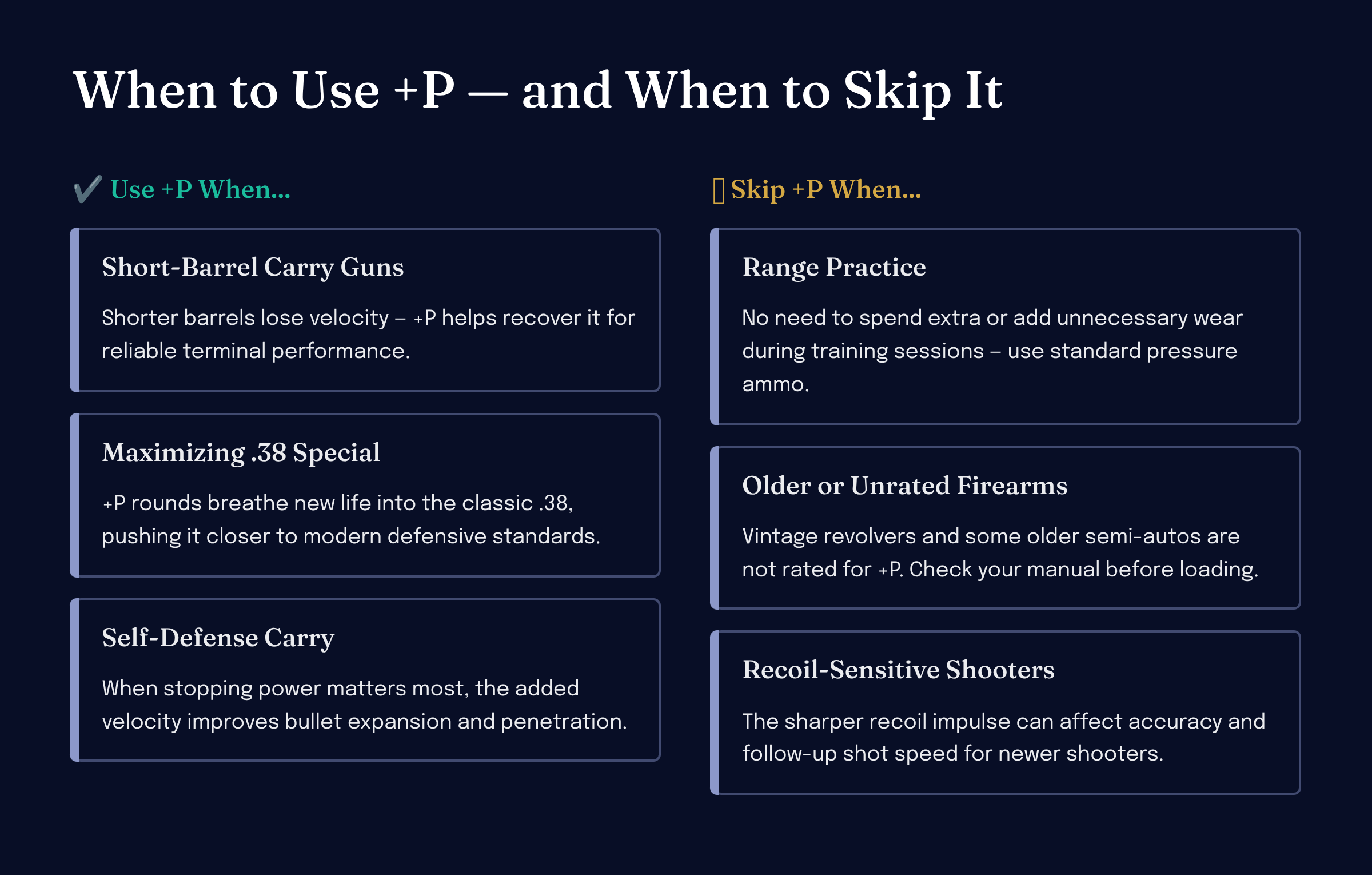
The caution flags go up with older firearms, alloy-frame and lightweight revolvers, and some vintage guns. These may not be rated for +P at all, and feeding them a steady diet of higher-pressure ammo can accelerate wear or, in extreme cases, cause damage. A featherweight snub-nose that's wonderful to carry isn't always built to digest thousands of +P rounds, and a decades-old service piece may predate +P ratings entirely. The rule is simple and absolute: confirm your specific gun's rating before you feed it +P, and never run +P+ unless the maker explicitly approves it.
Check the manual or call the manufacturer — and never assume an old gun handles +P. A two-minute lookup or phone call settles the question for good. If you can't confirm a +P rating, run standard-pressure ammo; it's the safe default in every firearm.
When +P Makes Sense
+P isn't pointless — there are situations where that modest pressure bump earns its keep. The strongest cases:
- Short-barreled defensive guns — snub-nose .38 Special revolvers especially. A 2-inch barrel robs a cartridge of velocity, and +P helps recover that lost speed so the bullet reaches the threshold needed for reliable hollow-point expansion. This is the textbook use case for +P.
- Maximizing the .38 Special — because standard .38 is a relatively low-pressure cartridge, it has real headroom. +P unlocks a genuine, worthwhile performance gain there in a way it can't in already-hot calibers.
- Defensive use where the bump is worth it — if your gun is rated for +P and you want every reasonable edge in a carry load, the modest performance gain can justify the extra recoil and cost.
If you carry a small revolver or a compact pistol, +P deserves a serious look — and it pairs naturally with the rest of a smart carry setup. For load selection across calibers, see our guide to the best concealed carry ammo.
When +P Doesn't Matter
Just as important is knowing when +P is optional. The biggest example is modern 9mm. Today's premium standard-pressure JHP designs — Federal HST, Speer Gold Dot, Hornady Critical Defense and the like — already perform excellently at standard pressure. The bullet technology matters far more than an extra 50-100 fps; a quality standard-pressure hollow point that expands reliably will outperform a crude bullet pushed to +P speed every time. That makes +P 9mm optional, not necessary: a nice-to-have if your gun is rated for it, but no requirement for effective defense.
And for range and practice, the answer is unambiguous: never pay extra for +P. Practice ammo is FMJ pushed to make holes in paper; the higher pressure adds cost, recoil and wear with zero practical benefit for training. Save the +P for the carry rounds in your gun and train on cheap standard-pressure ball.
Does +P Wear Out My Gun?
Yes, +P accelerates wear slightly compared to standard pressure — but for defensive use, the effect is trivial. Think about the actual round count: over a gun's practical lifetime you might fire only 50 to 200 rounds of actual carry ammo through it, while doing the overwhelming majority of your shooting with cheaper standard-pressure FMJ in training. A couple hundred +P rounds across years simply isn't enough to meaningfully wear out a quality, +P-rated firearm.
So the sensible approach is to practice with standard pressure and carry +P if you like (in a gun that's rated for it). The wear concern is overblown for normal defensive shooters; it only becomes a real factor if you decide to shoot +P by the thousands as your everyday practice ammo, which there's no reason to do. When you're ready to stock up, you can compare tested defensive +P loads from retailers like Lucky Gunner and Ammunition Depot through Kilo Tango's price search.
Putting It All Together
Strip away the myths and +P is simple: a standardized, roughly 10% pressure bump worth about 50-100 fps more velocity, with a little more recoil, blast and wear as the cost. +P+ is a different animal — it has no SAAMI standard, varies by manufacturer, and should only be used if your gun's maker explicitly approves it. +P shines in short-barreled guns, especially snub-nose .38 Specials, where it recovers lost velocity for reliable expansion; it's optional in modern 9mm, where premium bullet tech already does the work.
On safety, the rule is to verify your specific gun's rating — most modern, quality handguns are fine, but older and lightweight guns may not be. And the smart routine is the easiest one: practice with standard pressure, carry +P if your gun is rated for it, and never worry about wear for normal defensive volumes. Match your load to your gun and your mission, then go find the best carry ammo at the best price.
Find the Right Defensive Load
Whether you're stocking a +P-rated snub-nose or a modern 9mm, the right defensive ammo is the load your gun is rated for, that expands reliably, and that you can find at a fair price. Search live prices across every major retailer on Kilo Tango and set a free price-drop alert so you carry the right round without overpaying.
Frequently Asked Questions
Is +P louder?
Yes, somewhat. +P burns more powder at higher pressure, so it produces more muzzle blast, more flash and a sharper report than standard-pressure ammo in the same caliber — along with noticeably more recoil. The difference is real but not dramatic; double up on hearing protection at the range as always.
Can a Glock shoot +P?
Yes. Glock pistols are rated for SAAMI-spec +P ammunition, so you can safely use +P defensive loads. Glock does NOT recommend +P+ (which has no SAAMI standard) or unsupported reloaded/remanufactured +P. As always, verify in your model's manual and use quality factory ammo.
What about +P+?
+P+ has no formal SAAMI pressure standard, so its pressure isn't standardized and can run higher than +P, varying by manufacturer. Only use +P+ if your firearm's maker explicitly approves it — it's typically a law-enforcement/duty option. For most shooters, standard or SAAMI +P loads are the right call.