What Ammo Does a Glock 19 Use? Complete Compatibility Guide
The short answer is 9mm Luger — but which 9mm? Here's the complete breakdown: FMJ vs JHP, the best grain weights for range and carry, the exact loads worth buying, what to avoid, and how to break in a new G19.
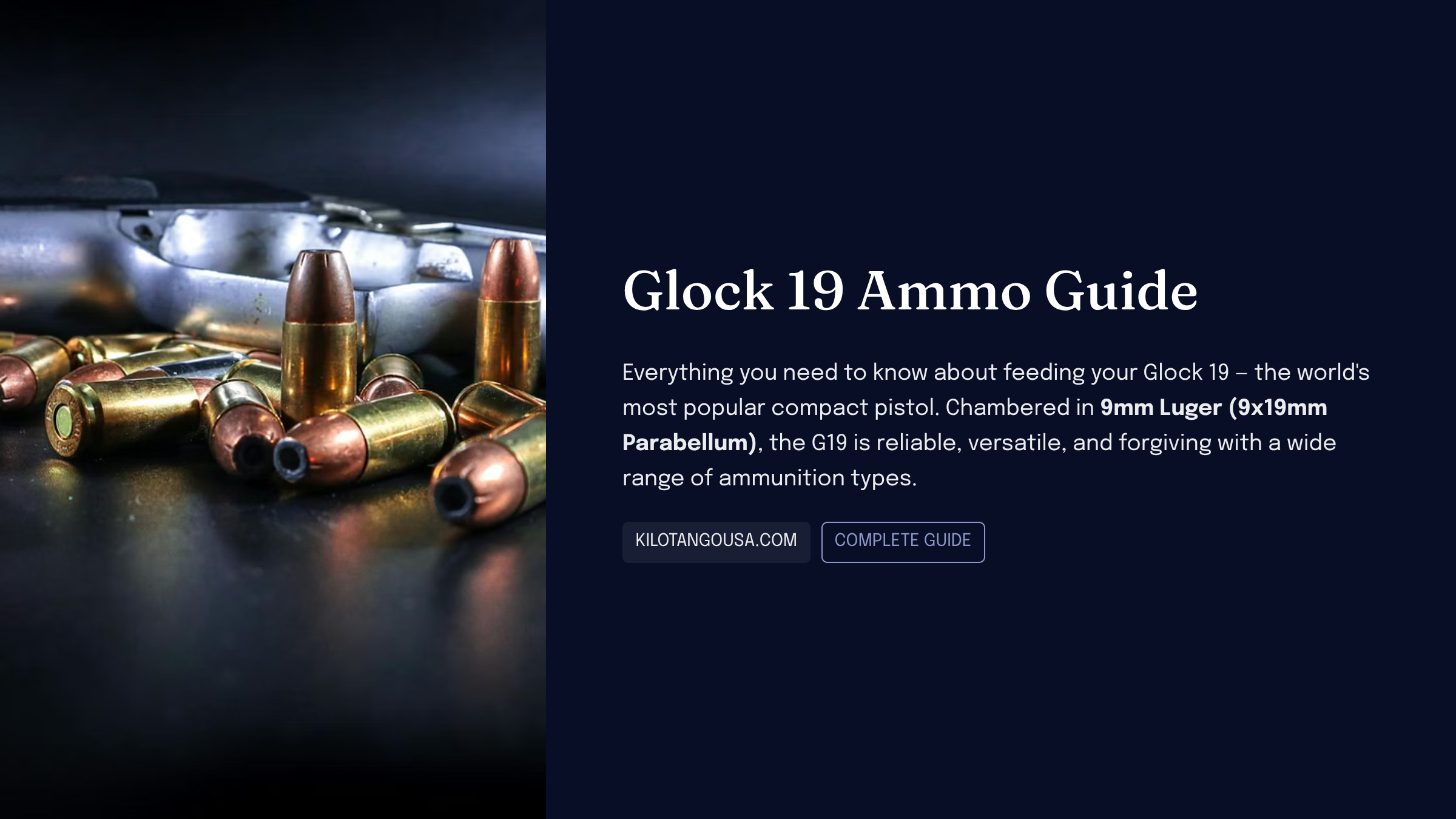
The Glock 19 is, by a wide margin, the most popular handgun in America — the default recommendation for a first pistol, a do-everything carry gun, and a nightstand defender all at once. Which means one question gets asked more than almost any other in shooting: what ammo does a Glock 19 actually take?
The good news is that the answer is refreshingly simple, and the Glock 19 is one of the least fussy guns ever made about what you feed it. But "9mm" is a category, not a single product — and the difference between range ammo and carry ammo, between 115 grain and 147 grain, is the difference between a fun afternoon and a gun you can stake your life on. This guide covers all of it.
The Glock 19 Uses 9mm Luger
The Glock 19 is chambered in 9mm Luger — also written 9x19mm Parabellum, or simply "9mm." These are all the same cartridge. If a box of ammo says 9mm Luger, 9x19, or 9mm Parabellum, it will fit and fire in a standard Glock 19. That's the whole answer for 95% of buyers.
The Glock 19 is a generously reliable gun. It will run cheap steel-case plinking ammo, premium defensive hollow points, and everything in between, across every generation from Gen 3 through the current models. You do not need special or proprietary ammunition. Any quality, in-spec 9mm Luger works.
Don't confuse 9mm Luger with other "9mm" cartridges. 9mm Makarov (9x18), .380 ACP (9x17 / 9mm Kurz), and 9mm Largo are different cartridges and will not work in a Glock 19. Always look for "9mm Luger" or "9x19" on the box.
FMJ vs JHP: Range Ammo vs Carry Ammo
Once you know the Glock 19 takes 9mm, the next decision is which type of 9mm — and it comes down to two jobs. Nearly all the 9mm you'll ever buy is one of these two bullet types.
FMJ — Full Metal Jacket (range & practice)
Full Metal Jacket rounds have a soft lead core fully wrapped in a harder copper jacket. They're cheap, clean-feeding, and designed to punch clean holes in paper. FMJ is your range and practice ammo — what you buy by the case to actually shoot a lot. It does not expand on impact, which is exactly why it's not ideal for defense but perfect (and affordable) for training.
JHP — Jacketed Hollow Point (self-defense & carry)
Jacketed Hollow Point rounds have a hollow cavity in the nose engineered to expand on impact, transferring energy and reducing the risk of over-penetration. JHP is your self-defense and carry ammo — premium, more expensive, and what you load when the gun has to do a serious job. You don't practice with it (it's too costly), but you must verify it runs in your specific pistol.
Practice with cheap FMJ. Carry premium JHP. Buy FMJ in bulk to shoot a lot, and keep a box or two of quality JHP that you've test-fired in your own Glock 19 for defense. Want the full breakdown of every bullet type? See our Ammo Types Decoded guide.
Best Grain Weights for a Glock 19
"Grain" (gr) is the weight of the bullet — there are 7,000 grains in a pound. In 9mm, three weights dominate, and the Glock 19 handles all of them. The difference is felt mostly in recoil character and use case.
| Weight | Feel | Best For |
|---|---|---|
| 115 gr | Snappy, fast | Range & target — cheapest, most common practice load |
| 124 gr | Balanced | All-purpose — what 9mm was designed around; great for range & carry |
| 147 gr | Soft, heavy push | Suppressed / subsonic shooting & heavier defensive loads |
115 grain — the practice default
The lightest and fastest common load, and usually the cheapest. Recoil is a touch snappier, but for blasting paper and putting in volume, 115gr FMJ is the value king. It's the natural choice for high-round-count practice sessions.
124 grain — the all-rounder
9mm was originally standardized around a 124-grain bullet, and many shooters consider it the sweet spot. The recoil impulse is a smooth push rather than a snap, which helps control and follow-up shots. It's an excellent all-purpose weight for both practice and carry.
147 grain — heavy & quiet
The heaviest common load, typically subsonic, which makes it the go-to for suppressed shooting (no supersonic crack) and for shooters who prefer a slower, heavier recoil push. Many premium defensive loads come in 147gr for exactly this reason.
Top Ammo Picks for a Glock 19
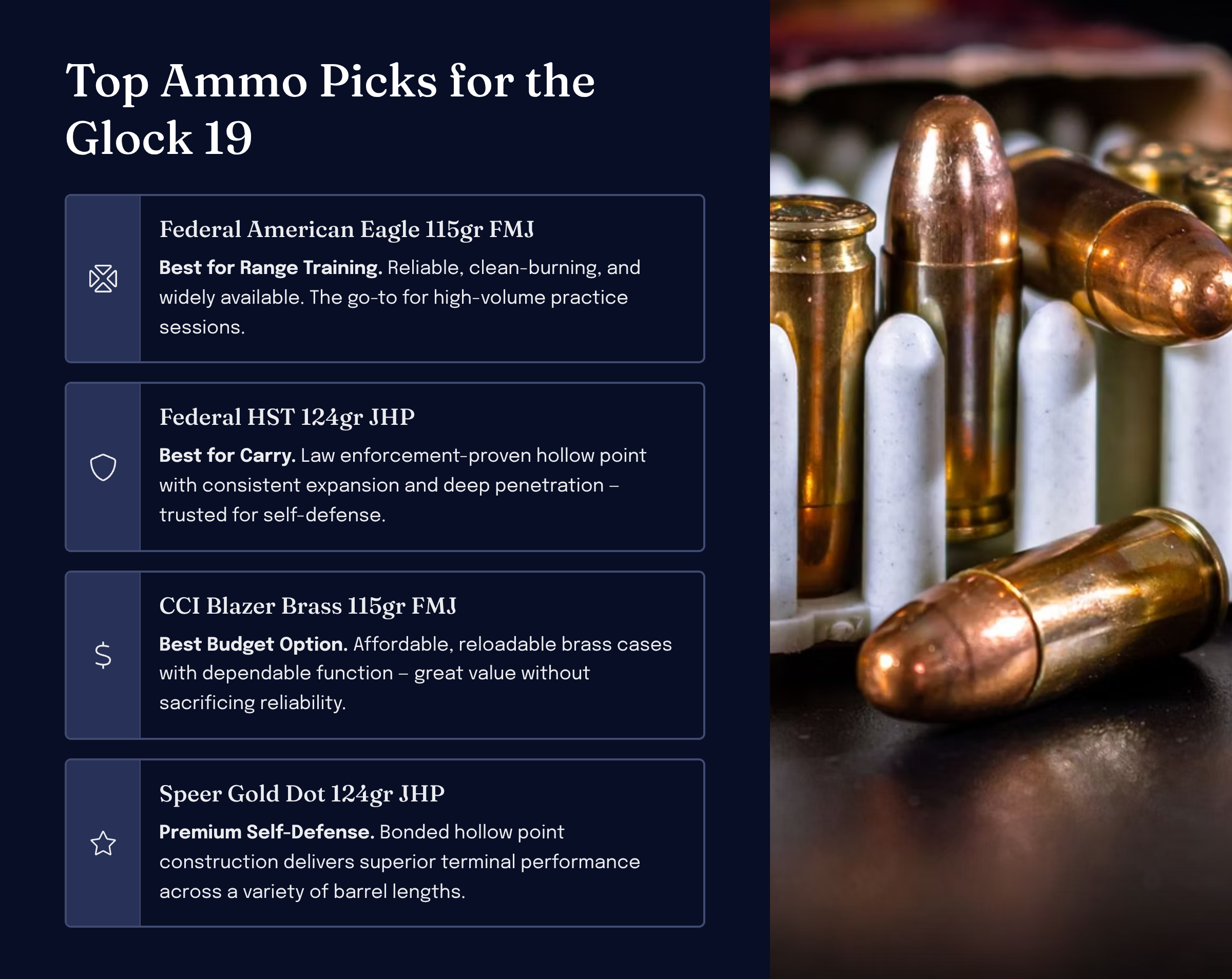
Here are proven, widely available loads that run reliably in the Glock 19 — split by job. Prices move constantly, so always search live per-round prices before buying.
Federal American Eagle 115gr FMJ
The gold-standard range load. Clean, reliable brass-case FMJ that's perfect for high-volume practice and bulk buying. If you want one practice ammo, this is it.
Best for: Range & PracticeFederal HST 124gr JHP
One of the most respected and street-proven defensive loads in 9mm, known for consistent expansion and reliability. A top-tier carry choice for the Glock 19.
Best for: Self-Defense / CarrySpeer Gold Dot 124gr JHP
A bonded hollow point trusted by countless law-enforcement agencies, prized for barrier performance and reliable expansion. Another premier carry load.
Best for: Self-Defense / CarryCCI Blazer Brass 115gr FMJ
Reliable, affordable brass-case practice ammo that's a perennial value pick. A great budget choice for feeding the Glock 19 by the case.
Best for: Budget Range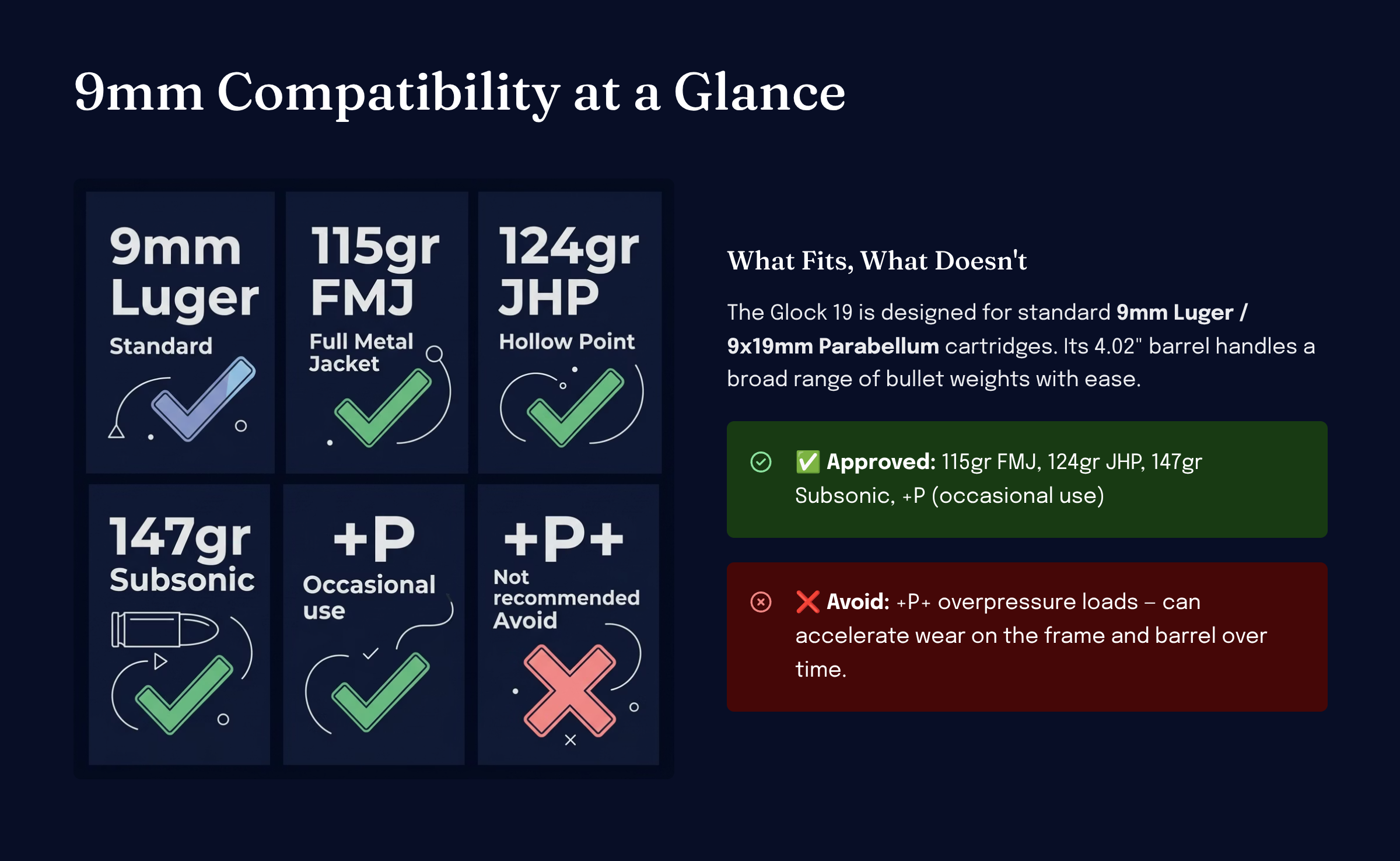
For a deeper ranking of defensive loads — expansion, penetration, and reliability data — see our full guide to the best 9mm ammo for self-defense.
What NOT to Use in a Glock 19
The Glock 19 is forgiving, but a few categories deserve caution.
+P+ — avoid; +P is fine occasionally
+P (overpressure) ammo is rated for the Glock 19 for occasional defensive use — many great carry loads are +P. But +P+ exceeds standardized pressure limits and is not recommended; avoid it. And don't make +P your everyday practice ammo — a constant diet of it accelerates wear. Standard-pressure FMJ for practice, the occasional +P or standard JHP for carry, is the right mix.
Steel-case ammo — works, with trade-offs
Steel-case ammo (Tula, Wolf) will function but seals the chamber less cleanly than brass, runs dirtier, and is banned at many ranges because it's often bi-metal or magnetic. With brass 9mm cheap in 2026, the savings are smaller than they used to be — brass is the safer default. See our cheapest ammo guide for how the math actually shakes out.
Reloaded / remanufactured ammo — caution
Glock's factory guidance specifically cautions against reloaded, remanufactured, or hand-loaded ammunition, and using it can affect your warranty. Unknown reloads carry a real risk of pressure inconsistencies. For a defensive pistol, stick to new, factory, brass-case ammunition from a reputable maker.
Always confirm the caliber stamped on your slide reads 9x19 before buying, and never carry a defensive load you haven't test-fired in your Glock 19. Reliability is gun-and-ammo specific — verify it yourself.
Breaking In a New Glock 19
Glocks are famous for running reliably right out of the box, so "break-in" is really about validation — proving the gun and your chosen ammo work together before you trust your life to them.
- First ~200 rounds: Run standard brass-case FMJ (115gr or 124gr) to confirm smooth, malfunction-free function and to get familiar with the trigger and recoil. This is the cheap, high-volume phase.
- Then validate your carry load: Put at least 100–200 rounds of your specific defensive JHP through the gun. It must feed, fire, and eject that exact load flawlessly. If it ever hiccups, fix the issue or pick a different carry load — don't carry an unverified one.
- Clean and lubricate per the manual before the first range trip and after break-in. A properly lubricated Glock runs better and breaks in faster.
Find the Cheapest 9mm for Your Glock 19
Once you know what to buy — FMJ for practice, quality JHP for carry — the only thing left is paying the least for it. Because the Glock 19 feeds the most common cartridge in America, you have enormous selection, and prices swing daily across retailers.
Kilo Tango tracks live per-round 9mm prices across Sportsman's Guide, Ammunition Depot, Lucky Gunner, Guns.com and OpticsPlanet, normalized so you can compare apples to apples — and surfaces the cheapest in-stock listing. Set a free price-drop alert and we'll email you the moment 9mm hits a new low.
Feed Your Glock 19 for Less
Your Glock 19 runs the cheapest, most available cartridge in America — so make sure you're paying the lowest price for it. Search live per-round 9mm prices across every major retailer on Kilo Tango, then set a free price-drop alert and let the deal come to you.
Frequently Asked Questions
Can a Glock 19 shoot +P ammo?
Yes. The Glock 19 is rated for occasional use of +P (overpressure) 9mm, and many popular self-defense loads are +P rated. Glock's guidance is that +P is fine for defensive use and qualification, but a steady diet accelerates wear, so it shouldn't be your high-volume practice ammo. The Glock 19 is not rated for +P+, which exceeds standardized pressure limits — avoid +P+ entirely. Run standard FMJ for practice and a quality +P or standard-pressure JHP for carry.
Does the Glock 19 use 9mm or .40 S&W?
The Glock 19 is chambered in 9mm Luger (9x19mm Parabellum) only. The .40 S&W version of the same compact frame is the Glock 23 — and you cannot safely fire .40 in a G19. The calibers are not interchangeable. Confirm the caliber stamped on your slide before buying ammo.
What grain is best for a Glock 19?
For most owners, 115-grain FMJ is the best value for range practice, while 124-grain is the ideal all-purpose weight — what 9mm was designed around. 147-grain subsonic is preferred for suppressed shooting and a softer recoil push. For self-defense, both 124gr and 147gr JHP are proven. Start with 115gr for practice and 124gr for carry and you can't go wrong.
Is steel-case ammo bad for a Glock 19?
Steel-case ammo (Tula, Wolf) will function but seals the chamber less cleanly than brass, runs dirtier, and is banned at many ranges. For occasional plinking it's generally fine in a Glock, but brass-case is the safer default for clean function and range compatibility — and with brass 9mm cheap in 2026, the savings on steel are smaller than they used to be.
How much ammo should I shoot to break in a Glock 19?
Glocks run reliably out of the box, but a sensible routine is ~200 rounds of standard brass FMJ to confirm function, then at least 100–200 rounds of your chosen carry load to confirm it feeds, fires, and ejects flawlessly. Never carry a defensive load you haven't verified in your own pistol.