Ammo Caliber Comparison Chart: Size & Ballistics
Every common caliber, side by side — bullet diameter, grain weight, velocity, energy, best use, and price per round. Bookmark this complete reference and use it to pick the right caliber for defense, carry, target shooting, or hunting.
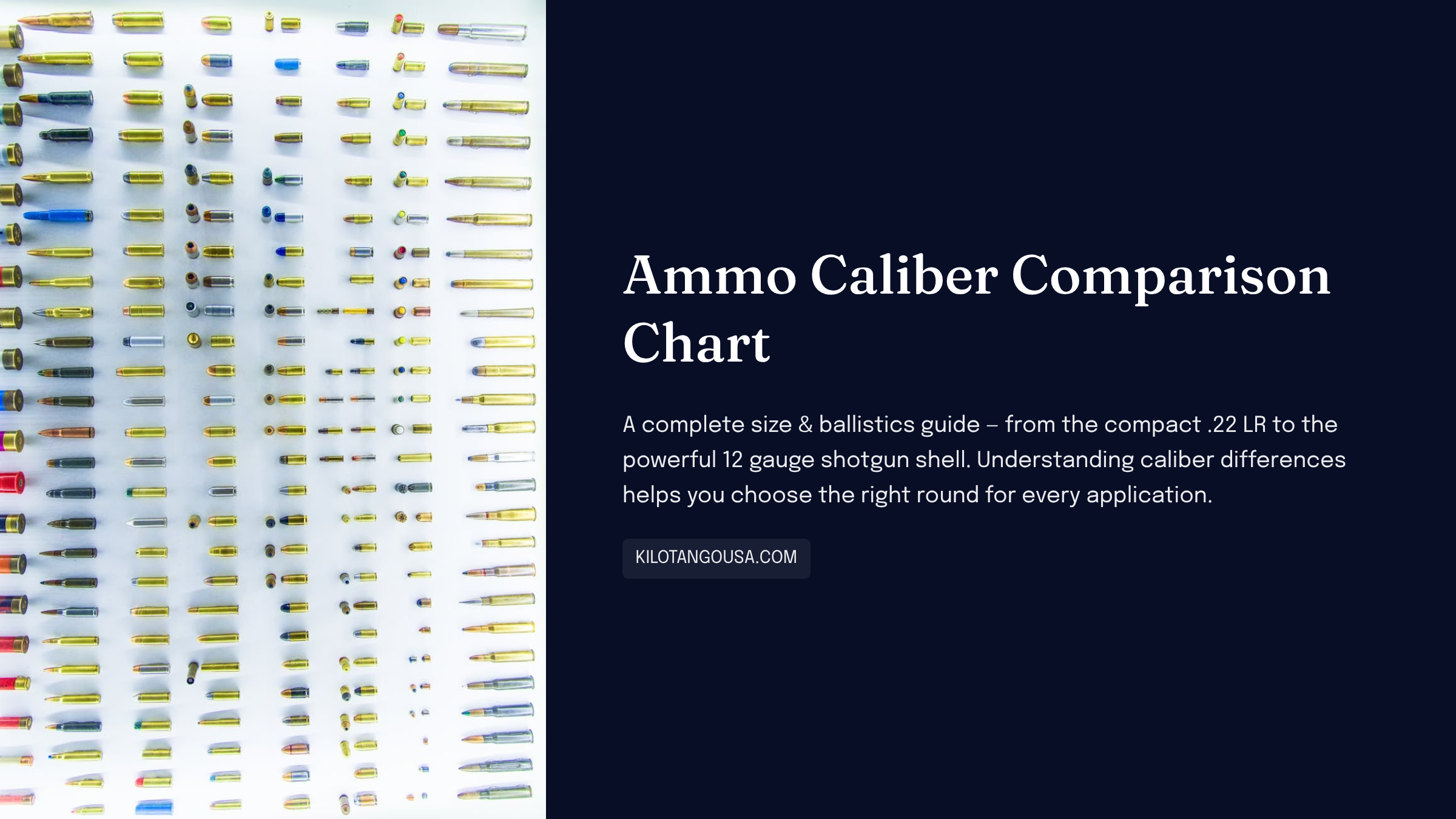
"Caliber" is the first word every new shooter has to learn — and it's also one of the most confusing, because the names rarely match the actual bullet sizes and the choices range from a tiny .22 plinking round to rifle cartridges that hit with ten times the energy. This page is the reference that clears it up: every popular caliber laid out side by side, with the diameter, weight, velocity, energy, best use, and price you need to choose intelligently.
Use it to settle the "what's bigger?" question, to compare ballistics at a glance, and to match the right caliber to your purpose — home defense, concealed carry, target shooting, or hunting. When you've picked one, search live prices for every caliber across all major retailers on Kilo Tango.
Caliber Size Comparison, Smallest to Largest
Before the numbers, it helps to picture the relative sizes. Lined up from smallest to largest, the calibers in this guide step up like this:
- .22 LR — the smallest here. A tiny rimfire cartridge, about the size of a pencil eraser stacked on a short case. Almost no recoil.
- .380 ACP — a short, stubby pistol round using a 9mm-width bullet on a shorter case.
- 9mm Luger — slightly longer than .380, the same bullet width. The benchmark service-pistol round.
- .38 Special / .357 Magnum — slim, tall revolver cartridges; the .357 Mag is the same diameter as the .38 but with a longer case and far more power.
- .40 S&W — a bit fatter than 9mm, a stocky pistol round.
- .45 ACP — noticeably wide and chunky; the classic big-bore pistol cartridge.
- .300 BLK — a compact rifle round on a short, fat case, designed to run in AR-15s.
- 5.56 / .223 — a small-diameter but long rifle cartridge with a bottleneck shape.
- 6.5 Creedmoor — a sleek, longer bottleneck rifle round built for distance.
- .308 / 7.62 NATO — a stout, powerful full-size rifle cartridge.
- 12 Gauge — in a class of its own: a wide shotgun shell, far bigger around than any cartridge above, firing a slug or a payload of pellets.
A bullet's diameter is only part of the story. Velocity, bullet weight, and case capacity matter just as much — which is why a small, fast 5.56 rifle round carries more energy than a fat, slow .45 ACP pistol round. Read the whole chart, not just the size.
Complete Caliber Comparison Chart
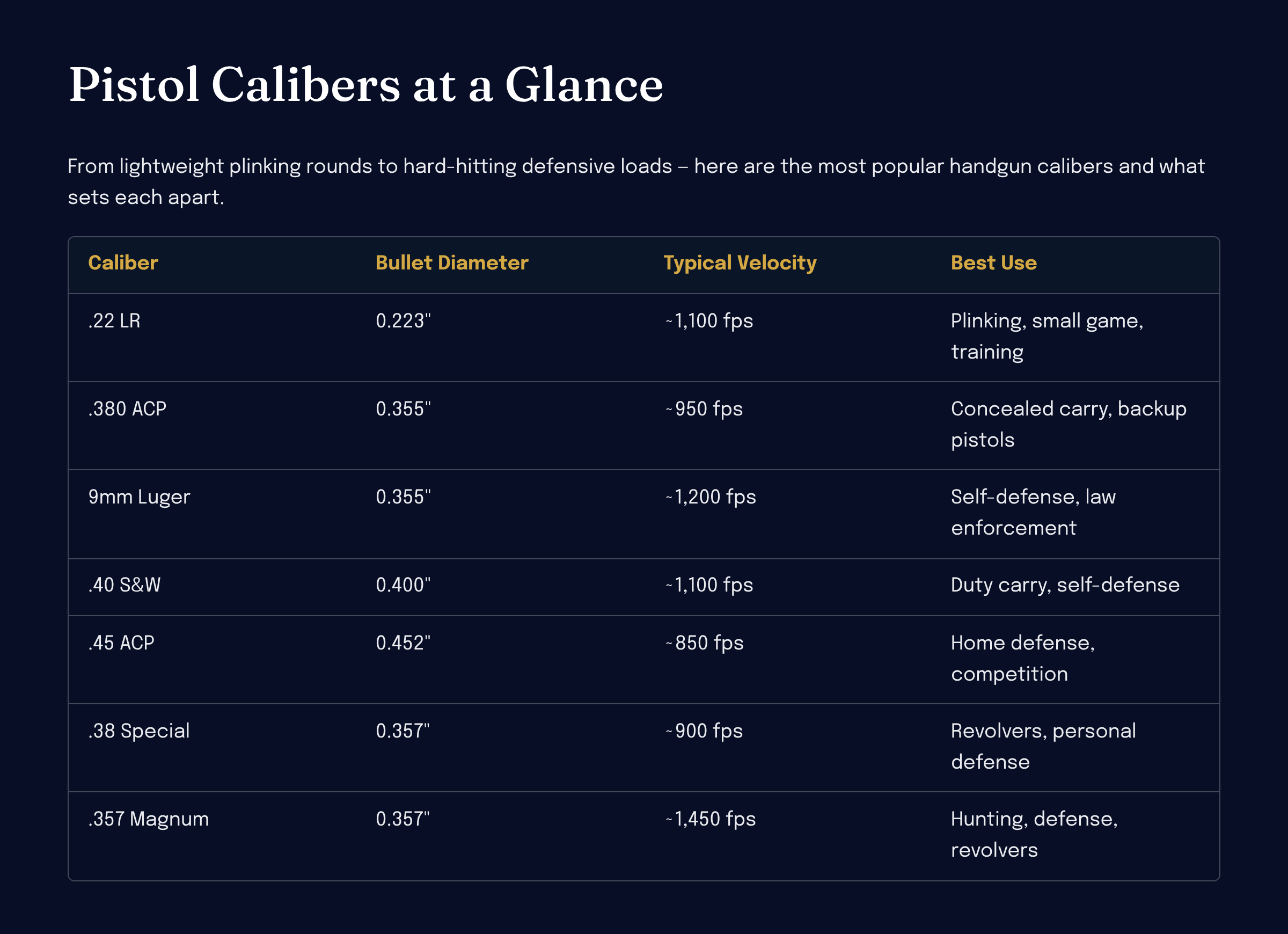
Here's the full reference. Figures are typical for common factory loads in each caliber; exact numbers vary by specific load, bullet weight, and barrel length, but these represent the real-world ballpark for each cartridge.
| Caliber | Bullet Dia. | Typ. Grain | Velocity (fps) | Energy (ft-lbs) | Best Use | Price/rd |
|---|---|---|---|---|---|---|
| .22 LR | .224 in | 36–40 gr | ~1,200 | ~130 | Plinking, training, small game | ~$0.06 |
| .380 ACP | .355 in | 90–95 gr | ~980 | ~200 | Pocket-pistol self-defense | ~$0.28 |
| 9mm Luger | .355 in | 115–147 gr | ~1,150 | ~360 | Carry, duty, home defense | ~$0.22 |
| .40 S&W | .400 in | 165–180 gr | ~1,000 | ~420 | Duty, self-defense | ~$0.32 |
| .45 ACP | .452 in | 230 gr | ~850 | ~370 | Big-bore defense, 1911s | ~$0.40 |
| .38 Special | .357 in | 125–158 gr | ~850 | ~250 | Revolver carry, range | ~$0.35 |
| .357 Magnum | .357 in | 125–158 gr | ~1,400 | ~550 | Defense, hunting, revolvers | ~$0.55 |
| 5.56 / .223 | .224 in | 55–77 gr | ~3,100 | ~1,300 | AR-15, range, varmint, defense | ~$0.32 |
| .300 BLK | .308 in | 110–220 gr | ~2,100 | ~1,300 | Short-barrel AR, suppressed | ~$0.85 |
| 6.5 Creedmoor | .264 in | 120–147 gr | ~2,700 | ~2,300 | Long-range precision, hunting | ~$1.30 |
| .308 / 7.62 | .308 in | 147–175 gr | ~2,700 | ~2,600 | Hunting, precision, battle rifle | ~$0.65 |
| 12 Gauge | .729 in bore | 1–1⅛ oz | ~1,200 | ~1,600 | Home defense, hunting, clays | ~$0.25 |
Typical figures for common factory loads, 2026. Energy is at the muzzle. 12 gauge is measured by bore diameter and shot weight rather than a single bullet. Always verify specifics on the box.
Pistol Calibers Explained
Handgun cartridges are built for compact, controllable firearms used at close range. They trade energy for portability and capacity. The main players:
- .22 LR — the universal trainer. Cheap, nearly recoilless, and perfect for learning fundamentals and plinking. Underpowered for serious defense but unmatched for volume practice.
- .380 ACP — the pocket-carry round. Soft-shooting and small enough for the tiniest pistols, with adequate defensive performance using a modern load. See our .380 ACP guide.
- 9mm Luger — the king. The best balance of capacity, controllable recoil, proven performance, and cheap ammo, which is why it dominates carry and duty use. Our 9mm defense guide covers the top loads.
- .40 S&W — the compromise. More energy than 9mm with snappier recoil and less capacity; once a duty standard, now fading as 9mm improved.
- .45 ACP — the big bore. A heavy, slow, large-diameter bullet with a loyal following, especially in the 1911. More recoil and cost, lower capacity.
- .38 Special & .357 Magnum — the revolver pair. The .38 is a mild, classic revolver round; the .357 Magnum uses the same diameter in a longer case for dramatically more power, and a .357 revolver can also shoot .38 Special.
Rifle Calibers Explained
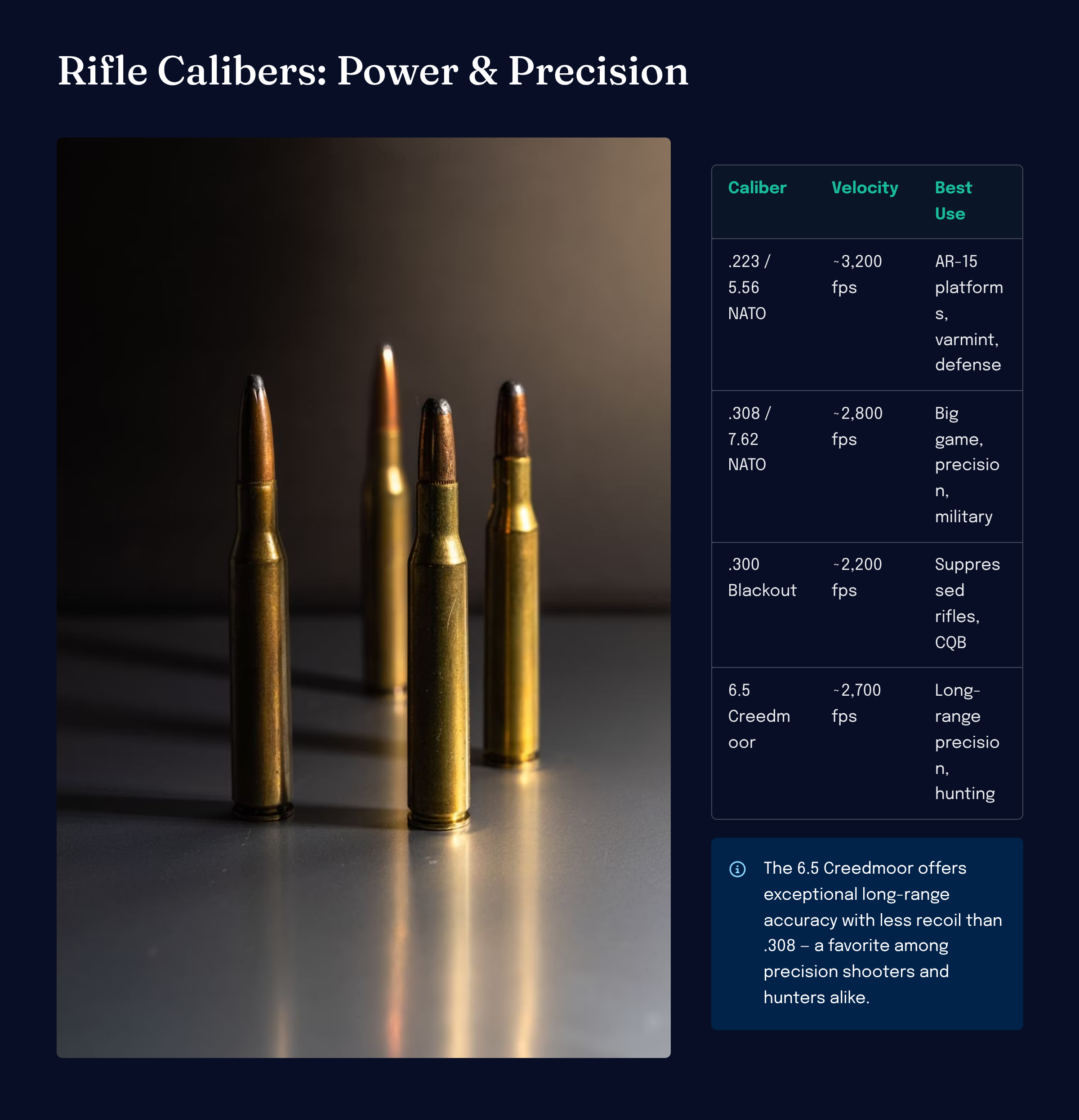
Rifle cartridges carry far more powder and velocity than pistol rounds, delivering vastly higher energy and range. They're built for everything from varmints to big game to long-range precision:
- 5.56 / .223 — America's rifle round. The AR-15 standard: flat-shooting, low-recoil, cheap, and versatile for range, varmint, and defense. See our best .223/5.56 guide and note the important .223-vs-5.56 chamber distinction.
- .300 BLK — the short-barrel/suppressor specialist. Designed to run reliably in compact AR-15s and to shoot quietly with heavy subsonic loads. More expensive and shorter-range than 5.56.
- 6.5 Creedmoor — the modern long-range darling. A sleek, high-ballistic-coefficient bullet that bucks wind and stays supersonic far downrange, making it a favorite for precision shooting and hunting.
- .308 / 7.62 NATO — the do-everything big-game and battle-rifle round. Hard-hitting, widely available, and proven for hunting, precision, and semi-auto rifles; more recoil than the smaller calibers.
Shotgun Gauges Explained
Shotguns work differently from rifles and pistols. Instead of "caliber," they use gauge — an old measure based on how many lead balls of bore diameter make up a pound. Counterintuitively, a smaller gauge number means a bigger bore:
- 12 gauge — the most popular and versatile. Powerful and available in everything from light birdshot to buckshot and slugs. The standard for home defense, hunting, and clay sports.
- 20 gauge — smaller and lighter-recoiling, popular for younger or recoil-sensitive shooters and upland bird hunting.
- .410 bore — the smallest common shotgun (measured in inches, not gauge). Light recoil, limited payload; good for small game and new shooters.
A shotgun's versatility comes from its loads, not its bore: the same 12 gauge fires birdshot for clays, buckshot for defense, and slugs for big game. For matching shot and choke to the job, see our shotgun shot & choke guide.
How to Choose the Right Caliber
The "best" caliber depends entirely on the job. Here's the quick guide for the four most common purposes:
- Home defense — 9mm for a handgun (capacity, control, cheap practice ammo), 12 gauge with buckshot for raw close-range effectiveness, or .223/5.56 in a carbine if you understand over-penetration. Load expanding defensive ammo, not FMJ.
- Concealed carry — 9mm is the default for the best balance of size, capacity, and performance. .380 ACP when you need the smallest possible pocket pistol. .38 Special for a simple revolver.
- Target shooting — .22 LR for cheap, high-volume practice, then 9mm for centerfire pistol and 5.56/.223 for rifle. Cost per round matters most here.
- Hunting — match the caliber to the game: .308 or 6.5 Creedmoor for deer and larger, .223 for varmints, 12 gauge with slugs or buckshot where rifles aren't legal, and .357 Magnum for handgun hunting.
For most people buying one gun for defense and practice, 9mm is the smart default — proven performance, mild recoil, high capacity, and the cheapest centerfire ammo. The best caliber is ultimately the one you can shoot well, afford to practice with, and will actually have on hand.
Putting It All Together
Caliber names are messy, but the logic underneath is simple: pistol rounds trade energy for portability and capacity, rifle rounds trade size for far more velocity and range, and shotguns trade everything for close-range versatility through interchangeable loads. Use the master chart above to compare diameter, energy, and price at a glance, then match the cartridge to your purpose.
Once you've settled on a caliber, prices vary widely between retailers and sales are frequent — so the last step is always to compare. Pick your caliber, then search live prices across every caliber on Kilo Tango before you buy.
Search Prices Across Every Caliber
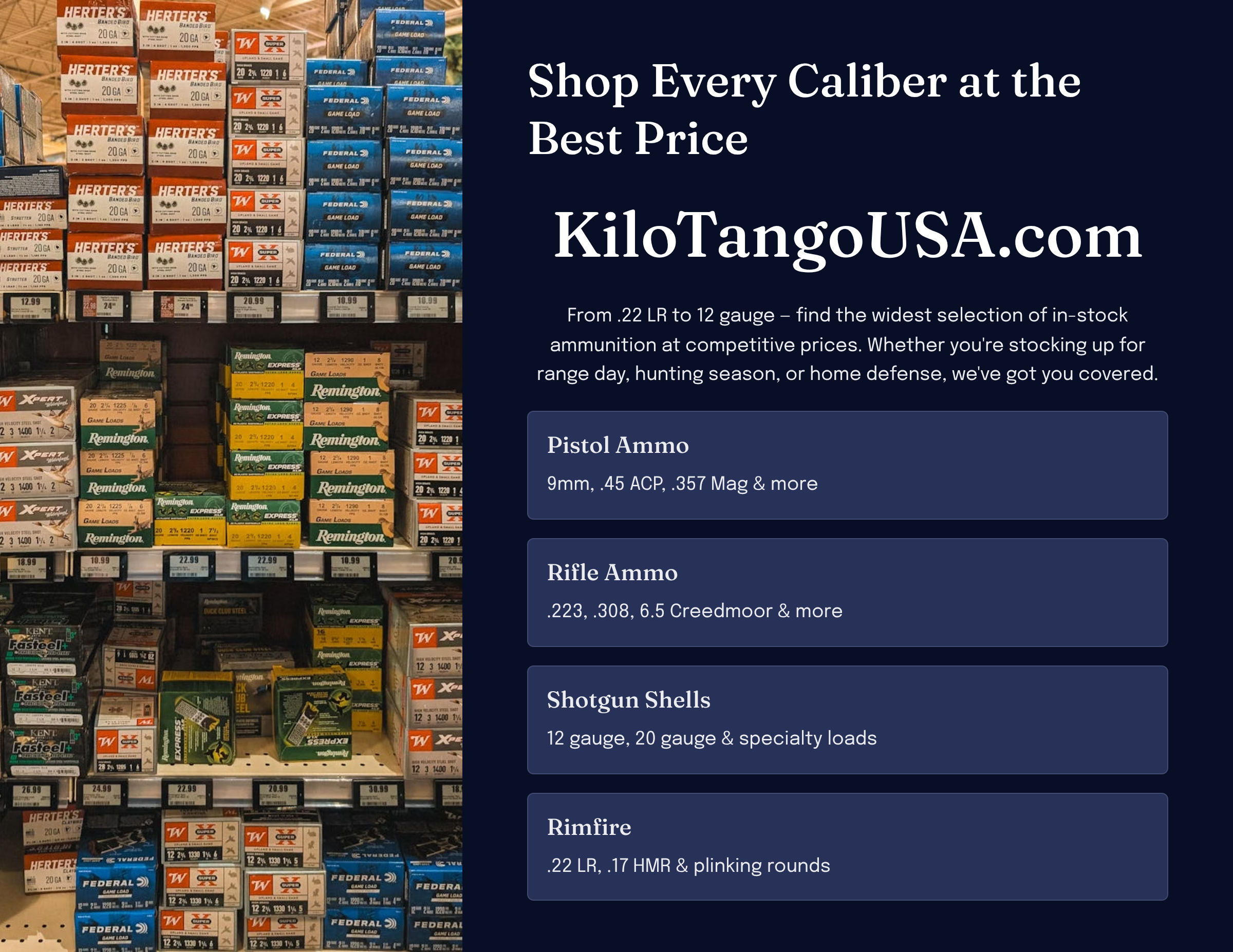
From .22 LR plinking ammo to 6.5 Creedmoor match loads, prices vary a lot between retailers and go on sale often. Search live prices across every major store on Kilo Tango, sort by the lowest cost, and set a free price-drop alert so you buy any caliber at the best possible price.
Frequently Asked Questions
What caliber is best for home defense?
For most people, 9mm Luger is the best all-around home-defense caliber — proven performance, manageable recoil, high capacity, and the cheapest, most available centerfire ammo. A 12 gauge with buckshot is devastating at close range, and a .223/5.56 carbine offers great control if you understand over-penetration. Load a quality expanding defensive round, not FMJ, and practice. See our 9mm defense guide.
What is the most popular caliber?
9mm Luger is by far the most popular centerfire caliber in the U.S., dominating carry, duty, and home-defense handguns, with the cheapest and most available ammo. .22 LR is the most popular rimfire and the most-produced cartridge overall, while .223/5.56 leads rifle calibers thanks to the AR-15.
What does "caliber" mean?
Caliber is the diameter of a firearm's bore and the bullet that fits it, measured in inches or millimeters. A ".45 caliber" bullet is about 0.45 inches; "9mm" is about 9 millimeters (.355 inches). Names don't always match exact diameter — .38 Special actually uses a .357-inch bullet — and case length, powder, and bullet design all affect real performance.
What is the cheapest caliber to shoot?
.22 LR is by far the cheapest at ~6¢ per round in bulk — a fraction of any centerfire cartridge, which is why it's the go-to for high-volume practice. Among centerfire, 9mm is cheapest at ~22¢ per round thanks to huge production volume. Larger rifle cartridges like .308 and 6.5 Creedmoor cost much more. See our cheapest ammo online guide.