Best .380 ACP Ammo for Self Defense & Range (2026)
The .380 ACP rules the pocket-pistol world — small, soft-shooting, and easy to carry every day. Here are the best .380 loads for self-defense and the range, plus the .380-vs-9mm facts, grain-weight guidance, and top pistols every .380 owner should know.
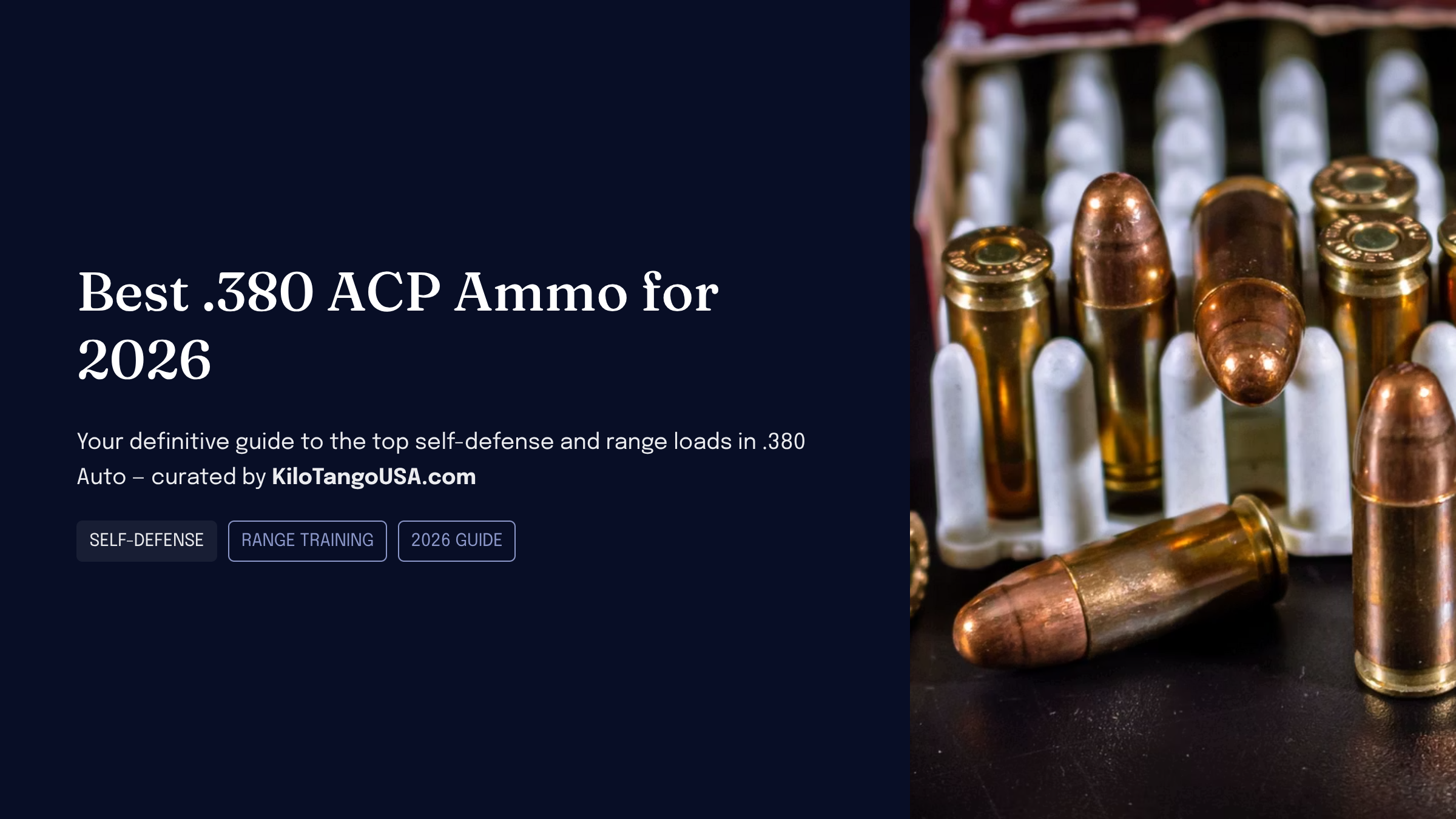
The .380 ACP is the cartridge that makes truly pocket-sized concealed carry possible. It powers the smallest, lightest defensive pistols on the market — guns you'll actually carry every day — and its mild recoil makes it friendly for new and recoil-sensitive shooters. But that small size cuts both ways: the .380 carries noticeably less energy than 9mm, so what you load it with matters more than in almost any other defensive caliber.
This guide cuts straight to the best .380 ACP loads for two jobs — self-defense and the range — then explains the three things every .380 owner should understand: the .380-vs-9mm difference, grain weight, and which pistols shoot it best. When you're ready to buy, search live .380 ACP prices across every major retailer on Kilo Tango.
What Is .380 ACP?
The .380 ACP (Automatic Colt Pistol) is a rimless, straight-walled pistol cartridge designed by John Browning in 1908. You'll see it under several names, and they all mean the same round:
- .380 Auto — the most common alternate name in the U.S.
- 9mm Short / 9mm Kurz — "Kurz" is German for "short"; it shares the 9mm's .355-inch bullet but uses a shorter case.
- 9x17mm — the metric designation (9mm bullet, 17mm case length).
The critical point: .380 ACP is NOT the same as 9mm Luger (9x19mm), even though both fire a .355-inch bullet. The .380's case is shorter and loaded to lower pressure, producing less velocity and energy. The two are not interchangeable — more on that next.
Think of .380 ACP as the 9mm's smaller, softer-shooting sibling. Same bullet diameter, shorter case, less power — and a cartridge built to fit in guns far too small to handle full 9mm pressure comfortably.
.380 ACP vs 9mm Luger: The Real Difference
This is the question every new .380 buyer asks, and the answer comes down to a clear set of trade-offs. Both fire the same .355-inch bullet, but the 9mm Luger's longer case and higher pressure give it significantly more velocity and energy. Here's how they stack up:
| Spec | .380 ACP | 9mm Luger |
|---|---|---|
| Case length | 17mm (shorter) | 19mm (longer) |
| Bullet diameter | .355 in | .355 in (same) |
| Typical velocity | ~950–1,000 fps | ~1,150–1,250 fps |
| Typical energy | ~200 ft-lbs | ~350–400 ft-lbs |
| Recoil | Lower / softer | Snappier |
| Gun size | Smaller, lighter | Slightly larger |
| Cost / round | ~$0.28 (FMJ) | ~$0.22 (FMJ) |
Approximate 2026 figures; exact numbers vary by load and barrel length.
The short version: 9mm hits harder, .380 carries easier. The .380 gives up roughly half the muzzle energy of 9mm, but it enables dramatically smaller and lighter pistols and produces less felt recoil. For deep concealment, backup guns, and recoil-sensitive shooters, that trade is often worth it. If you can comfortably carry and shoot a 9mm, it remains the more capable defensive choice — see our best 9mm self-defense ammo guide for those picks.
Best .380 ACP Ammo for Self Defense
Because .380 starts with limited energy, your defensive load has to do more work — it must expand reliably AND penetrate adequately from a short pocket-pistol barrel, a genuinely hard balance to strike. These three loads are engineered specifically for that challenge and have the testing record to back it up.
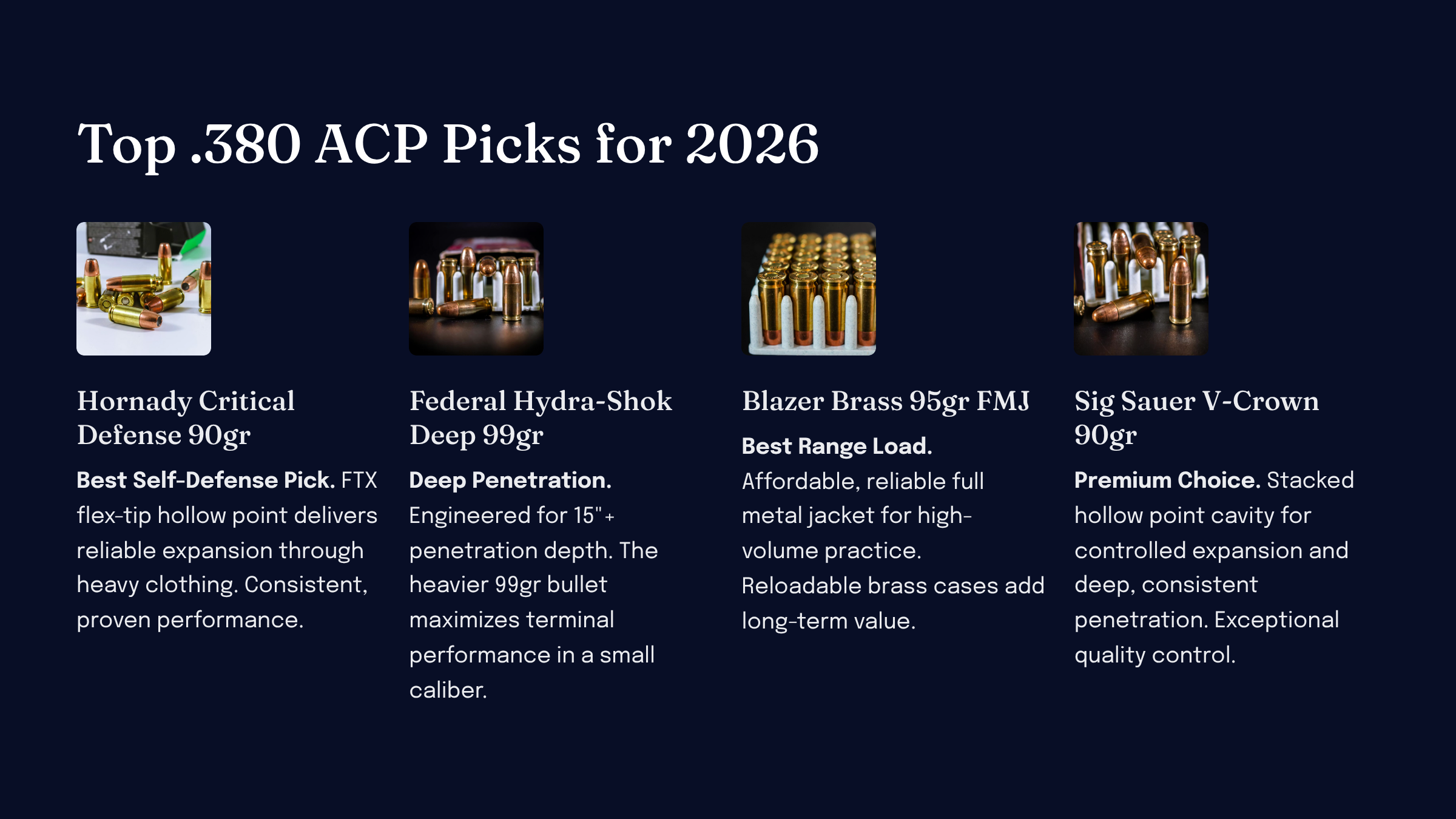
Hornady Critical Defense 90gr FTX
The benchmark .380 carry load. The patented FTX bullet uses a polymer tip in the hollow point that prevents clogging and drives consistent expansion even through clothing and at the lower velocities of short barrels. Reliable feeding, clean ignition, and a proven track record make this the safe default for .380 carry.
90gr FTX · expansion + reliability · TOP PICKFederal Hydra-Shok Deep 99gr
Federal redesigned the classic Hydra-Shok specifically to solve .380's penetration problem. The Deep load's center-post bullet is tuned to reach FBI-spec penetration depths from short barrels while still expanding — addressing the most common .380 shortcoming head-on. A top-tier, deep-penetrating defensive choice.
99gr JHP · deep penetration · barrier-tunedSig Sauer V-Crown 90gr
Sig's V-Crown JHP uses a stacked hollow-point cavity for controlled, uniform expansion and is loaded to consistent velocities for reliable performance in compact pistols. Accurate, clean, and often well-priced for a premium defensive round — a strong alternative to the top two.
90gr V-Crown JHP · uniform expansionSmall .380 pistols can be picky about hollow points. Before you trust any defensive load, run at least 50–100 rounds of it through your specific gun to confirm it feeds, fires, and ejects flawlessly. The best ammo in the world is useless if your pistol won't cycle it.
Best .380 ACP Ammo for the Range
For practice and plinking, you want reliable, accurate-enough FMJ that won't break the bank — because .380 isn't cheap, you'll want the best value you can get. These are the dependable, widely available range favorites.
Blazer Brass 95gr FMJ
The go-to .380 range load. Brass-cased, clean-burning, reliably accurate, and reloadable, Blazer Brass runs flawlessly in nearly every .380 and is consistently among the best-priced quality FMJ. The default choice for filling your range bag.
95gr FMJ · brass case · range/trainingFederal American Eagle 95gr FMJ
Federal's no-frills practice line, built to the same quality standards as its premium ammo. Clean, consistent, brass-cased and accurate — a trustworthy, widely stocked option for high-volume practice.
95gr FMJ · brass case · practiceFiocchi 95gr FMJ
Italian-made and a long-time value favorite, Fiocchi .380 is clean, consistent, and frequently among the cheapest brass-cased options. A great pick when you want quality FMJ at the lowest practical cost.
95gr FMJ · brass case · value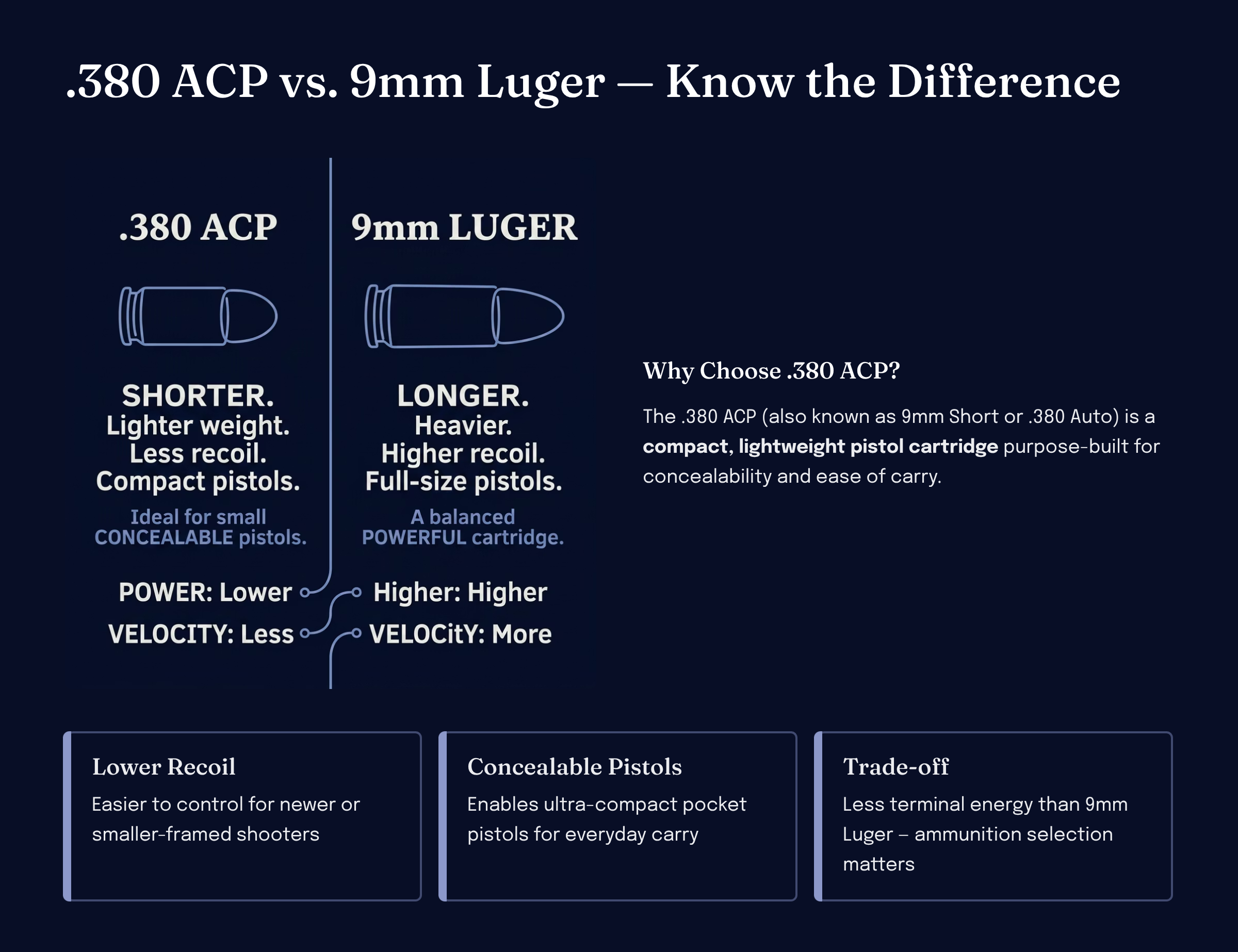
Best Budget .380 ACP Ammo
When you just need cheap rounds to feed a range session, these two stretch your dollar the furthest:
Tula 91gr Steel Case
The cheapest .380 you'll find. Tula's steel-cased ammo isn't reloadable and runs dirtier than brass, but it's reliable enough for plinking in most pistols at a rock-bottom price. Confirm your gun runs it well, and don't use it as a carry load.
91gr FMJ · steel case · lowest costWinchester White Box 95gr
The reliable budget workhorse. Brass-cased, clean enough, and almost always available at big-box stores, Winchester White Box (USA) is the dependable middle ground between premium practice ammo and bargain steel case.
95gr FMJ · brass case · everyday value.380 ACP Grain Weight Guide
The .380 comes in a narrower range of bullet weights than 9mm, but the differences still matter. Here's what each weight is for:
- 85–88 grain — light & fast. Lower recoil and higher velocity, often used in lightweight defensive loads. Can be flat-shooting but the light bullet may under-penetrate from short barrels — best paired with a proven expanding design.
- 90 grain — the standard defensive weight. The most common weight for premium hollow points (Critical Defense, V-Crown). The best balance of velocity, expansion and feed reliability in compact pistols.
- 95 grain — the standard FMJ. The default range and practice weight. Cheapest, most available, and what most bulk .380 FMJ is loaded to.
- 99–102 grain — heavy / subsonic. Heavier bullets (like the Hydra-Shok Deep 99gr) trade a little velocity for deeper, more consistent penetration. The choice when penetration depth is the priority.
| Grain Weight | Type | Best For |
|---|---|---|
| 85–88 gr | JHP (light) | Low recoil, fast defense |
| 90 gr | JHP (standard) | Carry / self-defense |
| 95 gr | FMJ | Range / practice |
| 99–102 gr | JHP (heavy) | Deep penetration defense |
General guidance, 2026. Always confirm your pistol cycles a given load reliably before relying on it.
Top .380 ACP Pistols
The .380's whole reason for existing is to power small, carry-friendly pistols. These are the standouts that define the category in 2026:
- Sig Sauer P365-380 — a higher-capacity micro-compact that shrinks the acclaimed P365 platform to .380. Soft-shooting, 10+ rounds, and arguably the most shootable .380 on this list. A favorite for those who want capacity without the bulk.
- Glock 42 — Glock's slimmest single-stack, chambered in .380. The familiar Glock reliability and trigger in a genuinely pocketable package. A dependable, no-drama carry gun.
- Smith & Wesson M&P Bodyguard 380 — a long-running, ultra-light pocket pistol, now offered in updated higher-capacity versions. Light, affordable, and easy to conceal.
- Ruger LCP MAX — the modern evolution of the iconic LCP, packing 10+1 into one of the smallest .380 footprints made. The benchmark deep-concealment pocket gun.
The smallest .380s (LCP MAX, Bodyguard) conceal best but kick more and are harder to shoot well; slightly larger ones (P365-380, Glock 42) are easier to shoot and hold more rounds. Choose the one you'll actually carry every day — and then practice with it.
Putting It All Together
The .380 ACP earns its place as the king of pocket carry: small, soft, and easy to carry every day. Feeding it well is simple once you know the rules — carry a proven expanding load (Hornady Critical Defense 90gr FTX, Federal Hydra-Shok Deep 99gr, or Sig V-Crown 90gr), practice with affordable 95gr brass FMJ (Blazer Brass, American Eagle, Fiocchi), and always test your carry ammo through your specific gun before trusting it.
Remember the cartridge basics: .380 is not 9mm Luger and the two aren't interchangeable, it's not the same as .38 Special, and it typically costs a bit more per round than 9mm. Pick your load by job, then search live .380 ACP prices across every major retailer before you buy.
Search Live .380 ACP Prices
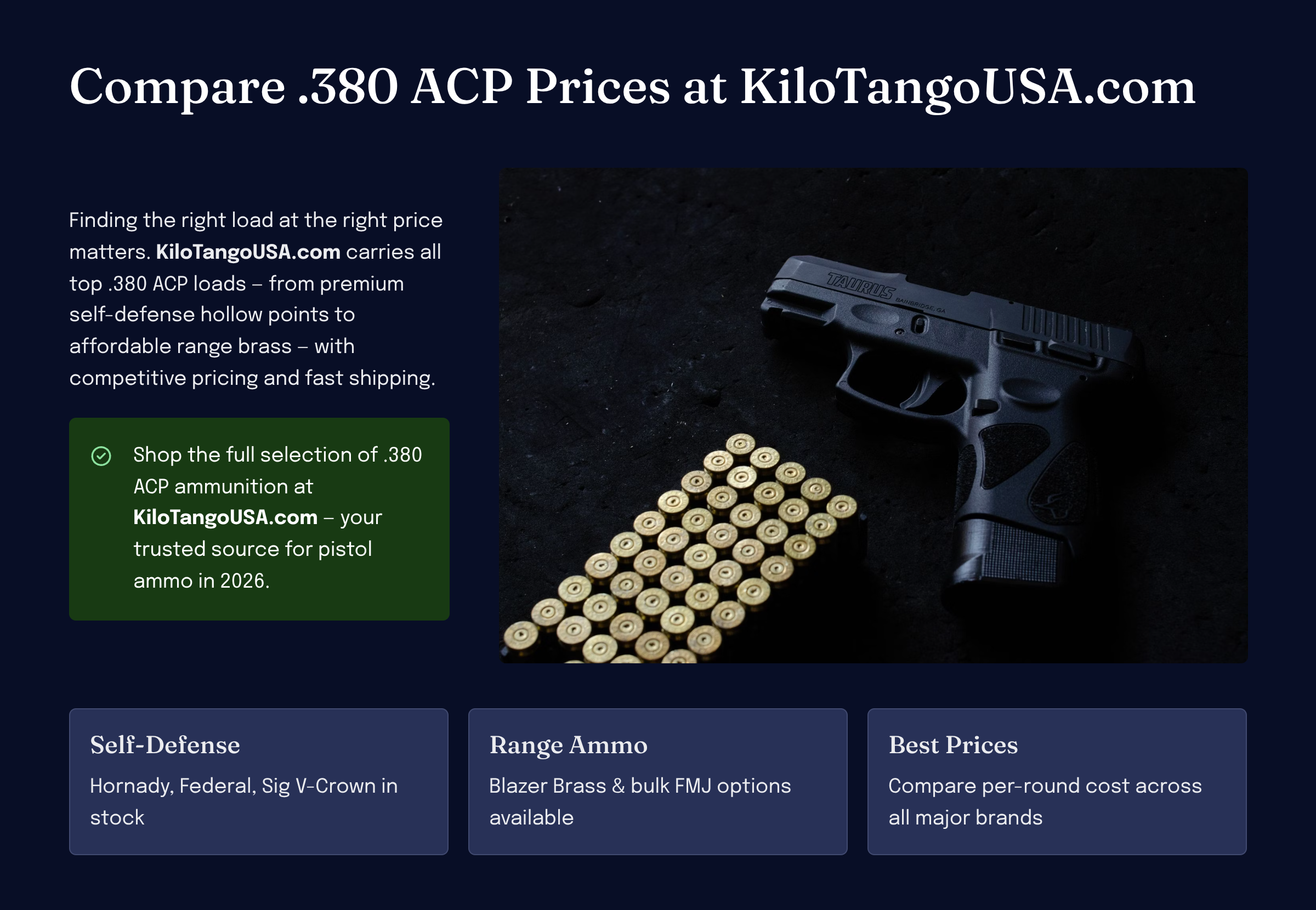
From premium defensive hollow points to bulk 95gr range FMJ, .380 ACP prices swing widely between retailers and go on sale often. Search live prices across every major store on Kilo Tango and set a free price-drop alert so you stock your pocket pistol at the lowest cost.
Frequently Asked Questions
Is .380 ACP enough for self defense?
Yes — .380 is an effective self-defense round with a quality modern load. Bullets like the Hornady Critical Defense FTX and Federal Hydra-Shok Deep are engineered to expand and penetrate adequately from short barrels. It carries less energy than 9mm, so shot placement and a proven expanding load matter even more. A well-fed .380 you'll actually carry beats a bigger gun left at home.
Can I shoot .380 in a 9mm pistol?
No. Although .380 is called "9mm Short" and uses the same .355-inch bullet, its case is shorter and lower-pressure than 9mm Luger (9x19mm). A .380 won't headspace or function safely in a 9mm chamber, and 9mm won't chamber in a .380 pistol. They are not interchangeable — use the exact caliber stamped on your barrel.
What's the difference between .380 and .38 Special?
They're completely different cartridges. .380 ACP is a rimless semi-auto round (.355-inch bullet) that feeds from a magazine. .38 Special is a rimmed revolver cartridge (.357-inch bullet) for revolver cylinders. They are not interchangeable. .38 Special is generally more powerful; .380 enables much smaller, lighter pocket pistols.
What grain .380 ammo is best?
For defense, 90–99gr expanding hollow points are the sweet spot — heavy enough to penetrate from short barrels while feeding reliably (Critical Defense 90gr, Hydra-Shok Deep 99gr). For range, 95gr FMJ is the standard, cheapest weight. Light 85gr loads kick less but may under-penetrate. See our 9mm grain weight guide for the same concept applied to 9mm.
Is .380 ammo cheaper than 9mm?
No — .380 is usually more expensive per round than 9mm despite being smaller. In 2026, bulk 9mm FMJ runs ~22¢ while .380 averages ~28¢, because 9mm is produced in far higher volume. .380 is more specialized, so it costs more and can be harder to find. Compare current prices on our cheapest ammo online guide.